Traffic Management Plan, Sleep Apnea, Fatigue Cause Deadly 2016 California Motorcoach Crash
10/31/2017
WASHINGTON (Oct. 31, 2017) — The National Transportation Safety Board determined Tuesday the probable cause of a fatal 2016 collision between a motorcoach and tractor-trailer truck near Palm Springs, California, was the California Department of Transportation’s inadequate transportation management plan for stopping highway traffic near utility work, coupled with fatigue related to undiagnosed obstructive sleep apnea and inaction by a driver due to fatigue.
In the early-morning darkness of Oct. 23, 2016, on Interstate 10, the motorcoach was traveling at highway speed when it crashed into a stopped truck, resulting in the death of the motorcoach driver and 12 motorcoach passengers. The truck and other traffic had been stopped on the highway by police for utility work. When traffic resumed, the truck did not move. The motorcoach struck the rear of the truck two minutes later, intruding about 13 feet into the truck trailer and pushing it 71 feet forward.
The NTSB determined the probable cause of the crash was Caltrans’ inadequate transportation management plan for stopping traffic, which resulted in a hazardous situation in which law enforcement did not detect the truck’s lack of movement following the traffic break and did not provide any advance warning to the bus driver of the potential for stopped traffic ahead.
The board also determined the truck driver did not resume driving after the traffic stoppage because he most likely fell asleep due to fatigue related to his undiagnosed, moderate-to-severe obstructive sleep apnea. Despite the fact the truck driver was severely obese and at a very high risk for obstructive sleep apnea, he had not been tested for the condition. And although the Federal Motor Carrier Safety Administration Medical Review Board has developed guidance for screening for obstructive sleep apnea, the FMCSA has not disseminated this guidance to the medical examiners it certifies to perform commercial driver’s license medical examinations.
The NTSB’s investigation also revealed the bus driver had untreated diabetes, but the FMCSA-certified medical examiner did not diagnose the bus driver’s condition or refer the driver for further testing despite a positive glucose urine test during the driver’s medical certificate examination. The NTSB also found that the bus driver did not take actions to avoid the crash because he too was likely fatigued and did not expect to encounter stopped traffic.
“In this crash, not one but two commercial vehicle drivers – people who drive for a living – were unable to respond appropriately to cues that other motorists acted on,’’ said NTSB Chairman Robert L. Sumwalt. “Federal and state regulators, commercial motor carriers and professional drivers can do better. Given the stakes, they must do better.’’
The board issued eight safety recommendations based upon the findings of the investigation, making two recommendations to the FMCSA, three to the Federal Highway Administration, one to the trucking company, one to three national trucking associations and one to the International Association of Chiefs of Police and the National Sheriffs’ Association.

WASHINGTON (Oct. 31, 2017) — The National Transportation Safety Board issued Safety Alert 071-17, Tuesday to highlight the potential hazards associated with conducting intersection takeoffs and the need for general aviation pilots to use all the runway available to them for takeoff.
Intersection takeoffs – where only a portion of the runway is used for takeoff instead of using the entire length – are, in general aviation operations, a common practice often associated with a desire to save time. However, pilots may not fully understand the potential risks associated with conducting intersection takeoffs. The NTSB has investigated at least 10 accidents between 2000 and 2015 in which pilots were attempting intersection takeoffs.
By reducing the amount of runway used during takeoff, pilots have less runway available to them in the event of a system or engine malfunction during takeoff, to abort the takeoff or to perform an emergency landing. This increases the risk of injury, death and aircraft damage.
The safety alert emphasizes the need for pilots to:
• Know their airplane’s takeoff and landing performance limitations
• Not feel obligated to accept an intersection takeoff if offered by air traffic control
• Use all available runway length to increase the margin of safety
Safety Alert 071-17 ‘Do Your Takeoff Homework; Runway Length Matters’ is available online at https://go.usa.gov/xn2C2, and an NTSB video on the issue is available via the NTSB YouTube Channel at https://www.youtube.com/watch?v=-UFY6ewJGZA&feature=youtu.be.


NTSB Says Federal Regulator Not Doing Enough to Keep Unsafe Operators Off Roads
11/13/2017
WASHINGTON (November 13, 2017) – A sleep-deprived driver operating a motorcoach during early morning hours on a California highway caused a crash that killed four of the 24 passengers, the National Transportation Safety Board said in a report released Monday.
“Here’s yet another fatal crash involving both a motorcoach carrier with a starkly evident history of safety problems and a severely fatigued driver,” said NTSB Chairman Robert L. Sumwalt. “It’s time that the Federal Motor Carrier Safety Administration move more aggressively to keep these unsafe carriers off American roadways.”
A motorcoach operated by Fresno-based Autobuses Coordinados USA Inc., traveling from Los Angeles to Modesto on State Route 99, drifted out of its travel lanes, striking a barrier system and a highway signpost shortly after 3 a.m., Aug. 2, 2016, near Livingston, California. The crash forces resulted in the signpost entering the passenger compartment and tearing through almost the entire length of the vehicle. The surviving passengers received serious-to-minor injuries.
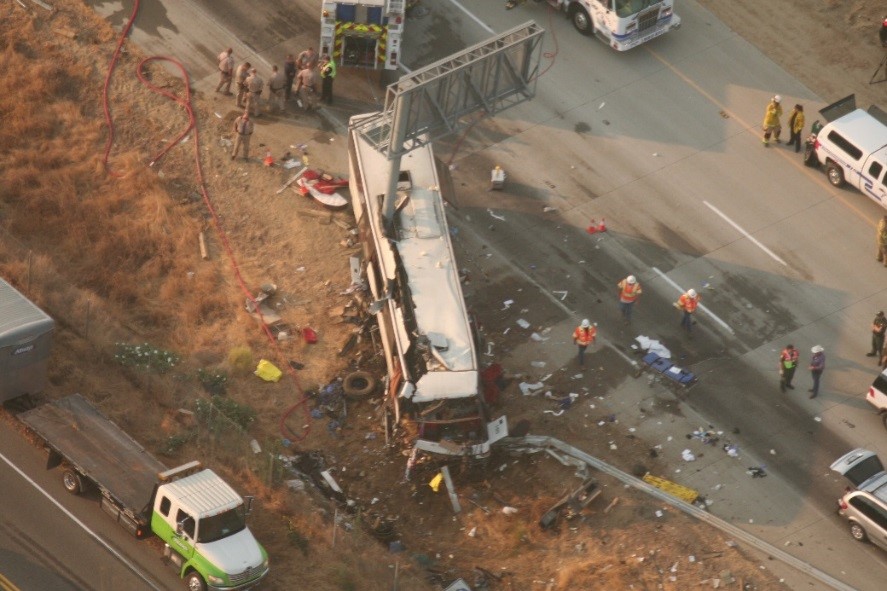
Aerial view of SR-99 northbound lanes, showing motorcoach at final rest and impact damage caused by 14-inch-diameter signpost penetrating two-thirds of vehicle, from front to back. (Photo: California Highway Patrol)
Investigators determined the driver, who was seriously injured, had only about five hours of opportunity for sleep in the 40 hours preceding the crash, leaving him in a state of “acute sleep loss” at the time of the crash. There were no tire marks or other indication the driver took any action to avoid the barrier after the motorcoach drifted out of its travel lane.
According to FMCSA records Autobuses Coordinados vehicles failed eight of 29 federal inspections in just under two years, pushing its out-of-service rate to 38 percent, almost five times greater than the national average of eight percent.
After determining that inadequate safety practices of Autobuses Coordinados and the FMCSA’s lack of oversight of contributed to the crash, the NTSB called on the FMCSA to change its motor carrier safety rating system to ensure carriers with serious safety issues either mitigate those risks or be placed out of service.
In its report the NTSB cited two 2011 motorcoach crashes it investigated that also occurred during early morning hours involving sleep-deprived drivers – a 15-fatality crash in New York City at 5:38 a.m., and a four-fatality crash in Doswell, Virginia, at 4:55 a.m. – and said those driving during early morning hours, when human performance is often degraded, present a unique risk to safety. To address that risk the NTSB reiterated an earlier recommendation that the FMCSA incorporate scientifically based fatigue mitigation strategies into hours-of-service regulations for passenger-carrying drivers operating overnight.
The NTSB also determined that the guardrail, which did not prevent the motorcoach from colliding with the signpost, and was not designed to do so, contributed to the severity of the crash.
The NTSB also issued two new recommendations aimed at developing risk-based guidelines to determine where high-performance barrier systems should be installed to shield heavy vehicles, such as motorcoaches, from roadside obstacles and hazards.
The entire 62-page report, including the two new and five reiterated safety recommendations, is available at https://go.usa.gov/xnDSQ.
An executive summary of the report, including the findings, probable cause, and safety recommendations, is available in Spanish at https://go.usa.gov/xnDSN.
========================
Fatigue, poor safety caused deadly Livingston bus crash
LOS ANGELES -- A severely sleep-deprived driver and a bus company with a poor safety record were causes of an August 2016 crash in California's Central Valley that killed four passengers and injured 20 others, including the driver, federal safety investigators said Monday.
The National Transportation Safety Board said the driver had only slept about five hours over the 40 hours preceding the Aug. 2, 2016 crash. The bus traveling from Los Angeles to Modesto drifted off the right side of Route 99 and struck a highway signpost that nearly sliced the bus from nose to tail. There were no signs the driver tried to stop or steer back on the highway.
The NTSB said a contributing cause was inadequate oversight by the federal agency regulating bus safety that allowed Fresno-based Autobuses Coordinados USA Inc. to continue operating despite a poor safety record. It called on the Federal Motor Carrier Safety Administration to change its rating system to make sure companies either fix serious safety issues or be taken off the road.
"Here's yet another fatal crash involving both a motor coach carrier with a starkly evident history of safety problems and a severely fatigued driver," said NTSB Chairman Robert L. Sumwalt. "It's time that the Federal Motor Carrier Safety Administration move more aggressively to keep these unsafe carriers off American roadways."
The company had failed eight of 29 federal inspections in less than two years and its out-of-service rate was nearly five times greater than the national average, yet it received a satisfactory rating from the FMCSA, the NTSB said.
Less than three months after the crash, the administration shut down the carrier after giving it an unsatisfactory safety rating, FMCSA spokesman Duane DeBruyne said Monday.
The incident was one of several fatal bus crashes in early morning hours involving fatigued drivers, including 2011 crashes that killed 15 in New York City and one that killed four in Doswell, Virginia, the NTSB said.
Fatigue was blamed in a crash that killed 13 people on Interstate 10 near Palm Springs on Oct. 23, 2016 when a charter bus traveling from a casino plowed into the rear of a big-rig whose driver had fallen asleep during a freeway closure. The truck driver was recently charged with 13 counts of vehicular manslaughter with gross negligence.
The NTSB said the August 2016 crash outside of Livingston would not have been as bad if a stronger guardrail prevented the bus from striking the signpost.
The board recommended guidelines to determine where stronger barriers should be installed to protect heavy vehicles, such as buses, from obstacles and hazards.


Nebraska businesses face thousands of dollars in fines from U.S. Labor Department for multiple violations
By Barbara Soderlin / World-Herald staff writer
Nov 8, 2017
The U.S. Department of Labor has fined a Nebraska grain cooperative and placed it in a special enforcement program after a May 4 incident in which a worker was partly trapped in a grain bin in Raymond.
Separately, the department cited a Bellevue commercial bakery for worker safety violations, the department’s Occupational Safety and Health Administration said Wednesday. The companies have 15 business days to address the violations and comply with the penalties or to contest the findings.
Dorchester-based Farmers Cooperative faces nearly $374,000 in proposed penalties for a total of seven violations, and has been placed in OSHA’s Severe Violator Enforcement Program. OSHA said the co-op has previously been cited for a similar violation at a facility in Talmadge. Farmers Cooperative has 60 locations in Nebraska and Kansas.
Investigators for the May incident in Raymond determined that a worker entered a bin to clear soybeans while an auger was running. The worker was engulfed in soybeans up to his chest.
“It is well-known throughout the industry that entering a bin is extremely dangerous, especially while the auger is operating,” said OSHA Regional Administrator Kimberly Stille, in Kansas City.
An official at the cooperative didn’t immediately respond to a request for comment for this story.
In Bellevue, the Bimbo Bakeries USA plant faces more than $122,000 in proposed penalties after investigators cited it for six violations after a June 6 inspection.
The alleged violations included lack of machine guarding, failing to provide fall protection and using a damaged electrical panel box. OSHA said it has cited the company before for similar hazards at other locations.
Pennsylvania-based Bimbo Bakeries USA, with more than 60 bakeries, is a division of Mexican baking company Grupo Bimbo. Its brands include Sara Lee, Oroweat, Entenmann’s, Thomas’ and Boboli.
In a statement to The World-Herald, the company said: “The safety of our associates is a top priority at Bimbo Bakeries USA. We are currently reviewing the citation issued by OSHA ... and expect to respond to the agency in the coming days.”


BILLERICA, Mass. (AP) — A federal workers' safety agency is recommending $267,081 in penalties for a Massachusetts auto auction house where five people died when a vehicle suddenly accelerated into a crowd.
The Occupational Safety and Health Administration announced Thursday it was citing Lynnway Auto Auction in Billerica for a range of infractions, including blocked exit routes, electrical hazards and record-keeping deficiencies.
The OSHA inspection came after a Jeep Grand Cherokee driven by a Lynnway employee apparently lurched out of control and crashed through a wall on May 3, killing two Rhode Island residents, three Massachusetts residents and injuring seven others.
Lynnway Auto President Jim Lamb said Thursday the "majority" of the infractions were "unrelated" to that accident and are being resolved.
The company has installed fixed bollards to serve as barriers and taken other safety measures.
The Rhode Islanders were 48-year-old Brenda Lopez, of Providence, and 49-year-old Pantaleon Santos, of Cumberland.
=====================
Two of three victims in fatal Billerica crash identified as Rhode Islanders
by BRIAN CRANDALL, NBC 10 NEWS
Thursday, May 4th 2017
A vehicle suddenly accelerated at an auto auction in Billerica, Mass., killing three people. (WBTS)
PROVIDENCE. R.I. (WJAR) — Two Rhode Islanders were among the three people killed in a crash at an auto auction in Billerica, Massachusetts.
Brenda Lopez, 48, of Providence, and 49-year-old Pantaleon Santos, of Cumberland, died when a 2006 Jeep Grand Cherokee smashed through a wall at LynnWay Auto Auction Wednesday morning.
Authorities said a 70-year-old worker accelerated through the cinder block wall. They are trying to determine what went wrong, but said the crash does not appear to have been intentional.
Nine other people were hurt, one of them seriously.
“My mom was god fearing. She was our rock,” Lopez’s son, Richard Meza-Lopez, told NBC 10 News.
He said Lopez regularly went to auto auctions for a family car business.
“My father was there, but he was in the restroom when the incident occurred,” he said.
Santos was part of the business, too, and a family friend.
Lopez, who was originally from Guatemala, lived in Providence for more than 25 years.
“She always had a positive outlook on things,” said Meza-Lopez, the oldest of her four children.
The youngest is 18. “It breaks my heart because she was going to graduate from high school in a couple of weeks. And we were all supposed to go to the graduation.”
Now, they want to carry on their mother’s legacy.
“I just want to make her proud,” Meza-Lopez told NBC10. “I want to live my life to honor her memory.”


