CeFaan Kim
Saturday, February 18, 2017 05:45PM
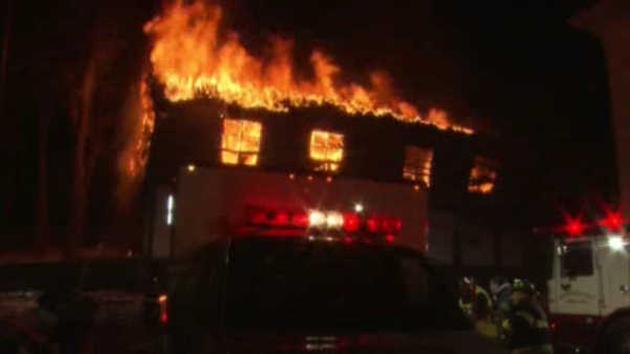
MOUNT KISCO, New York (WABC) -- Firefighters are still battling hot spots after flames first broke out Friday night at a Yeshiva classroom building in Mount Kisco.
The building, located on top of a remote hilltop, is accessible only by a narrow, windy road. Flames first broke out around 6:30 p.m. Friday.
It took more than 100 firefighters over six hours to get the three-alarm fire under control. They were fighting flames well past midnight. Now, firefighters are still spraying foam, because water was not doing the job.
"The building is completely destroyed...the roof has collapsed. That's one of the reasons we're here so long. With the building having collapsed the way it did, we have a lot of hidden pockets of fire. We can't enter the building at all, so it's very difficult to get all that fire," says Mt. Kisco Fire Chief Al Bueti.
The fire broke out during the Sabbath, so no one was in the building, so the good news is that no one was injured.
Officials say water was an issue in fighting the fire, because the nearest water source is about a half mile away.


Southern California bore the brunt of the latest storm to blast into the western United States as the region is now cleaning up from flooding, mudslides, sinkholes and downed trees.
This storm, one of the biggest storms in years to target the region, bombarded Southern California with heavy rain and gusty winds on Friday into Friday night.
Widespread rainfall amounts in excess of 3 inches were measured in Ventura and Santa Barbara counties.
"The airport at Santa Barbara measured 4.16 inches alone on Friday, shattering the day's previous rainfall record of 2.08 inches from 1980," AccuWeather Senior Meteorologist Kristina Pydynowski said. "Friday was also Santa Barbara's wettest day since March 20, 2011."
Downtown Los Angeles received slightly more than 2 inches of rain from the storm, guaranteeing the city will experience its first above-normal winter rainfall (December to February) since the winter spanning 2010-2011.
The storm caused at least two fatalities after a large tree brought down power lines in Sherman Oaks, California, electrocuting a 55-year-old man. Additionally, one driver drowned in his car after flash flooding suddenly overtook the roadway.

A man struggles against gusty wind and heavy rain as he walks along a pier Friday, Feb. 17, 2017, in Huntington Beach, Calif. A major Pacific storm has unleashed downpours and fierce gusts on Southern California, triggering flash flood warnings and other problems. (AP Photo/Jae C. Hong)

Cars trying to make it through the flood waters in Long Beach, California. (Instagram/derek_drizzle)

Multiple vehicles sit idly as flood waters hinder motorists from getting to their destination. (Instagram/actress_jenniferannescott)

A tree fell over, crushing a car in Los Angeles. No injuries were reported. (Photo/Twitter user @navajoBehr)

In this image released by the Santa Barbara County Fire Department, a large eucalyptus tree toppled onto carport damaging vehicles in Goleta, Calif., Friday, Feb. 17, 2017. A powerful Pacific storm blew into southern and central California on Friday, unleashing wind-driven heavy rains that forecasters said could become the strongest in years if not decades. (Mike Eliason/Santa Barbara County Fire Department via AP)

Downed trees across the region caused many travel delays and power outages. (Instagran/mlmracing)

Pacific Coast Highway is reduced to one lane from three at the California Incline due to mud and debris being washed down from the bluffs in Santa Monica, Calif., as a powerful storm moves into Southern California Friday, Feb. 17, 2017. The saturated state faces a new round of wet weather that could trigger flooding and debris flows. (AP Photo/Reed Saxon)

(Instagram/derek_drizzle)
On the Water Front: Finding the Leaks, Getting the Lead Out
Tom Johnson | February 14, 2017
New Jersey’s aging infrastructure can waste up to 30 percent of drinking water before it’s even delivered to customers
In a bid to avoid costly water losses, a legislative committee yesterday adopted a bill that would order water companies to conduct audits of their own systems to see how much water is wasted before it ever gets to customers.
The legislation (A-4415), modeled after similar measures in place in other states, is designed to address the well-known problem of leaks in aging water infrastructure that allow up to 30 percent of drinking water to be lost before it gets to consumers.
In another measure related to drinking water, the Assembly Environment and Solid Waste Committee approved a bill (A-4139) to require healthcare facilities to test for and remove lead in drinking water found in their systems.
The legislation is part of a series of bills aimed at addressing problems with the quality of drinking water, ranging from lead-tainted supplies in schools and other facilities to toxic contaminants in public water-supply systems and private wells.
At the same time, a legislative task force is conducting hearings on the aging drinking-water infrastructure in New Jersey, much of its 100 years or older and prone to leaks and major water-main breaks. The federal government has projected the state needs to spend $8 billion to overhaul the drinking-water infrastructure.
Among the biggest problems are undetected leaks in older mains that are losing an estimated 130 million gallons of water a day, according to one recent study by the Natural Resources Defense Council.
Larry Levin, a water attorney for the NRDC, told the committee that water audits could be used to reduce water losses, and save consumers money. More than 50 million gallons of water daily could be recovered with better accounting, at an estimated savings of $10 million.
“Considerable savings can be garnered by doing these audits,’’ said George Kunkel, a former executive with the Philadelphia Water Department and an author of the study.
“The problem here (New Jersey) is as great as elsewhere given the age of the water system,’’ Levine added.
“It’s astounding,’’ agreed Assemblyman John McKeon (D-Essex), a member of the legislative task force studying drinking water, referring to estimated water losses. “Something needs to be done. All it takes is money.’’
But Jeff Tittel, director of the New Jersey Sierra Club, said that is precisely the problem with the bill. It will identify and confirm a well-recognized problem, but it does not spell out how to find the money to fix the leaks. “This bill kicks the problem down the road,’’ he said.
======
ASSEMBLY, No. 4139
STATE OF NEW JERSEY
217th LEGISLATURE
INTRODUCED SEPTEMBER 19, 2016
Sponsored by:
Assemblyman DANIEL R. BENSON
District 14 (Mercer and Middlesex)
Assemblywoman ELIZABETH MAHER MUOIO
District 15 (Hunterdon and Mercer)
Assemblyman HERB CONAWAY, JR.
District 7 (Burlington)
SYNOPSIS
Requires health care facilities to test for and remediate lead in drinking water, and disclose test results.
CURRENT VERSION OF TEXT
As introduced.
An Act concerning lead in drinking water at health care facilities and supplementing Title 26 of the Revised Statutes.
Be It Enacted by the Senate and General Assembly of the State of New Jersey:
1. a. The owner or operator of a health care facility shall undertake periodic testing of each drinking water outlet in the health care facility for the presence of lead. Each test for lead shall be conducted by a laboratory certified for this purpose by the Commissioner of Environmental Protection, in accordance with the sampling and testing methods specified by the commissioner. The initial tests for lead shall be conducted no later than 90 days after the effective date of this act, and subsequent testing shall be conducted every five years thereafter, unless the commissioner determines, on a case-by-case basis, that a greater or lesser frequency of testing is necessary or sufficient to ensure public health.
b. If testing conducted pursuant to subsection a. of this section reveals an elevated lead level at a drinking water outlet, the health care facility shall immediately shut or close off access to that drinking water outlet and take appropriate remedial measures to ensure that patients, staff, and visitors to the health care facility are not exposed to drinking water with an elevated lead level and have access to clean and safe drinking water at the facility. Such remedial measures may include, but need not be limited to: permanently shutting or closing off access to the drinking water outlet; providing an alternative source of water; manual or automatic flushing of the drinking water outlet; installing and maintaining a filter at the drinking water outlet; and repairing and replacing the drinking water outlet, plumbing, or service line contributing to the elevated lead level.
c. Each health care facility shall: (1) submit to the Department of Environmental Protection and the Department of Health, as soon as practicable, information on testing activities conducted pursuant to subsection a. of this section, including, but not limited to, the date the testing was completed, the location and type of each drinking water outlet tested, the complete results of each test, and any measures being taken pursuant to subsection b. of this section to remediate a drinking water outlet found to have an elevated lead level; (2) maintain copies of the information submitted pursuant to this subsection in a suitable location for inspection by the public and on the health care facility’s Internet website, if applicable; and (3) post a summary of the test results and information on the availability of the complete test results for public inspection, in the area of each major entrance and in each admitting room in the health care facility.
d. Notwithstanding the provisions of the “Administrative Procedure Act,” P.L.1968, c.410 (C.52:14B-1 et seq.), to the contrary, the Department of Environmental Protection, in consultation with the Department of Health, may adopt, after notice, interim rules and regulations necessary to implement the provisions of this act, including, but not limited to, sampling and testing methods. The rules and regulations shall be effective as regulations immediately upon filing with the Office of Administrative Law and shall be effective for a period not to exceed 18 months, and may, thereafter, be amended, adopted, or readopted by the department in accordance with the provisions of the “Administrative Procedure Act.”
e. As used in this section:
“Commissioner” means the Commissioner of Environmental Protection.
“Drinking water outlet” means any water fountain, faucet, or tap regularly used for drinking or food preparation, including ice-making and hot drink machines.
“Elevated lead level” means a lead concentration in drinking water that exceeds the standard therefor established by the United States Environmental Protection Agency or the Department of Environmental Protection, whichever is more stringent.
“Health care facility” means the same as that term is defined in section 2 of P.L.1971, c.136 (C.26:2H-2).
2. This act shall take effect immediately.
STATEMENT
This bill would require health care facilities to test for and remediate lead in drinking water, and disclose the test results.
Specifically, under the bill, the owner or operator of a health care facility would be required to undertake periodic testing of each drinking water outlet in the facility for the presence of lead. Each test for lead would be conducted by a laboratory certified for this purpose by the Commissioner of Environmental Protection, in accordance with the sampling and testing methods specified by the commissioner. The initial tests would be conducted no later than 90 days after the effective date of the bill, and subsequent testing would be conducted every five years thereafter, unless the commissioner determines, on a case-by-case basis, that a greater or lesser frequency of testing is necessary or sufficient.
Under the bill, if testing reveals an elevated lead level at a drinking water outlet, the health care facility would be required to immediately shut or close off access to that outlet and take appropriate remedial measures to ensure that patients, staff, and visitors to the health care facility are not exposed to drinking water with an elevated lead level and have access to clean and safe drinking water at the facility. Each health care facility would be required to submit to the Department of Environmental Protection and the Department of Health information on its testing activities, maintain copies of that information in a suitable location and on its Internet website, if applicable, and post a summary of the test results and information on the availability of the complete test results in the area of each major entrance and in each admitting room in the health care facility.


A bill advancing in New Jersey's Legislature would require water companies to determine how much water is lost because of leaks and breaks in aging pipes every year.
Natural Resources Defense Council attorney Larry Levin told an Assembly committee Tuesday such audits can guide efforts to control water loss.
"There are 130 million gallons of treated drinking water we estimate lost each day across the state," he said. "And, of that, about 50 million gallons per day valued at $10 million a year are likely to be cost effective for utilities to reduce to solve that loss."
Similar measures in other states have made a difference, said George Kunkel, an independent consultant and former executive with the Philadelphia Water Department.
"In my time in Philadelphia, where we pioneered these approaches for over 20 years, there were considerable savings garnered by doing the audit and using the data from the audit to guide and structure loss control programs," he said.
New Jersey Sierra Club director Jeff Tittel said he favors a more aggressive approach that would require suppliers to fix problems where the biggest water losses are occurring.
"I think it needs to be tied to actually a planning process and then a funding mechanism, either a set-aside by the utilities or others, to start moving that forward," Tittel said.
Assemblyman John McKeon, a member of the legislative task force that's studying the state's drinking water infrastructure, said the water loss from aging pipes is astounding.
"Ten to 15 percent of leakage you expect because they're a pressured system. That's a good thing, because it keeps the bad stuff from leaching in if it's pressurized," said McKeon, D-Bergen. "But we're at 30 percent and really something has to be done. It is time for action. All it takes is money."
Advocates estimate about $8 billion in water system improvements are needed in the state over the next 20 years.
=========
Renewing Aged Water Infrastructure in New Jersey, One Street at a Time
Jon Hurdle | December 21, 2016
Antiquated leak-prone systems are being upgraded in some parts of the state, but water industry advocates argue that much more needs to be done

Utility workers prepare to install a new water main along Horace Avenue, Palmyra.
On Horace Avenue, a quiet suburban street in Palmyra, workers wearing hard hats and yellow safety vests were knee deep in a trench running between Fourth and Fifth Streets, using shovels to dig the sandy soil away from pipes connecting water and gas mains to individual houses.
On a freezing December morning, the crew from New Jersey American Water was preparing the street for a new water main to replace one that has served the Burlington County town since the Riverton-Palmyra Water Company, the town’s original water purveyor, was founded in about 1889.
The old system, consisting mostly of cement pipe wrapped in sheet metal, has become increasingly leak-prone as the material ages, leading to 15-20 water-main breaks a year in the approximately 6,000 feet of pipe that are being replaced on Horace Avenue and surrounding streets.
With an investment of some $1.15 million, the company is replacing the old brittle pipes with new eight-inch diameter iron pipes that will improve service and cut maintenance costs. The new system is being laid at a rate of 200 to 300 feet a day, and is parallel to the old line which will be shut off and left in the ground when the new system becomes operational. 
A new pipeline awaits connection in a trench along Horace Avenue, Palmyra.
As the old Palmyra system gets replaced — a process that is expected to take eight to 10 weeks — the rate of breaks has dropped to only two this year, reflecting the remaining pipes in the old system.
The Palmyra project is just one example of the renewal of aging water infrastructure statewide, a process that is taking place in some locations but which needs to happen in many more, according to water industry advocates.
They argue that a long-term lack of investment in many water systems that originated in the 19th century has led to an antiquated system that is increasingly leak-prone, susceptible to water-quality problems, and expensive to maintain. According to Jersey Water Works, a multi-stakeholder coalition dedicated to overhauling the state’s creaking water infrastructure, the tab for upgrading the whole system would be some $40 billion.
The statewide initiative has won the support of a wide range of public and private entities, and replacement operations like that in Palmyra aim to work with local government.
“We try really hard to coordinate with municipalities,” said Carmen Tierno, senior director of operations for New Jersey American Water’s southwest region. “Sometimes the town might want to do something with the sewer or the gas company might be doing something, so it makes sense if we work together on these kinds of underground investments.”
The cooperative approach saves money for the water company. Edward Opczynski III, construction supervisor for the Palmyra project, said he bases his decision on which stretches of pipeline to replace partly on whether a local authority is already planning to repave a street where antiquated pipeline is buried.
About half of his projects take place in locations where repaving is scheduled, and where there is a high level of leakage, problems with water quality, or simply old pipe that can be expected to fail soon. In those cases, the water company will only pave the trench where the new pipe has been installed, leaving the paving of the rest of the street to the local authority, and saving money for other water projects, Opczysnki said.
“We can put more pipe in the ground because we don’t have to pave as much,” he said. “We can make our capital budget go farther.”
New Jersey American Water, one of the state’s biggest water utilities, says that some 15 percent of its pipes, covering 1,300 miles statewide, are between 100 and 140 years old, and nearing the end of their useful lives.
The old cement pipes such as those beneath Horace Avenue resist internal corrosion or buildup but are not as strong as cast iron, and are harder to repair. The result has been frequent water-main breaks, often requiring day-long repair operations, during which customers would have dirty water while the company flushed out the main.
The new pipelines are not only more reliable but provide better fire protection because their larger diameter provides a higher volume of water.
Still, not all old pipelines need to be replaced, Tierno said. Some cast-iron pipe, for example, is still structurally sound, and its performance can be improved by cleaning out material that has built up inside the pipe over the years, and then re-lining it to prevent that process happening again.
Targeted repairs to the Palmyra system began decades ago but progress was slow because of a limited capital budget and the large scale of the needed repairs to the old lines — known to maintenance crews as “stovepipe” because of their visual similarity to the pipe used to vent a stove or furnace.
The pace of replacement stepped up with the launch in 2013 of the Distribution System Improvement Charge (DSIC), a mechanism that imposes a surcharge on ratepayers of water systems that are regulated by the Board of Public Utilities to pay for infrastructure improvements. The system allows a water company a quicker return on its investment than under the previous system, increasing its incentive to make the improvements.
Before the DSIC began, a utility would typically initiate a new rate case with the BPU every two to three years, and would not get a return on its capital until that process was complete, Tierno said.
“The DSIC program really changed the landscape in the speed of return on that investment,” he said. “Whereas before you might have investment capital sitting there for two or three years before your rate reflected that, now we can file every six months and get an adjustment made to our tariff.”
DSIC rates for New Jersey American Water customers, effective December 1 this year, range from $1.90 a month for a 5/8-inch meter — the size of most residential meters — to $380.76 a month for a large customer with a 16-inch meter.
The surcharges apply statewide, reflecting a renewal program that is taking place for the company’s 650,000 customers in 18 counties, Tierno said.
Helped by the DSIC mechanism, the company has replaced about 16 miles of old pipe in Palmyra, Riverton, and Cinnaminson since 2012 at a cost of $15.3 million. There will be only about a mile of the old system left when it completes the Horace Avenue-Leconey Avenue project in early 2017, the officials said.
Statewide, the company said it will make some $300 million in infrastructure investment approved under DSIC by the end of 2016. The company’s total capital budget for 2016 is about $350 million.
While BPU-regulated utilities like New Jersey American Water are addressing the state’s water infrastructure shortcomings, municipally owned systems have a bigger challenge to raise the funds they need because their elected officials face taxpayer resistance to higher water charges, analysts say.
That may account for a difference between the dire warnings issued by Jersey Water Works and the relatively upbeat outlook by investor-owned utilities like New Jersey American Water whose replacement program is well underway.
Tierno argued that there’s a disparity between the level of investment by BPU-regulated utilities and that by municipal systems. “Municipalities are challenged to invest because their rates are set almost politically,” he said. “The mayor, the council have to get elected.”
Even if the regulated utilities are investing more than the municipal systems, there is no doubt that many parts of the state’s infrastructure are still in dire need of replacement, said Chris Sturm, managing director for Policy and Water at New Jersey Future.
“We hear anecdotally all the time that there are pipes being held in place by the dirt around them, that pipe material is so old that it might be wood, that 20, 30, 40 percent of treated water leaks out of the pipe,” she said.
Investor-owned utilities generally do a better job of repairing or replacing old water infrastructure but that doesn’t mean that public entities should not own water systems, Sturm argued. “There are excellent publicly owned water and sewer systems but it requires real leadership to make the right investment,” she said, arguing that municipal systems should be required to assess the condition of their systems and report that information to the public.
But while municipal systems may be lagging, there is a growing recognition that the time has come to make the long-needed upgrade to the state’s water system, said Tierno of New Jersey American Water.
“There has been a public as well as a regulatory recognition that infrastructure issues are upon us,” he said.
String of New Jersey Wood-Frame Apartment Fires Prompts Call for Examination of State Building Codes
Source: National Ready Mixed Concrete Association (NRMCA) Feb 13, 2017
On Saturday, February 4, a six-alarm fire in Maplewood, New Jersey destroyed part of an apartment complex under construction, reigniting the debate over the use of lightweight, wood-framing.
The fire marks a troubling recent history for wood-framed construction in New Jersey. In January 2015, a fire destroyed a 240-unit apartment building in Edgewater, burning for seven hours and leaving 500 people homeless. Ironically, the same apartment complex burned down 15 years prior, while it was still under construction using the same wood-frame construction methods. The two fires are considered the worst in Bergen County’s history.
“These fires should cause state lawmakers and members of the building code community to pause and consider the consequences when analyzing regulations and legislation that permits the use of vulnerable construction methods,” says Kevin Lawlor, a spokesperson for Build with Strength. “Fortunately, no one was killed in these fires, but as long as the regulatory environment authorizes this type of development, the threat will remain, it’s up to state lawmakers to protect their constituents.”
The Edgewater Zoning Board recently approved AvalonBay to rebuild the twice-destroyed Edgewater Apartment complex – again using the same lightweight wood-frame construction – although this time with added fire safety features beyond the state building code minimum, including an extensive fire sprinkler system, masonry firewalls, and storage space for fire ladders.
According to reports, the Maplewood building, also an AvalonBay project, was built using a higher fire safety standard than what was featured at the 2015 Edgewater site, including additional sprinklers. It remains unclear whether the Maplewood complex was constructed at the same standard as the Edgewater complex currently under development.
“The Edgewater and Maplewood fires should serve as a catalyst for change to strengthen our building codes and fire prevention efforts. We can’t wait for another tragedy where lives may be lost,” said Assemblyman John Wisniewski, chairman of the New Jersey Fire Safety Commission.
Assemblyman Wisniewski has introduced legislation seeking to amend the New Jersey state construction code for fire safety reasons.
A September 2016 poll of registered New Jersey voters found respondents were very supportive of the state making changes to construction codes in the wake of the 2015 Edgewater fire. According to the poll, ninety-five percent are supportive of changes to construction codes.
New Jersey voters overwhelmingly support legislative changes to make buildings in the state more resistant to fires and natural disasters. This includes support for a requirement for concrete and steel frames for buildings over three stories high, as well as proposed legislation that would place limits on construction with wood. In addition to the poll, a new video and infographic examining the Edgewater fire and the reaction from the community was released.