MEC&F Expert Engineers

Tuesday, November 25, 2014

THE LEADING CAUSES OF SEMI TRUCK ACCIDENTS AND THE NUMBER ONE SAFE DRIVING RULE


THE LEADING CAUSES OF SEMI TRUCK ACCIDENTS AND THE NUMBER ONE SAFE DRIVING RULE


Here are some of the leading causes of accidents:
·         Distracted Drivers,
·         Rear End Truck Collisions,
·         Left Turn Violations,
·         Running Red Lights and Stop Signs,
·         Drunk Drivers,
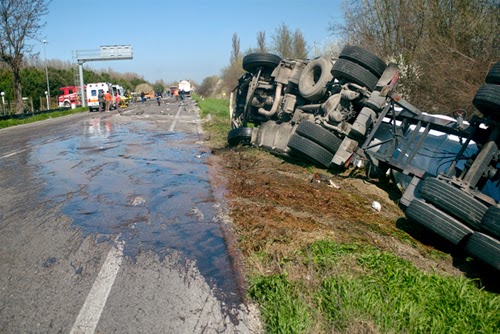
·         Big Truck Roll-Overs and
·         Unsafe Lane Changes.
Most all of these accidents have one thing in common: One or more drivers violated One Safe Driving Rule;
1.   "Failure to Look Ahead as Far as You Can See When Driving" or
2.   "Failure to pay attention to the road" especially when talking on the phone or texting, etc.
Don't become a statistic by following their example.  Use this simple safe driving tip that professional drivers know and trust. This is THE NUMBER ONE SAFE DRIVING RULE FOR TRUCKERS.  When this rule is violated, disastrous consequences may result.  You'll see many of these unfortunate drivers as you look the accident reports.

Truckers First Safe Driving Rule
"WHEN DRIVING, ALWAYS LOOK AHEAD AS FAR AS YOU CAN SEE".
Following this ONE simple rule will keep you out of trouble most of the time and you will experience less stress in your driving life because you will have time to respond to most emergencies in a professional, relaxed manner with plenty of time to make course corrections or adjust your speed.
Look down your path of future travel far into the night or day. Let nothing important escape your attention.
Look for stopped or slow moving traffic in the distance.
Watch for road hazards such as stalled or wrecked vehicles in the travel lanes or on the shoulder.  Watch for traffic officers giving someone a ticket, aiming a laser gun in your direction or attending to a stalled vehicle or chasing someone down the highway.


Fatigue among truck drivers a growing threat on U.S. highways

NEW YORK (PIX11) – The New York State Department of Motor Vehicles say that in 2013 alone, there were 94 fatalities as a result of tractor trailer crashes. Those numbers are no doubt shocking.
However, when you expand to the entire nation, the number of fatal crashes rises to nearly 4,000.
In the past three weeks, we have reported two different fatal crashes during the PIX11 Morning News, which snarled traffic during the morning rush.
Back in June, a Walmart truck barreled through a construction zone and collided with a  party van. The impact critically injured comedian Tracy Morgan and killed his friend James McNair.
The driver of that truck had not slept in 24 hours and is now facing charges.
In 2012, there were more than 300,000 crashes involved trucks nationwide. Locally, in New York state, there were 12,000 crashes.
In most cases, the driver of the big rig walks away unharmed. Morgan’s crash and a wreck involving Marilu Rodriguez highlight a growing issue of driver fatigue.
“I thought my son was dead, I didn’t want to look in the backseat,” Rodriguez said, describing the moments after after she was hit by a tractor trailer in 2006 along the New Jersey Turnpike.
“The worst part was knowing I was going to be hit and there was just nothing I could do about it.”
Attorney Alan Markman sees the issue of driver fatigue as a huge problem on the roads.
“If you want to put a percentage on it, I would say 90 percent of truck driver accidents relate to fatigued, simply too many hours on the road,” Markman said.
That was partially to blame in Rodriguez’s case.
“I can hear the metal , his tires screeching,” she recalled. “ I can hear the windows popping. It is something you just never forget.
“I was in such a daze. I didn’t know what was going on. I stepped out of the car and when I looked up, I was walking into traffic.”
In the backseat was Rodriguez’s 12-year-old son, who she thought had died.
“ I really thought my son had not made it. But then I heard his squeaky little voice,” Marilu said.
Marilu’s son miraculously walked away unharmed, however, she did not. She had to have a metal cage surgically implanted in her back and is now on pain medication for the rest of her life.
The driver of the crash settled the case before it went to court.    There was a big reason for that happening according to her attorney.
“Not only were the records on the truck inaccurate,” Makman said. “But the vehicle itself should not have been on the road in the first place.”


Contractor’s insurer had failed to comply with N.Y. Ins. Law 3420(d)(2) because it had not sent its disclaimer notice to its additional insureds


Contractor’s insurer had failed to comply with N.Y. Ins. Law 3420(d)(2) because it had not sent its disclaimer notice to its additional insureds

The owner and managing agent of an apartment building (collectively, the insureds) were insureds under two different policies: they were named insureds under their own policy and additional insureds under a policy obtained by a contractor they hired. When an employee of the contractor was injured, the contractor’s insurer, seeking to disclaim liability, sent written notice to the insureds’ own carrier but not to the insureds themselves. The insureds brought third party claims against the contractor and the contractor’s insurer, asserting that the contractor’s insurer was required to provide them with a defense and indemnification. Supreme Court granted summary judgment against the contractor’s insurer. The Appellate Division affirmed, concluding that the contractor’s insurer had failed to comply with N.Y. Ins. Law 3420(d)(2) because it had not sent its disclaimer notice to its additional insureds. The Court of Appeals affirmed, holding that the contractor’s insurer failed to comply with section 3430(d)(2) under the circumstances of this case.

Sierra v 4401 Sunset Park, LLC 2014 NY Slip Op 08216 Decided on November 24, 2014 Court of Appeals Smith, J. Published by New York State Law Reporting Bureau pursuant to Judiciary Law § 431. This opinion is uncorrected and subject to revision before publication in the Official Reports.

Decided on November 24, 2014
No. 216

[*1]Juan Sierra, Plaintiff,

v

4401 Sunset Park, LLC, et al., Defendants. 4401 Sunset Park, LLC, et al., Third-Party Respondents, LM Interiors Contracting, LLC, Third-Party Defendant, Scottsdale Insurance Company, Third-Party Appellant. (And A Second Third-Party Action.)


Matthew Lerner, for third-party appellant.
Corey Reichardt, for third-party respondents.


SMITH, J.:
Insurance Law § 3420 (d) (2) requires a liability insurer that disclaims liability to give written notice of the disclaimer "to the insured." This case involves parties who were insureds under two different policies: they were named insureds under their own policy, and [*2]additional insureds under a policy obtained by a contractor they had hired. The contractor's insurer, seeking to disclaim liability, sent written notice to the insureds' own carrier, but not to the insureds themselves. We hold that this did not meet the requirement of the statute.
I
4401 Sunset Park LLC and Sierra Realty Corp., defendants and third-party plaintiffs in this action, are respectively the owner and managing agent of an apartment building in Brooklyn. They contracted with third-party defendant LM Interiors Contracting, LLC to do renovation work on the building. The contract required LM to maintain liability insurance that named the owner and managing agent as additional insureds, and LM obtained such a policy from third-party defendant Scottsdale Insurance Company. The owner and managing agent also had their own liability insurance policy, issued by Greater New York Mutual Insurance Company (GNY).
On August 18, 2008, plaintiff, Juan Sierra, an LM employee (unrelated to the managing agent, Sierra Realty Corp.), lost a finger in an accident while working on the renovation project. The managing agent learned of the accident that day, but gave no notice of it to either GNY or Scottsdale. More than three months later, on November 30, 2008, plaintiff brought this action seeking damages for personal injuries against the owner and the managing agent, and at this point they notified GNY of the claim. GNY retained a lawyer for its insureds, but neither the insureds nor GNY informed Scottsdale of the injury or the claim until January 6, 2009, when GNY sent the summons and complaint to Scottsdale. In a letter that accompanied the summons and complaint, GNY asked Scottsdale to "respond in writing upon receipt of this letter whether you will defend, indemnify and hold our insured harmless in connection with this lawsuit." The letter included the name and address of the law firm that GNY had retained to answer the complaint on the insureds' behalf.
Scottsdale replied to GNY on February 2, 2009, disclaiming liability on various grounds, including the insureds' failure to comply with their obligation under the policy "to see to it that we are notified as soon as practicable of an 'occurrence' which may result in a claim." Scottsdale did not send its letter to the owner and managing agent (its additional insureds and GNY's insureds) or to the lawyer representing the insureds in this action.
The owner and managing agent brought third party claims against LM Interiors and Scottsdale asserting, among other things, that Scottsdale was required to provide them with a defense and indemnification. Supreme Court granted summary judgment against Scottsdale on that claim, and the Appellate Division affirmed that portion of Supreme Court's order (Sierra v 4401 Sunset Park, LLC, 101 AD3d 983 [2d Dept 2012]). The Appellate Division concluded that Scottsdale had failed to comply with Insurance Law § 3420 (d) (2) because it had not sent its disclaimer notice to its additional insureds. We granted leave to appeal from a later judgment, bringing this part of the Appellate Division order up for review (22 NY3d 854 [2013]), and we [*3]now affirm.
II
Insurance Law § 3420 (d) (2) says:
"If under a liability policy issued or delivered in this state, an insurer shall disclaim liability or deny coverage . . . it shall give written notice as soon as is reasonably possible of such disclaimer of liability or denial of coverage to the insured and the injured person or any other claimant"
(emphasis added).
It is undisputed that Scottsdale did not give notice of its disclaimer directly to its additional insureds or to the lawyer who had been retained to represent them. Scottsdale argues that the disclaimer notice it sent to GNY was sufficient to satisfy the statute. We disagree.
GNY was not an insured under Scottsdale's policy; it was another insurer. While GNY had acted on the insureds' behalf in sending notice of the claim to Scottsdale, that did not make GNY the insureds' agent for all purposes, or for the specific purpose that is relevant here: receipt of a notice of disclaimer. GNY's interests were not necessarily the same as its insureds' in this litigation. There might have been a coverage dispute between GNY and the insureds, or plaintiff's claim might have exceeded GNY's policy limits. Because the insureds had their own interests at stake, separate from that of GNY, they were entitled to notice delivered to them, or at least to an agent — perhaps their attorney — who owed a duty of loyalty in this matter to them only. As the Appellate Division correctly held in Greater N.Y. Mut. Ins. Co. v Chubb Indem. Ins. Co. (105 AD3d 523, 524 [1st Dept 2013]), the obligation imposed by the Insurance Law is "to give timely notice of disclaimer to the mutual insureds . . . not to . . . another insurer."
Scottsdale argues that it has "substantially complied" with the statute, relying on Excelsior Ins. Co. v Antretter Contr. Corp. (262 AD2d 124 [1st Dept 1999]) and Cincinnati Ins. Co. v Sirius Am. Ins. Co. (51 AD3d 1365 [4th Dept 2008]). Excelsior, as the court in GNY v Chubb pointed out (105 AD3d at 525), may be distinguishable: in that case, as a result of a settlement, the insured had no real interest in the litigation, and the insurer to which the disclaimer was sent was the only real party in interest (see Excelsior, 262 AD2d at 127). In any event, if Excelsior and Cincinnati are read to stand for the general proposition that notice to an additional insured's liability carrier serves as notice to the additional insured under section 3420 (d) (2), those cases should not be followed.
Accordingly, the judgment appealed from, and the order of the Appellate Division, insofar as reviewed, should be affirmed with costs.
* * * * * * * * * * * * * * * * *
Judgment appealed from and order of the Appellate Division, insofar as brought up for review, affirmed, with costs. Opinion by Judge Smith. Chief Judge Lippman and Judges Graffeo, Read, Pigott, Rivera and Abdus-Salaam concur.
Decided November 24, 2014

THE EMERGING ELECTRONIC WASTE RISKS: AT&T TO PAY CALIFORNIA $52 MILLION IN HAZARDOUS WASTE DISPOSAL SETTLEMENT FOR ILLEGALLY DISPOSING ELECTRONIC WASTE


THE EMERGING ELECTRONIC WASTE RISKS:  AT&T to pay California $52 million in hazardous waste disposal settlement FOR ILLEGALLY DISPOSING ELECTRONIC WASTE


We reported in a recent blog the emerging health, safety and environmental risks posed by the handling and disposal of electronic waste.  Here is that blog:

Potential Occupational Overexposure to Lead, Cadmium, Chromium, Mercury and Noise at Electronic Scrap Recycling Facilities – EMERGING GLOBAL THREATS FROM E-WASTE

In a recent development, AT&T Inc will pay $52 million in civil penalties and environmental compliance as part of a settlement with California over illegal dumping of electronic hazardous waste but won’t be required to clean up the resulting contamination, state officials said on Thursday.
State officials said it marked the first enforcement action in California against a telecommunications company for mishandling of electronic waste. The settlement must still be approved by the Alameda County Superior Court, where it was filed.
Investigators cited AT&T for illegally disposing of hazardous wastes and other materials at more than 235 of its warehouses and dispatch centers across the state over a nine-year period.


Inspections of trash dumpsters at those facilities by county prosecutors and state regulators found the company was routinely sending hazardous materials to local landfills not permitted to receive such contaminants.
The wastes in question consisted primarily of discarded electronic equipment, batteries and aerosol cans, as well as “certain liquids and gels” used by AT&T service technicians, the state said in a statement.
“This settlement holds AT&T accountable for unlawfully dumping electronic waste,” state Attorney General Kamala Harris said.
AT&T admitted no wrongdoing as part of the settlement, nor is it compelled to remove any of the waste it was found to have dumped illegally, said David Beltran, a spokesman for Harris.
But the judgment also expressly does not release AT&T from any liability for contamination in the event the Dallas-based company is named in a lawsuit seeking damages, Beltran said.
AT&T officials were not immediately available for comment.
Verizon Communications Inc has acknowledged that it was the subject of a similar investigation by California earlier this year.
Under the agreement with AT&T, the company will pay $23.8 million in civil penalties and other costs and spend $28 million more over the next five years to carry out “enhanced environmental compliance measures” required by the settlement, the state said.
Consumer advocate Liza Tucker from the nonprofit Santa Monica-based group Consumer Watchdog criticized the settlement as falling short by not requiring AT&T to undertake a costly cleanup necessary to ensure public health and deter similar dumping by others.
“They’re being fined what amounts to chump change for a company like AT&T, and the public is not going to be protected in the end because wherever they’ve illegally disposed of that waste, it’s going to stay there,” she said.


Metropolitan Engineering, Consulting & Forensics (MECF)
Providing Competent, Expert and Objective Investigative Engineering and Consulting Services
P.O. Box 520
Tenafly, NJ 07670-0520
Tel.: (973) 897-8162
Fax: (973) 810-0440
We are happy to announce the launch of our twitter account. Please make sure to follow us at @MetropForensics or @metroforensics

Metropolitan appreciates your business.
Feel free to recommend our services to your friends and colleagues.


UNDERSTANDING WAIVERS OF SUBROGATION AS THEY APPLY TO THE CONSTRUCTION INDUSTRY


Understanding Waivers of Subrogation as they apply to the Construction Industry


Suppose an air conditioning contractor, while installing a system for a new industrial building, has an accident. Another contractor’s employee on the job site suffers injuries when the AC contractor’s scaffolding collapses and falls on top of him.  The injured worker sues the AC contractor and the project owner.  The project’s contract included a requirement that the contractor assume the owner’s liability for any accidents arising out of the contractor’s work.  Consequently, the contractor’s general liability insurance company pays the injured worker for both the contractor and owner’s shares of the damages.  The insurance company, however, has determined that the owner was twenty percent responsible for the accident. It files a claim with the owner demanding some of its money back.
The insurance company’s action is entirely legal. Many project owners and general contractors, wanting to avoid this situation, insist that their subcontractors agree to a waiver of subrogation.
Subrogation is a legal principle in which a person who has paid another’s expenses or debt assumes the other's rights to recover from the person responsible for the expenses or debt. For example, if someone hits your car in a parking lot and causes significant damage, your insurance company will pay you for the damage (assuming you bought collision insurance,) then recover the amount of its payment (subrogate) from the other driver (or, more commonly, from the driver’s insurance company.) Subrogation holds ultimately responsible the person who should pay for the damage.
Owners and general contractors want to transfer their liability to subcontractors, to the extent that they can. Therefore, contracts often include a waiver of subrogation agreement. In such an agreement, the subcontractor promises not to pursue recovery from the other party. That agreement might bind the subcontractor’s insurance company, depending on the type of policy and its terms.
A standard commercial general liability policy forbids the policyholder from doing anything to impair the insurance company’s rights after the loss occurs. This implies that a waiver of subrogation agreed to before a loss binds the company. Also, the sub’s policy may protect the other party if it names him as an additional insured. Under common law, an insurance company may not subrogate against its own insured. To remove any doubt, the sub should ask the company to add an endorsement applying a waiver of subrogation to the person or organization named in it. Insurance companies vary on the amount of premium they charge for this; some make no charge at all.

The standard business auto insurance policy has language similar to the general liability policy. Unlike GL insurance, there is no standard waiver of subrogation endorsement for auto insurance. Some insurance companies may offer their own versions of such an endorsement. Again, premium charges will vary.
Workers’ compensation policies require an endorsement whenever a waiver of subrogation is desired. This endorsement may apply on a blanket basis to all parties with whom the insured has written contracts requiring waivers. Alternatively, it can apply only to the party listed on its schedule. The insurance company may charge up to two percent of the policy premium for blanket coverage or two to five percent of the project’s premium for individual coverage.
Commercial property and inland marine insurance policies vary as to whether they permit waivers of subrogation even before a loss.
In all cases, a contractor or building tenant who is required by contract to provide such a waiver should check the relevant insurance policies. Policy changes should be requested if it is unclear whether they permit pre-loss waivers. The firm should consult with an insurance agent on all insurance-related contractual matters to ensure that the proper coverage is in place.


WHAT LANGUAGE AND/OR ENDORSEMENTS TO USE 


One of the most common contractual requirements your commercial insureds face is a requirement to waive a right of subrogation. Most often, these waivers are one-sided when it comes to general liability, but mutual with regard to property damage under lease agreements. They can also arise under business auto, workers compensation, marine, umbrella, and other exposures.  Contracts will often stipulate that the right of subrogation must be waived.  The CGL only restricts waivers of subrogation after a loss. It does not restrict waiving subrogation before a loss (written, oral, or implied). Specifically, the policy language in the 2004 CGL says:
Transfer Of Rights Of Recovery Against Others To Us
If the insured has rights to recover all or part of any payment we have made under this Coverage Part, those rights are transferred to us. The insured must do nothing after loss to impair them. At our request, the insured will bring "suit" or transfer those rights to us and help us enforce them.
In addition, it is generally accepted that insurers cannot subrogate against their own insureds except in rare instances such as intentional losses. Thus, additional insured status possibly grants some degree of insulation from subrogation after loss. However, to fully comply with some contractual requirements, it may be necessary to attach ISO form CG 20 04 10 94 – Waiver of Transfer of Rights of Recovery
Against Others To Us which amends the condition above by adding the following language:
We waive any right of recovery we may have against the person or organization shown in the Schedule above because of payments we make for injury or damage arising out of your ongoing operations or "your work" done under a contract with that person or organization and included in the "products-completed operations hazard". This waiver applies only to the person or organization shown in the Schedule above.
Workers compensation waivers typically must be endorsed to the policy and they must be in writing according to the workers compensation endorsement (e.g., the NCCI WC 00 03 13, Workers Compensation Waiver of Our Right to Recover From Others endorsement).
If a contract requires a full waiver of subrogation, it is advisable that the agent not indicate compliance on the certificate of insurance unless authorized to do so in advance by the insurer based on policy language. In addition, some state statutes require the attachment of an endorsement even though the policy grants waivers prior to loss.


RECENT CASE LAW UPHOLDS THE WAIVERS OF SUBROGATION CLAUSES


Travelers Indem. Co. v. Crown Corr, Inc., 2014 U.S. App. LEXIS 21101 (9th Cir. 2014)

This action arose out of the construction of the University of Phoenix Stadium (the “Stadium”), home of the Arizona Cardinals.  Tourism and Sports Authority (the “Owner”) entered into a Design/Build Agreement with the Arizona Cardinals and Hunt Construction Group (the “Contractor”) for the design and construction of the Stadium (the “Prime Contract”).  The Contractor then entered into a subcontract with Crown Corr, Inc. (the “Subcontractor”) for the design of the Stadium’s exterior enclosure system (the “Subcontract”).

Construction was completed and the Stadium opened in August 2006.  Nearly four years later, a storm moving through Glendale, Arizona caused metal panels to fall from the Stadium, resulting in an estimated $1.5 million in damages to its façade, retractable roofs and the sound system.  The Owner submitted the claim to its post-construction property insurer, Travelers Indemnity Co. (the “Insurer”), who in turn brought suit as subrogee of the Owner against the Subcontractor.  The Insurer’s complaint alleged that the failure of the panels and the subsequent damage caused by that failure were a direct result of the Subcontractor’s negligent construction. The Subcontractor responded by filing a motion to dismiss on the basis of the following waiver of subrogation clause contained in the Prime Contract (the “Waiver”):

“The Parties waive subrogation against one another, the Design/Builder, Design Consultants, Subcontractors, and their respective agents and employees on all property and consequential loss policies that may be carried by any of them on adjacent properties and under property and consequential loss policies purchased for the Facility.”

The district court dismissed the action after concluding that the Waiver operated to preclude the Insurer’s claims, and the Insurer appealed to the Ninth Circuit.   On appeal, the Court addressed three challenges raised by the Insurer to the findings below.

First, the Insurer argued that the district court erred in interpreting the term “Facility” as used in the Waiver to mean “the Stadium after it is fully operational.”  The Insurer argued that the term “Facility” referred to the structure during construction and not the completed Stadium.  Thus, the Insurer asserted that the Waiver had expired upon substantial completion of the project, and did not apply to its post-construction claims.  In rejecting the Insurer’s temporal argument, the Court found that the Insurer failed to put forth a persuasive reading that showed that “Facility” refers only to the Stadium before substantial completion.  The Court cited to other uses of the term in the Prime Contract referring to “Facility” in a way that describes a post-completion Stadium.  For example, the Court noted a provision forecasting that the Arizona Cardinals will play “at the Facility for thirty (30) years.”  Thus, the Court reasoned, that even if “Facility” could possibly refer to pre-completion as the Insurer argued, at most, it only established that the term refers to the Stadium bothbefore and after substantial completion.  The Court held that the Waiver was therefore still applicable and not “reasonably susceptible” to the Insurer’s more restrictive view.

Second, the Insurer challenged the district court’s determination that the Owner could waive the subrogation rights of a property insurer providing insurance years after the property in question was completed.  In rejecting this argument, the Ninth Circuit noted that Arizona courts recognize the right of an insured, when the insured is waiving its own rights, to waive its insurer’s subrogation rights.  The Court pointed to the insurance provision in the Prime Contract wherein the parties waived their own subrogation rights with respect to the property insurance the Owner was required to carry, and a similarly broad release contained in the Subcontract having the same effect.  Because these provisions also waived the Owner’s rights to subrogation, the Court concluded that the Waiver applied to the Insurer and barred its contract claims against the Subcontractor.

Third, the Insurer argued that, in any event, the Waiver should not apply to its negligence claim on the grounds that exculpatory clauses are disfavored and construed strictly in Arizona.  The Court disagreed, finding that a subrogation waiver is different from a true exculpatory clause. The Court reasoned that subrogation waivers do not present the same dangers as exculpatory clauses, because no risk exists that the injured party will be left without compensation.  The Court also highlighted the important policy goals served by subrogation waivers as a matter of risk allocation.  While acknowledging that Arizona did not appear to have ruled explicitly on whether a subrogation waiver applies to a tort claim, the Court found no reason that Arizona would depart from the general rule that subrogation waivers apply regardless of the nature of the claim.  Thus, because the Court concluded that the Owner waived its rights against the Contractor and Subcontractors and that the Waiver applied against the Insurer as to its contract claims, the Court also concluded that the Waiver applied to the Insurer’s tort claim.

Consequently, the Court affirmed the district court’s decision to enforce the Waiver and dismiss the Insurer’s action for recovery.


Metropolitan Engineering, Consulting & Forensics (MECF)

Providing Competent, Expert and Objective Investigative Engineering and Consulting Services
P.O. Box 520
Tenafly, NJ 07670-0520
Tel.: (973) 897-8162
Fax: (973) 810-0440
We are happy to announce the launch of our twitter account. Please make sure to follow us at @MetropForensics or @metroforensics

Metropolitan appreciates your business.
Feel free to recommend our services to your friends and colleagues.