MEC&F Expert Engineers

Saturday, January 12, 2019

Chief Judge Kozinski: It is an open secret long shared by prosecutors, defense lawyers and judges that perjury is widespread among law enforcement officers


The Police and ‘Testilying’: Perjury On the Witness Stand?

During any given criminal case, certain facts in police testimony that appear to be banal or happenstance—such as the placement of a hand or someone dropping a bag of drugs—seem reasonable when taken by themselves.

But looking at police testimony in similar cases, if some facts continue to appear in case after case, an observer may come to a disquieting conclusion: police are lying.

“Testilying” is the colloquial term for the police practice of lying on official documentation or in court under oath (i.e., perjury). Typically, testilying is used to justify searches in drug cases that would otherwise be deemed illegal.

The exclusionary rule, established in Mapp v. Ohio (1961), states that evidence gathered from a search that violates the Fourth Amendment cannot be used in court against a defendant. If, however, a police officer testifies that he saw the drugs dropped into plain view, he has probable cause—and thus, legal permission—to conduct a search without a warrant.

Some criminal justice observers think it may be the most common manifestation of police misconduct.

Alex Kozinski, former chief judge of the U.S. Court of Appeals for the Ninth Circuit once said, “It is an open secret long shared by prosecutors, defense lawyers and judges that perjury is widespread among law enforcement officers.” Many commentators in the legal community agree, though there is no consensus about what to do about it.

The repeat players in the criminal justice system naturally recognize testimony they hear over and over again. Unless drug dealers magically became klutzier after Mapp, there is strong reason to believe so-called dropsy testimony has become a widespread and illegal institutional work-around to the Fourth Amendment.

Perjury—lying in court under oath—is a crime in any circumstance, whether in a misdemeanor drug trial or a capital murder case. Police officers are very rarely charged with perjury in any type of case, despite testilying's ostensible pervasiveness. If testilying is as common as some believe, and police feel immune to perjury prosecutions, the incentive to lie to defend themselves or a colleague in a use-of-force case must be very strong.

Testilying in drug cases strongly suggests police are acutely aware of the evidentiary rules and procedural demands placed on them by legislators and the judiciary. As I noted in my last piece, officers operate with wide discretion within the boundaries of those demands.

In use-of-force cases particularly, giving broad leeway to police officers makes a lot of sense. Unlike members of the public who are free—if not demanded, in some cases—to flee dangerous situations, police officers are tasked to run toward danger for the sake of the citizenry. Police are forced to make split-second judgments on dangers to themselves and others when dealing with a potentially dangerous suspect.

Officers are human and therefore make honest mistakes, and thus the justice system should provide them with a modicum of protection when they make errors that reasonable people would make given the same circumstances.

But just as any power may lead to abuse, so may legal privileges, even those granted with the best of intentions.

The two most prominent Supreme Court cases in use-of-force authority are Tennessee v. Garner (1985) and Graham v. Connor (1989). These two cases indeed provide ample protections for police officers with regard to the use of force.

Edward Garner was a teenager fatally shot by Memphis police while fleeing officers after commission of a burglary. In Tennessee v. Garner, the Supreme Court held that lethal force may not be used to stop a suspect simply to prevent him from fleeing. The Court writes:

“Where the suspect poses no immediate threat to the officer and no threat to others, the harm resulting from failing to apprehend him does not justify the use of deadly force to do so….A police officer may not seize an unarmed, nondangerous [sic] suspect by shooting him dead….[I]f the suspect threatens the officer with a weapon or there is probable cause to believe that he has committed a crime involving the infliction or threatened infliction of serious physical harm, deadly force may be used if necessary to prevent escape, and if, where feasible, some warning has been given.”

Notably, the Garner decision exposed the government to litigation for the officer's unreasonable use of force. The Court noted that Garner, being an unarmed young teen of slight physical build who was fleeing police, could have posed no imminent threat to police or others and therefore the use of lethal force was clearly unreasonable.

In Graham, the Court goes further to describe what is and is not a Fourth Amendment violation as a result of excessive force. Perhaps as a surprise to some readers, there is no right against excessive force as such, but rather courts must make after-the-fact determinations of whether seizures (i.e., violence used by police to arrest or detain a suspect) before trial are unreasonable and thus violate the Fourth Amendment. Therefore, even though the officers involved in Graham handcuffed and roughly threw an innocent man suffering insulin shock into a squad car saying, “Ain't nothing wrong with the motherfucker but drunk. Lock the son of a bitch up,” the Court ruled his perfectly legal but suspicious behavior—running into and out of a convenience store—led the police officers to reasonably believe that a crime may have been committed and his detainment, however aggressive, was therefore legal.

Simplifying, then, these cases taken together lay out the standards for what is expected of police officers in use-of-force encounters and how their actions should be judged after the fact. Garner outlines the specific conditions that may obviate the prohibition on the use of lethal force against a suspect: the suspect must pose an immediate threat to the officer or the public; be armed and/or dangerous; must threaten the officer with a weapon; or had committed a crime causing serious physical harm. Additionally, when possible, the officer should warn the suspect before opening fire. Graham dictates that any actions taken by a police officer must be “objectively reasonable” given the circumstances presented to pass Fourth Amendment scrutiny.

Just as we see the fit-the-requirement nature of dropsy testimony to avoid Mapp's exclusionary rule, we may expect to see similar accounts of officer-involved shootings in regard to Garner and Graham.

Put another way, the requirements of these cases may inadvertently provide a template for officer testilying in use-of-force cases.

Sure enough, these shootings tend to include many of the following details: a description of the officer's imminent fear for his own safety; phrases such as “the suspect made furtive movements” or “charged the officer”; the suspect exhibited a super-human resistance to non-lethal force such as physical restraint, TASER, bean-bag rounds, or even bullets; the suspect ignored repeated and explicit demands to put hands up; or the suspect “raised his weapon.” In addition, some version of the phrase “he reached for his waistband,” “he reached under the seat,” or “he was reaching for my gun” will demonstrate the officer had reason to believe the suspect was reaching for a firearm, satisfying Garner's imminent safety requirement, even though the suspect may turn out to be unarmed.

These statements paint a picture of an officer waiting until the last possible moment and exhausting all other available means before deploying lethal force. Indeed, this is what we want our officers to do when faced with mortal danger. A recollection of facts in this way—absent proof to the contrary—is often enough to clear a police officer, given the cultural inclination to give police the benefit of the doubt and the case law currently governing use-of-force incidents.

Surely, sometimes those facts recited in these investigations are entirely true. But given the relative uniformity of testimony in case after case, it is unreasonable to believe each officer is following the guidelines time after time.

The quick-to-violence escalations we see on video of officer-involved shootings and other uses of force unambiguously confirm this. Add the continued patterns of abuse in minority communities, the resentment that treatment engenders, and the disproportionate rate at which people of color are shot by police, the numerous protests around the country demonstrate a concentrated and growing skepticism the police narratives in use-of-force incidents.

One may wonder how exactly these stories acquire such relative uniformity across jurisdictions, and whether testilying has, in fact, bled into use-of-force cases.

In his grand jury testimony, then-Ferguson police officer Darren Wilson recounted that he methodically and rationally went through the checklist of possible non-lethal defenses against his alleged attacker Michael Brown as he was in imminent fear for his own life. Perhaps that's true.

But Wilson also testified:

“Yeah, just from what I have been told about the incident originally, is that you are supposed to have 72 hours before you are actually officially interviewed, recorded statement and all of that. You tend to remember more through a couple sleep cycles then what you do as soon as it happens. It is a traumatic event, a lot of details kind of come as one detail.”

Police officers may receive such “cooling off” periods before giving statements in criminal or internal investigations of which they played a role. Although not codified in Missouri law, this period is just one aspect of a broader program of police protection known as “law enforcement officers' bills of rights.” These bills of rights are only statutory in a handful of states, but various protections in them are operative in many jurisdictions as standard operating procedure.

Among the other benefits afforded to police officers is the right to union representation at all questioning by police authorities. This means that during this cooling off period, the officer may discuss the matter with union representatives and, presumably, they will work together to provide the best possible story for the investigators. Such a story would necessarily align with the requirements of Graham and Garner.

Whether Wilson was given this time after initial questioning as a matter of collective bargaining agreement or professional courtesy, it's fair to say most civilian shooting suspects wouldn't hear a detective say, “Go home, sleep on it for a couple days—oh, here's the number of a good defense lawyer—and come back when you get your head right.”

Given all this, that Wilson's testimony about the events that led to Michael Brown's death read like a checklist of the most menacing and dangerous behavior imaginable by Brown and, alternatively, that Wilson himself calmly considered and then exhausted every possible non-lethal option before opening fire cannot be surprising.

Again, it could all be true, but the people of Ferguson have plenty of reasons to doubt it.

Positive framing of events so requires no malice, it is natural that someone and his counsel would paint his actions in the best possible light. But it is important to remember that our criminal justice system is based on an adversarial system—prosecution and defense before a neutral arbiter—and prosecutors who regularly depend on police officers as their allies in court are naturally less likely to challenge the credibility of those officers when one of them is accused of wrongdoing.

Moreover, as Garner shows, a finding against the officer further exposes the department and government to costly lawsuits, thereby increasing potential political pressure to exonerate the officer.

In short, police officers are afforded extra protections in use-of-force incidents and, additionally, are less likely to face anyone within the criminal justice apparatus who will strongly challenge their version of events. This creates an environment that implicitly tolerates inappropriate uses of force because of the diminishing likelihood of negative repercussions for those actions.

Police have a dangerous job. Undoubtedly, officers face deadly situations and can be wholly justified in their use of lethal force. And it would be going too far to say that police lawyers, unions, and prosecutors knowingly suborn police perjury.

However, the incentives in jurisdictions all over the country encourage officers to lie, not only in their day-to-day work, but also when their actions result in violence against the public.

The criminal justice apparatus has yet to seriously address police lying in most cases, let alone when police themselves are subjects of criminal investigations. Thus, police officers are incentivized to lie and their institutions are incentivized to protect their officers in use-of-force incidents.

This results in more injustice, less trust in the police, and more dead civilians.

It is a crime for law enforcement officers to file reports with deliberately false information


Police Officers Filing False Reports
(California Penal Code 118.1)

We grant police officers enormous power. Obviously, we give them the power to arrest people and take them to jail.

But cops also have the power of writing police reports (or crime reports) and sending these reports to the district attorney. Prosecutors rely on these reports to decide whether to file criminal charges, and what charges to file.

Fortunately, most cops are generally honest and do their best to file accurate and truthful police reports. What happens when cops lie? What happens when they file false police reports?

The simple answer -- sadly -- is that it can cause (and does cause) innocent people to get wrongly prosecuted, convicted and jailed.

This article will examine California Penal Code 118.1, the section making it a crime for police officers to file reports with deliberately false information. Specifically, we will examine:


1. What would a prosecutor have to prove to convict a cop of filing a false police report?

2. What are the penalties if the officer is convicted?

3. What defenses does the police officer usually assert?

4. What can you do if you're a victim of a false police report?

5. Related crimes


Penal Code 118.1 states that

Every peace officer who files any report with the agency which employs him or her regarding the commission of any crime or any investigation of any crime, if he or she knowingly and intentionally makes any statement regarding any material matter in the report which the officer knows to be false, whether or not the statement is certified or otherwise expressly reported as true, is guilty of filing a false report punishable by imprisonment in the county jail for up to one year, or in the state prison for one, two, or three years. This section shall not apply to the contents of any statement which the peace officer attributes in the report to any other person.1

The key to this section is that it applies regardless of whether or not the officer signs the report under penalty of perjury.

Sometimes police do file their reports under penalty of perjury. They sign an oath directly in the report. Or they sign a separate "statement of probable cause" attesting under oath that everything they say in the attached reports is true to the best of their knowledge and belief.

In these situations, if they get caught lying in the report, they can be prosecuted directly under California perjury laws.

But many times police officers file crime reports, investigation reports, witness statement reports and detective follow-up reports without necessarily attesting to them under penalty of perjury. With Penal Code 118.1, no oath or affirmation is required. They can still be prosecuted any time they report on an alleged crime untruthfully.

Certain conditions must be met, however, before a false report becomes a crime.

Let's examine this statute part by part:
Official capacity


Penal Code 118.1 only applies to those reports an officer files in his official capacity with the agency that employs him. An LAPD officer who writes a report for the Sheriffs Department, the FBI or some other agency, for example, would probably not fall with in the ambit of this section.

Criminal matter

Penal Code 118.1 only applies to criminal matters. Many times police officers write reports in connection with purely civil or administrative matters, such as traffic accidents or fires or earthquakes. If they are not reporting on a crime specifically, the section does not apply.

Material matter

The false statement in the police report must be "material." This means it must relate to something of significance or importance, rather than something trivial or incidental. 3 Consider an example:

San Francisco police officer Jones is eating a meal at Chipotle when he gets a radio call of a shooting in the neighborhood. He responds immediately. When he files his police report, he states that he was driving on patrol when he got the call. This is obviously false. But everything else in the report is truthful.
Even though the statement (about his location when he got the call) is false, it would probably not be deemed material so as to trigger Penal Code 118.1. But let's change the facts:

When officer Jones arrives at the scene, he sees the suspect running away. Other officers catch and apprehend the suspect. The gun (the one used in the shooting) is found in some nearby bushes. Officer Jones, wanting to help "seal" the case for the prosecution, lies and states in his police report that "as I arrived at the scene, I observed the suspect throw the gun into the bushes."
Now this false statement in the police report definitely would be considered material. If it could be proven that officer Jones lied in this way, it would fall right within the ambit of Penal Code 118.1.

Knowingly false


It's not uncommon for police to misrepresent aspects of an event based on misperception or innocent misrecollection. Police often write their reports hours or even days after witnessing or investigating a crime. Memory does fade and falter. Honest mistakes are not criminal. 


To commit a crime under this section, the officer must knowingly and intentionally lie with an intent to be deceptive. Consider an example:

Deputy Torres files a police report in connection with a DUI arrest. In the report, he states that he initially makes the traffic stop because he sees the driver "weaving within the lane" for 4 blocks. A video of the incident later shows that Deputy Torres only follows the car for 2 blocks, and thus could only have seen the driving for 2 blocks. When Torres writes the police report, he pictures the distance in his mind as 4 blocks. He is honestly mistaken.

Here, the deputy is not liable for "filing a false police report" under Penal Code 118.1. Granted, he may have been negligent for not being more certain and precise in his reporting. But his statement about the distance was mistaken rather than knowingly false. Let's change the facts with the next example:

Deputy Torres knows for a fact that he only saw the driver weaving for 2 blocks. But he worries that this may not be enough "observed bad driving" to give him probable cause for the DUI traffic stop (especially of the defense lawyer runs a motion to suppress
evidence in court). So in order to justify his traffic stop, and to help bolster the case in court, he lies and states in his police report that he observed the driver weave for 4 blocks.

Here, Deputy Torres clearly is liable for issuing a false police report. The misstatement about the distance is knowingly false and deceptive. It is material in that it purports to give him the probable cause needed for his DUI traffic stop. And it relates to the criminal matter of driving under the influence.

More Passaic County Officers Arrested for Extortion, Robbery, Police Brutality, Drug Dealing


Matthew Torres

PATERSON, New Jersey  — 


Wednesday morning’s arrest of Police Officer Matthew Torres — the fifth city cop nabbed in an ongoing FBI probe — drew a mixed reaction from community activists, who said the case seems to confirm longstanding suspicions some people had about Paterson cops.

But community leaders also said they see the arrests as a sign that authorities are ridding the department of its bad apples, providing an opportunity to improve the relationship between the police and city residents.

Torres, who was charged with violating citizens’ civil rights, is accused of participating in an illegal traffic stop in Paterson in December 2017, an incident during which he and one of the other accused cops, Eudy Ramos, allegedly took $1,000 in cash from a passenger in the vehicle.

Torres, 30, was suspended for 30 days last summer in connection with allegations of steroid use, according to city law enforcement sources.

Wearing handcuffs and leg irons, Torres appeared in federal court on Wednesday afternoon, and Judge Steven Mannion ordered his release on a $100,000 bond as the accused cop’s mother and fiancée looked on.

During the hearing, Torres’ lawyer, John Whipple, asked that Torres be allowed to travel to Pennsylvania while free on bail because he plans to be married there next year. Authorities granted that request.

When asked for comment, Whipple said his client has been cooperative with authorities, surrendering to federal agents. “We’re looking forward to reviewing the evidence and moving forward on how to approach the case,” Whipple said.

Three other rogue officers have pleaded guilty in the probe. The criminal charges against Ramos are still pending. Four of the officers arrested in the case —including Torres — went through the police academy together in 2014.


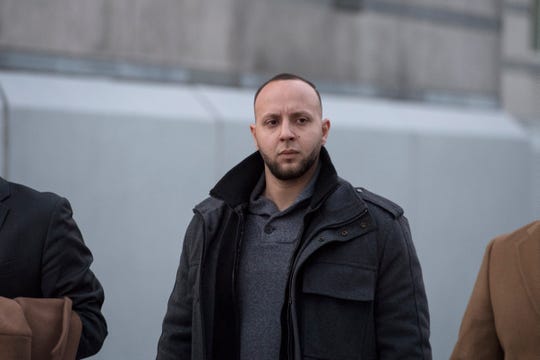
Matthew Torres leaves Federal Court in Newark on Wednesday, December 19, 2018. Matthew Torres was arrested Wednesday morning by federal agents, and charged with participating in an illegal traffic stop in Paterson last December with Eudy Ramos, another accused officer, according to authorities. (Photo: Michael Karas/NorthJersey.com)

“How long has this been going on undetected?” asked Zellie Thomas, a schoolteacher and leader of Paterson’s Black Lives Matter group. “We’ll never know. But there had to be a culture in place that allowed it to happen.”

Activist Bilal Hakeem, who has been critical of the Police Department in recent years, said he was saddened by the “scandalous allegations and convictions of officers who think they are above the law.”

“They took an oath, and they violated that oath,” Hakeem said. “Whatever penalty they get, they deserve.”

But the Rev. Kenneth Clayton, head of the Paterson chapter of the NAACP, said the corruption case provided an opportunity for bridge-building between the community and the department.

“The residents appreciate the fact that the police are being policed,” Clayton said. “There were always suspicions of corruption, but there was never any proof. Now we have a city administration and a police chief and a police director who want to make sure the department has integrity.”


Matthew Torres leaves Federal Court in Newark on Wednesday, December 19, 2018. Matthew Torres was arrested Wednesday morning by federal agents, and charged with participating in an illegal traffic stop in Paterson last December with Eudy Ramos, another accused officer, according to authorities. (Photo: Michael Karas/NorthJersey.com)

The Rev. James Staton, a former city councilman, called the arrests disconcerting but said they send a positive message. “It’s good to see that the truth is coming out,” he said. “It shows there is accountability.”

Mayor Andre Sayegh declined to comment on the latest arrest. Police Chief Troy Oswald said the FBI probe started at the request of city police officials after they heard allegations of wrongdoing by city cops.

Oswald said the FBI’s probe has actually improved morale within the Paterson Police Department. He said officers “who do their job the right way” had complained about the rogue ways of some of their colleagues.

“The guys who are hands-on and doing the job out on the street — they love this,” Oswald said of the housecleaning.

The three cops who already pleaded guilty have been fired, city officials said.

Jonathan Bustios on Tuesday admitted he made illegal stops, took cash from motorists and extorted one suspect in order to get a handgun. Ruben McAusland has admitted he sold drugs and participated in an assault on a suicide patient at a hospital emergency room. Roger Then has pleaded guilty to charges that he participated and video-recorded the hospital assault.


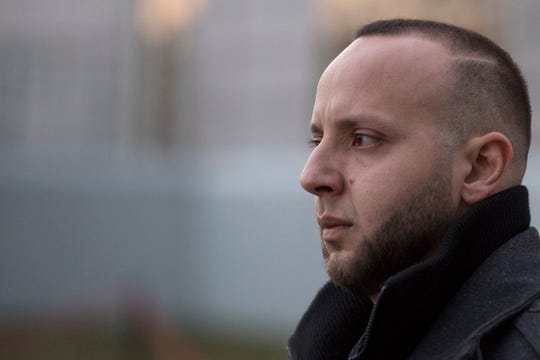
Paterson police officer Matthew Torres was arrested Wednesday morning by federal agents, and charged with participating in an illegal traffic stop in Paterson last December. (Photo: Photo courtesy of Paterson Police Department)

Federal law enforcement officials said Ramos and Torres allegedly sometimes used fake paperwork to trick individuals into believing that their cash seizures and vehicle stops were legitimate.

During the Dec. 7, 2017, traffic stop, Torres and Ramos placed the driver in one police car and the passenger in the other, authorities said.

The passenger told Torres and Ramos that he had two bags of marijuana and $3,100, according to the United States Attorney’s Office. Ramos took the money, placed it on the back seat of the vehicle and told the passenger that he did not care about the marijuana, authorities said.

But Ramos told the passenger that the officers could not simply let him go because his activity likely had been picked up by Paterson police cameras, authorities said.

Ramos told the passenger that the two officers would take $500 from him, have him sign a piece of paper, and then give that paper to the narcotics division, authorities said. Ramos then pretended he made a phone call to his supervisor and told the passenger that the higher-ranking cop said it had to be $800, authorities said.

Ramos took out a piece of white paper, wrote something on it, and told the passenger to sign it, authorities said. The passenger did not know what was written on the paper.

Afterward, Torres and Ramos released the driver and passenger. Authorities said the passenger told them there was $1,000 missing from his original $3,100.

Federal authorities have accused Torres and Ramos of sharing the stolen cash proceeds. The officers did not report the illegal cash seizure to the Paterson Police Department, authorities said.


=====================================


Fifth Cop Arrested in Paterson this Week

By NYNJ
December 23, 2018


A Paterson city officer has been arrested by the FBI. Allegations say Officer Mathew Torres made unjust traffic stops to steal cash from motorist. For you home-gamers, this is the 5th Paterson policeman arrested for corruption charges this year. The news comes just 24 hours after a another officer was arrested. Officer Jonathan Bustios pleaded guilty to extortion and conspiracy charges in the illegal seizure of a handgun from a driver in exchange for a lesser charge.

Officer Torres, faces a charge of conspiring to deprive individuals of their civil rights under cover of law, according to the U.S. Attorney’s Office for the District of NJ. In at least one stop, he allegedly stole $1000 while pretending to write-up the cash on a report that never existed.

In April, Officer Ramos and Officer Bustios were also arrested by the Feds in connection with these investigations.


Video from an unrelated case, where officer manbun is clearly illegally searching a mans vehicle in broad daylight. (Video by Paterson Times *Explicit Language)

Two other Paterson cops have also faced charges for the beating of a hospital patient that was suicidal. Officer McAusland and Officer Then, have since accepted plea deals in March. Oh yeah, McAusland also admitted to selling heroin and weed to a FBI informant and stealing crack cocaine and heroin from the scene of a crime.


Yikes… Extortion, Robbery, Police Brutality, Drug Dealing. Is it just me or does this sound like the plot to American Gangster?

Do you think there are more officers that will be arrested? Do you think this will be the turning point to Paterson finally cleaning up its act?

Mechanic Bruce Runyon, 63, was crashed to death when a car that was raised on a floor jack fell on him at a car donation site on Lauren Canyon Boulevard in North Hollywood


Worker Crushed By Car Publicly Identified
Posted by Contributing Editor


January 2, 2019 

The coroner’s office Wednesday publicly identified a worker crushed to death in Sun Valley when a car that was raised on a floor jack fell on him.

Bruce Runyon, 63, was a resident of Winnetka, coroner’s Lt. Larry Dietz said.

The accident was about 8 a.m. Monday at 7245 Laurel Canyon Blvd., Los Angeles Fire Department spokeswoman Margaret Stewart said.


Firefighters removed the man now identified as Runyon from under the vehicle, but he died at the scene, Stewart said.


===========================

Bruce Runyon Killed in North Hollywood Automotive Work Accident


Bruce Runyon has been identified by authorities as the victim following an accident that occurred at a car donation site on Lauren Canyon Boulevard in North Hollywood on December 31 at approximately 8:00 a.m. Mr. Runyon was underneath a car when a jack apparently failed and the vehicle fell on top of him. First responders from the Los Angeles Fire Department were apparently unable to help the man, who died at the scene. Mr. Runyon was 63 and a resident of Winnetka.


===========================


Life Story for Bruce Edward Runyon

Bruce E. Runyon

Sunrise: March,1955 – Sunset: December, 2018


Bruce Edward Runyon, 63, was born in Burbank, CA to Robert Runyon and Margaret Madelyn (Steinmetz), the youngest of six children. He moved about the San Fernando Valley, Winnetka most recently, until his unexpected passing the morning of New Year's Eve in a tragic accident at work.


Bruce is survived by his wife Patricia (McLeod), daughter, Jennifer (Chris Lewis), son, Daniel (Veronica Macias), and five grandchildren – Grace, Logan, Jade, Melody, and Kingston, five siblings – Robert (Jane), Gail (Mark) Eltgroth, Jan Trapero, Joel, and fraternal twin, Alan (Molly), as well as many nieces, nephews, cousins, relatives and friends.


Bruce was respected by all as a dedicated family man with a heart of gold and an iron-clad work ethic. He worked in the automotive industry for over 40 years as a mechanic, tow-truck driver, and most recently for the auto auction, rarely ever missing a day. He loved everything automotive and spent much of his free time working on cars, and watching and attending NASCAR races. Bruce's first love was his family – always making sure everyone was taken care of and he never missed an opportunity to lend a helping hand or celebrate a happy occasion. His light-hearted spirit, genuine smile and kind eyes touched everyone he knew – family, friends, co-workers and neighbors alike. Bruce's passing is an incomprehensible loss but the loving memories we share leave a legacy that will be forever cherished.

Michael D. Crow, 72, was crushed to death when a piece of equipment fell on him while working at Liberty Casting in Delaware, Ohio


Man crushed to death at Liberty Casting had been injured on the job before, family says

By: Rob Sneed


January 02, 2019


DELAWARE, Ohio (WCMH) -- 


Michael Crow, 72, was killed Friday morning when a piece of equipment crushed him while working at Liberty Casting Friday morning. His family tells NBC4 it wasn't the first injury he had received on the job.

The Federal Occupational Safety and Health Administration (OSHA) said their investigation into the fatal accident is still in its infancy. OSHA officials couldn't release any details on the most recent incident, pending the investigation.

NBC4 obtained records from the explosion at the iron foundry in August 22, 2018, which burned several workers with molten iron. One of the victims died from their injuries, Larry Johnson with OSHA said. Those records show Liberty Casting received multiple violations and was fined more than $70,000 as a result.

Just over four months later, Michael Crow died in an unrelated industrial accident at the foundry. The incident report obtained from Delaware County emergency services says a piece of equipment crushed the Fairfield County man. When they were able to get the equipment off him, he was no longer breathing.

His brother Donald Crow says his family is in mourning tonight.

“Oh that was terrible. There was no need of that. I don’t know how he got in between the two walls, how many guys were supposed to handle--I don’t even know what it was,” said Crow.

Donald told NBC4 he had worried about his brother ever since he says Michael was hurt on the job several months back.

"He was working on this shaker table and the guy helped him turn it on. It damn near tore his arm off and killed him but it didn’t," Crow explained.

Donald says he will miss his brother for his heart, and his talent.

"He was just a nice guy," he said. "He was a master craftsman."

NBC4 reached out Liberty Casting for comment about Crow’s death; no one returned our calls.


=========================


Michael D. Crow

BALTIMORE - Michael D. Crow 72 of Baltimore, Ohio died Friday, December 28, 2018 as the result of an industrial accident in Delaware, Ohio.

He was a Bloom-Carroll High School Graduate Class of 1964. He was a Vietnam veteran serving in the US Army where he was awarded the Vietnam Service Medal w/2 Bronze Service Stars, First Oak Leaf Cluster to Purple Heart, Republic of Vietnam Campaign Medal, National Defense Service Medal, Combat Infantryman Badge, Sharpshooter (Rifle) and Sharpshooter (M60 MG).

Michael was a mill wright and a life time member of the Baltimore VFW Post 3761

He is survived by his sons, Christopher (Anita Webb) Crow and Matthew Crow all of Baltimore, Ohio; brothers, Martin (Margo) Crow of Thurston, Ohio, Donald Crow of Carroll, Ohio and Ronald (Sophie) Crow of Europe; sister-in-law, Diane Crow of Carroll, Ohio; mother of his children, Linda Crow of Baltimore, Ohio; step-children, Allison and Andrew; 2 step grandchildren; several nieces, nephews and cousins.

Michael was preceded in death by his wife, Mary Crow, parents, Donald and Virginia Crow, brother, Harley Crow and sister-in-law, Evelyn Crow.