Carwash employee dies in chain-reaction accident in parking lot
By Jennifer Barrios
March 24 at 5:11 PM
MANASSAS, VA:
A carwash employee in Manassas was killed Saturday after she was struck by a vehicle in a chain-reaction accident, police said.
The employee, Paula Margarita Rogel, 38, of Manassas, was in the parking lot of Soaps and Suds Car Wash on Liberia Avenue at about 8:45 a.m. when she was hit by a Scion XD, Prince William County police said.
Another employee, identified only as a 19-year-old Manassas man, had been trying to move a Jeep Grand Cherokee from the back entrance of the carwash when the Jeep hit a Dodge Ram, which then hit the Scion, according to police.
Rogel was taken to a hospital, where she died due to her injuries, police said. A customer at the carwash received minor injuries.
Police are continuing their investigation.
====================
A Manassas woman died Saturday after she was struck by a car in a chain-reaction crash at Soap and Suds Car Wash on Liberia Avenue in Manassas.
Paula Margarita Rogel, 38, was working at the car wash when the accident occurred at about 8:45 a.m. on Saturday, March 24. She died at an area hospital as a result of her injuries, according to Prince William County police.
Rogel was struck in the car-wash parking lot by a 2011 Scion XD, which was struck by a 2011 Dodge Ram pickup truck. The pickup was initially hit by a Jeep Grand Cherokee, setting off the chain reaction, according to a police press release.
A police investigation revealed that another employee was driving the Jeep when it hit the pickup truck. The employee, identified only as a 19-year-old man, was attempting to move the Jeep from the back entrance of the car wash when the accident occurred, according to a police press release.
A female customer sustained minor injuries as she moved to avoid the collision. The owner of the Jeep remained on scene and was uninvolved in the incident, the press release said.
The car wash is located at 9725 Liberia Avenue in Manassas.
The cause of the initial collision is still under investigation, the press release said.
The remains of a worker killed in a chemical plant explosion last week were recovered on Wednesday.
Dylan Mitchell, 27, was killed in the explosion at the Tri-Chem Industries plant in Cresson last Thursday. But the subsequent fire from the explosion burned for days, preventing any recovery efforts by officials.
Investigators had to wait on the fire to burn itself out before they were able to search through the entire plant. Dangerous chemicals spilled and mixed during the explosion, leading to a slow cleanup.
One of the two other workers injured by the explosion remains hospitalized.
Dylan's family is angry, but not at fire officials or the owners of Tri-Chem Industries.
"We can't be mad at the Lord because the Lord doesn't hurt us,” said father Vernon Mitchell. “It was an accident, as far as I know. And that's how I'm going to look at it until I'm told otherwise."
=====================
A North Texas man and his family fear the worst after an explosion destroyed the chemical plant where he worked Thursday morning.

Dylan Mitchell, 27, is missing after an explosion and fire at a chemical plant in Cresson, Texas, March 15, 2018.
Photo credit: Mitchell Family
Dylan Mitchell, 27, is believed to have been inside the Tri-Chem Industries Plant, located along Texas 171 in the town of Cresson about 20 miles southwest of Fort Worth, Thursday when something sparked a fire and explosion that consumed the building.
Mitchell has been missing since the fire was first reported; two of his coworkers were found and have been hospitalized with injuries.
Mitchell's brother, Austin Mitchell, spoke with NBC 5 Thursday afternoon and said his family is fearing the worst since his brother hasn't been seen since the blast was reported.
"That my brother's dead; that no one can find him. I don’t blame anyone, like any of the responders, because it’s messy. It sucks. I feel hollow," Austin Mitchell said. "It's been this long, he's probably dead."
Missing Man's Brother Fears the Worst After Plant Explosion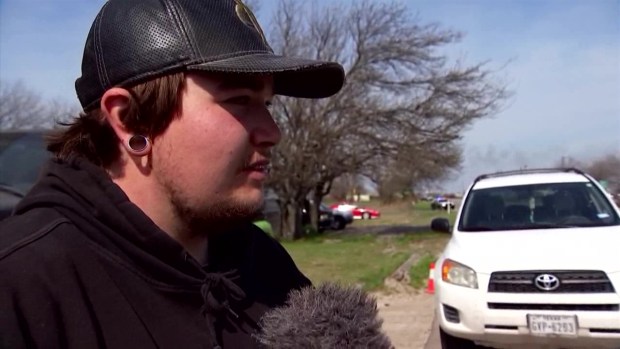
Austin Mitchell, whose 27-year-old brother Dillon is missing after the blast, spoke with NBC 5 Thursday and said his family was fearing the worst.(Published Thursday, March 15, 2018)
Cresson Plant Catches Fire, Explodes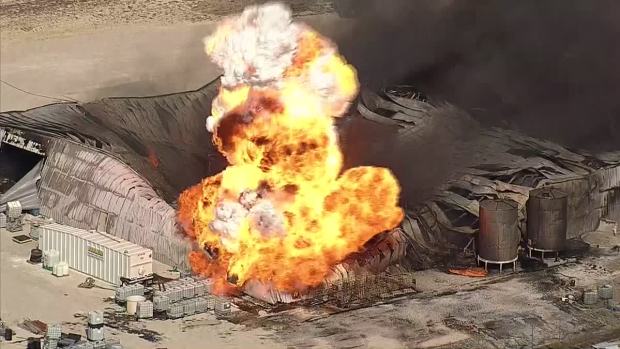
One person is missing and two people have been injured in an explosion and large fire at a chemical plant in Cresson, southwest of Fort Worth, Thursday morning, authorities say.(Published Thursday, March 15, 2018)
Two other people working at the facility were injured in the fire, including one person who was critically burned on his trunk and hands and flown about 50 miles to Parkland Memorial Hospital in Dallas. A second injured person, whose injuries were not as serious, was taken to Lake Granbury Medical Center.
NBC 5 has learned about 12 people work at the Cresson facility, which opened about a year ago. There were no other injuries reported and it's not immediately clear how many people were working at the facility Thursday.
First responders, including a number of volunteer fire departments from multiple jurisdictions, including a hazmat crew from the Fort Worth Fire Department, were called to the fire at about 9:45 a.m.
Witnesses reported hearing crackling followed by a pop and a "big kaboom" before "big fireballs" began shooting out of the building.
Man Missing, 2 Injured in Explosion, Fire at Cresson Chemical Plant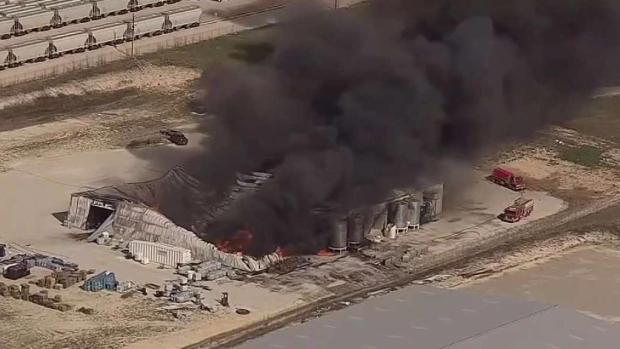
A North Texas man and his family fear the worst after an explosion destroyed the chemical plant where his brother worked Thursday morning. Fears of another blast amid the toxic chemicals prevented crews from battling the ensuing blaze, an official said.(Published Thursday, March 15, 2018)
Firefighters arrived to attack the fire but were then ordered to stand down over concerns about subsequent explosions and exposure to toxic fumes. The attack plan was then scrapped in favor of simply allowing the fire to burn itself out.
As the fire continued to collapse the metal building, secondary explosions were seen at about 11:15 a.m. By 1 p.m., most of the roof of the building had collapsed and the fire had burned down to only a few active areas.
Cresson Mayor/Fire Chief Bob Cornett told the Associated Press that investigators believe the fire could have started by a worker dragging his foot along the floor while chemicals were being mixed. In conversations with NBC 5, Cornett clarified the statement to say that while static electricity may have been the cause of the fire, they won't know exactly what sparked the fire and explosion until they've had time to investigate the scene after the fire is out. Cornett added that people working in the plant have special shoes designed to reduce or eliminate static discharge and that theory may not be valid.
Cornett said the earliest rescuers could begin searching for Dylan Mitchell was Friday morning, after the fire had extinguished itself and heavy excavation equipment could be brought to the site.
Woman Says Son-in-Law Burned on Back, Hands in Plant Explosion
Jessica Gregg says her son-in-law was burned on his back and legs in an explosion at the chemical plant where he worked. She said he started at the plant just three weeks ago and that they didn't realize how dangerous the job could be.(Published Thursday, March 15, 2018)
Jessica Gregg identified the man flown to Parkland as Jason Speegle, her son-in-law, and said he started working at the facility only three weeks ago.
"We were told that this was a hazardous job when he started, but we didn’t understand that it was something that could lead to this," said Gregg, through tears. "My daughter is very upset. We just need prayers. Everybody needs to be praying for them."
Kale Nicodemus, who was standing near the plant when the first explosion erupted, described hearing a noise followed by several "big fireballs" that kept shooting out of the plant.
"Things were blowing out of the roof, like metal lids on buckets. Then, the fire," said Jesse Bailey, who was working next door. "It smells like sulfur."
Witnesses to the chemical plant explosion in Cresson, Texas, March 15, 2018, said they heard crackles and pops followed by a louder boom before big fireballs started erupting from the building.
With winds from the south to the north, smoke from the fire blew toward DFW, including Fort Worth and Weatherford. The Environmental Protection Agency and other authorities are monitoring air emissions.
The Texas Center on Environmental Quality said they are assisting first responders and coordinating with Hood County, EPA responders, and Fort Worth hazmat for response actions needed to address any discharges from the site and air monitoring. The TCEQ said they'll also monitor cleanup efforts. Additionally, the State Fire Marshal's Office has been asked to investigate the cause of the fire.
The chemical plant and a nearby lumber yard were evacuated; no other evacuations reported.
Tri-Chem Industries offers commercial chemical blending services for customers in Texas, Louisiana and the Gulf Coast region, according to its website. Cornett told The Associated Press that Tri-Chem Industries mixes chemicals that are primarily used by the oil and gas industry to drill disposal wells. He said he doesn't know how many of the chemicals stored at the plant were hazardous, but that "what was burnt and exploded was quite toxic."
A spokesman for the TCEQ, the state agency responsible for coordinating the cleanup, declined to produce a list of the plant's on-site chemicals, telling an AP reporter to file a public information request. In recent years, Texas leaders have made it increasingly difficult for the public to find out about the chemicals manufactured and stored at such plants.
After a fertilizer plant explosion in the city of West, Texas, killed 15 people in 2013, Greg Abbott, who was then attorney general and is now governor, ruled that state agencies could withhold information about hazardous chemicals because of "ongoing terroristic activity."
AYER, Mass. -- An explosion Friday evening at an Ayer commercial building has turned fatal.
Two employees were taken to the hospital following the explosion, which occurred around 5:20 p.m. at Advanced Vacuum Systems' building on Fitchburg Road. One of those employees, a man in his 50s, died of his injuries at the hospital, the Middlesex district attorney's office said in a statement.
The condition of the second employee was not immediately available. Two mutual aid firefighters also sustained minor injuries.
The cause of the explosion is still under investigation but preliminary findings suggest it was the result of a pressure vessel malfunction, according to the state fire marshal. Advanced Vaccum Systems makes specialty furnace equipment.
The federal Occupational Health and Safety Administration is conducting a separate investigation.
========================
AYER (CBS) – Two workers were hurt in an explosion and fire at an industrial building in Ayer Friday afternoon.
One worker was seriously injured and taken to the hospital by MedFlight. Another worker was not as severely hurt.
The explosion occurred at Advanced Vacuum Systems on Fitchburg Road, a company that makes specialty furnace equipment.

Damage from explosion at AVS in Ayer (WBZ-TV)
According to the State Fire Marshal, a preliminary investigation points to a failure of a pressure seal as the cause of the explosion.
The federal Occupational Health and Safety Administration is conducting a separate investigation.
Routine Testing of Hydrogen-sulfide Gas Monitors Critical to Safety

It is critical to routinely inspect and test low-cost gas monitors, like the one above, before using them during high-risk farm tasks. Photo courtesy of the University of Iowa.
Agriculture is one of the most dangerous occupations, both nationally and worldwide. Among its risks to workers are transportation incidents and exposures to pesticides and other dangerous chemicals.
An especially dangerous chemical is hydrogen-sulfide gas, which forms during the handling and processing of livestock manure. After several workers recently died while handling manure, interest is growing in easy-to-use, inexpensive gas monitors to warn workers when manure handling generates dangerous levels of hydrogen-sulfide gases. Many monitors are commercially available, but little information is available to help farmworkers select the right one or maintain it during long periods of use.
To address this issue, researchers in a NIOSH-funded study at the University of Iowa, in Iowa City, recently compared four commercially available monitors and published their findings in the Journal of Agricultural Safety and Health. The laboratory study simulated a year of use in a pig barn by exposing the monitors for 18 weeks to levels of hydrogen-sulfide gas comparable to those found in livestock operations.
Study findings showed that the performance of monitors that only sound an alarm decreased faster than that of monitors that both sound an alarm and display air concentrations of hydrogen-sulfide gas. Of particular concern was the failure of alarm-only monitors to sound an alarm in the presence of high gas levels, even when the monitors had not reached their expiration dates. Although the monitors that both sound alarms and display readings were more accurate in sounding alarms, their displays of gas levels were inaccurate in the presence of high levels.
These findings underscore the importance of inspecting and testing low-cost gas monitors before using them during high-risk tasks, including manure agitation, pumping, and pressure washing, according to the researchers. In addition, they advised the routine testing of all gas monitors, even in the absence of manufacturer’s recommendations, to ensure that they continue to work properly.
More information is available:
Evaluation of Low-cost Hydrogen Sulfide Monitors for Use in Livestock Production
In Livestock Production, Not All Gas Monitors are the Same
NIOSH: Agricultural Safety
NIOSH Extramural Research and Training Programs: Centers for Agricultural Safety and Health

During sand transport, a visible cloud of dust containing crystalline silica floats past this top sand-mover operator station. Photo courtesy of Barbara Alexander, NIOSH.
An improved, NIOSH-developed tool, or engineering control, can help reduce the amount of dangerous, airborne crystalline silica dust generated during sand moving for oil and gas extraction, according to research published in the Journal of Occupational and Environmental Hygiene.
During hydraulic fracturing for oil and gas extraction, workers use equipment that pumps millions of pounds of water and sand into rock formations deep underground. The purpose of this pressurized mixture is to create and maintain cracks in the rock to extract the oil and gas trapped within. The problem is that the sand usually contains crystalline silica dust, which, when inhaled, can cause severe illness, including lung cancer and the deadly lung disease silicosis. During certain tasks, such as moving and mixing sand at hydraulic-fracturing sites, airborne crystalline silica dust poses a serious risk to workers’ health.
Engineering controls are a critical part of preventing worker exposure to airborne crystalline silica dust. In fact, respirable crystalline silica standard 29 CFR 1910.1053 from the Occupational Safety and Health Administration will require hydraulic-fracturing companies to adopt engineering controls for crystalline silica dust by June 23, 2021.
NIOSH investigators who study and develop these engineering controls showed in previous research that a NIOSH-developed control effectively reduced levels of airborne crystalline silica dust released from inspection hatches on top of sand movers. Known as the NIOSH mini baghouse, it comprises four large bags made of filter material and a baseplate that clamps to the openings on top of sand movers. It is unique in that it has no moving parts, requires no power source, and can retrofit to existing sand movers.
In a study of the third generation of the mini baghouse, investigators tested it at an Arkansas sand mine during May 19–21, 2015. They collected 168 air samples at 12 locations on and near a sand mover, both with the mini baghouse installed and without it, and then measured the levels of respirable crystalline silica dust in the air samples. The measurements showed that air samples taken with the mini baghouse installed contained 98%–99% less respirable crystalline silica dust than those taken without the mini baghouse. In addition, other tests showed that the crystalline silica dust probably contained freshly fractured quartz, which is an especially dangerous type of crystalline silica dust.
Compared to earlier versions, this third-generation mini baghouse performed significantly better due to improvements, such as a larger surface area of a “slipperier” filter fabric. Now, the investigators are studying additional design improvements, including a cover to offer protection from the weather. They also are planning future trials looking at long-term use of the mini baghouse.
More information is available:
Field Evaluation of the NIOSH Mini-Baghouse Assembly Generation 3 for Control of Silica Dust on Sand Movers
Field Evaluation of a NIOSH Mini-baghouse Assembly for Control of Silica Dust on Sand Movers
NIOSH Research Rounds: Investigators Design Experimental Engineering Control for Silica Dust
NIOSH: Silica


