Indiana Fines Kansas Contractor $24.5K After Worker Dies in Fall
October 16, 2017
A contractor was fined $24,500 for safety violations after a worker died from a fall at a Richmond, Ind., factory.
The Richmond Palladium-Item reports 23-year-old Jacob Bugg died June 27 after falling about 40 feet at a Purina animal food plant. Bugg worked for Kansas-based contractor Brewer’s Restoration & Coating, which was hired to do maintenance work.

The Indiana Occupational Safety and Health Administration found five violations. The agency says the contractor failed to have a safety system in place, did not train employees properly and did not keep adequate training records.
The cause of Bugg’s fall is unknown, because it was not witnessed.
Messages left at Brewer Restoration requesting comment were not returned.
Brewer's Restoration & Coating is a privately held company in Hutchinson, KS and is a Unknown business.
Categorized under Sandblasting. Our records show it was established in 2003 and incorporated in Kansas. Current estimates show this company has an annual revenue of less than $500,000 and employs a staff of approximately 1 to 4.
=============
Kansas Roofer Dies in Fatal Fall at Eastern Indiana Plant
A coroner says a 23-year-old Kansas man died after he fell while working on a roof at an eastern Indiana animal feed plant.
June 28, 2017, at 2:21 p.m.
Kansas Roofer Dies in Fatal Fall at Eastern Indiana Plant
RICHMOND, Ind. (AP) — A coroner says a 23-year-old Kansas man died after he fell while working on a roof at an eastern Indiana animal feed plant.
Wayne County Coroner Ron Stevens says Jacob Bugg of Hutchinson, Kansas, was working with a roofing crew about 1 p.m. Tuesday when he fell about 40 feet at Richmond's Purina Mills plant.
Stevens tells the (Richmond) Palladium-Item (http://pinews.co/2siqBzs ) it's not clear what caused the fall because no one witnessed it. He says Bugg was working on a lower section of the roof than the rest of his crew.
Stevens says Bugg sustained blunt force trauma. An autopsy was scheduled for Wednesday.


Tree removal crews have
come to Calaveras County and Tuolumne County from all over the United
States, Mexico and other countries in response to the ongoing mortality
crisis that has killed more than 100 million trees in the Central Sierra
Nevada and elsewhere in California since 2010. They have also come to
remove trees burned in recent wildfires.
A tree worker died Monday morning in an accident outside a home east of Groveland.
Jason Alan Stuart, 35, was a resident of Bay Point, an East Bay community in Contra Costa County, according to staff at Terzich & Wilson Funeral Home of Sonora.
A call about the incident came in at 10:45 a.m. and the accident location was 21925 Big Creek Shaft Road, a residence, said Sgt. Andrea Benson with the Tuolumne County Sheriff’s Office.
The company is local, from Groveland, and it’s called Down to Earth Construction. Workers were doing tree work and according to the company owner, Stuart was about 80 to 100 feet up a large Ponderosa tree.
“He had on his climbing gear and for unknown reason the other workers heard him say something and looked up and saw Stuart already half the way down the tree falling,” Benson said in response to questions from The Union Democrat. “He hit the sidewalk just outside the residence.”
Stuart was unresponsive, but he had a pulse, Benson said. Fire and medic personnel transported him to Highway 120 to meet an air ambulance. But he died before being flown for treatment.
Stuart was an experienced tree worker and climber, his employer told sheriff’s personnel. Before he fell Monday he was cutting branches as he was climbing up, and he was going to cut the large tree down in sections.
An autopsy will be scheduled, Benson said. Representatives for Down to Earth Construction could not be reached for comment.
Stuart’s death was at least the third fatality involving tree workers in the Mother Lode so far this year.
Tree removal crews have come to Calaveras County and Tuolumne County from all over the United States, Mexico and other countries in response to the ongoing mortality crisis that has killed more than 100 million trees in the Central Sierra Nevada and elsewhere in California since 2010. They have also come to remove trees burned in recent wildfires.
On April 15, Jorge Garcia Moctezuma , 21, from Winlock, Washington, and Guerrero, Mexico, died when a 100-foot-tall ponderosa pine he was working to remove off Cedar Springs Road, near Twain Harte, snapped below him.
Moctezuma was an employee of Action Tree Service, LLC, a Kentucky-based contractor for Pacific Gas and Electric Co.’s emergency program to remove trees near power lines that are dead or dying due to drought and infestation.
On April 6, Christopher Hiser, 21, of Soulsbyville, died while working a project in Mountain Ranch to remove trees burned by the 2015 Butte Fire.
Hiser was employed by a subcontractor for Phillips and Jordan, the primary contractor for the Butte Fire project.
Eric Hedrick, vice president of Phillips and Jordan, released a statement in mid-April that said the company had launched an investigation into events that led to Hiser’s death in hope of preventing another accident like it.
The Division of Occupational Safety and Health under the California Department of Industrial Relations, also known as Cal-OSHA, investigates all workplace deaths in the Golden State.
Logging is consistently ranked as one of the most dangerous jobs in the nation. According to the U.S. Bureau of Labor Statistics, logging topped the list of deadliest civilian occupations at a rate of about 132 deaths for every 100,000 full-time workers in 2015. The total number of deaths that year was 67.
A news release by Cal-OSHA stated 12 tree workers died in accidents on the job between Oct. 1, 2014, and Sept. 30, 2016.


The Utah Occupational Safety and Health Division is investigating the death Tuesday night of a Rio Tinto Kennecott employee exposed to sulfur dioxide two days earlier at the company’s smelter near Magna.
Division Director Cameron Ruppe said Wednesday that compliance officers with the state agency are conducting the probe and details will not be released until an accident-site inspection is complete.
Kennecott spokesman Kyle Bennett identified the deceased worker as Albert Lozano, 64, a 12-year company veteran. Lozano’s Facebook page called him a “former blister king” at Kennecott and said he lived in Santaquin.
To honor Lozano, Bennett said the company shut down operations at all of its Utah facilities — the smelter, refinery, concentrator and the Bingham Canyon Mine — for an hour Wednesday “to talk about this, to talk about safety and to make sure our people are physically and emotionally ready to return to work. … This has really shaken us to our core.”
The smelter has remained closed since the accident, he added.
Bennett said Lozano and another employee were performing “regular work duties to remove debris from a boiler and [were] exposed to sulfur dioxide gases” about 2 a.m. Sunday. The boiler is a large structure that captures and cools hot gases generated in the smelting process, producing particulate matter that can build up.
The victims notified another employee about the exposure, Bennett said. The company’s emergency response team came and treated Lozano onsite before he was transferred to an unidentified hospital, where he died Tuesday night.
The second victim’s injuries were not considered to be life threatening, Bennett added.
“We are deeply saddened by this tragedy,” Kennecott Utah Copper Managing Director Marc Cameron said in a news release. “Our hearts go out to our colleague’s family at this difficult time. We have lost a valuable employee and dear friend, and this incident will have a lasting impact on all of us.”
He noted that counseling is being provided to company employees and that an internal investigation also has been launched.
“It’s critical for us to understand what happened,” Bennett said. “We’re an organization that prides ourselves on safety. We have to ensure we improve and that our business is safer and we continue on this ultimate journey to zero harm.”
Lozano was a member of the United Steelworkers union, which also is sending two members of its international safety committee to investigate the death, said Scott Mullins, president of union local 392.
=================
About us
Rio Tinto Kennecott
At Rio Tinto Kennecott, we mine essential elements that make modern living possible. Our products are used in cell phones, computers, CAT scans and hybrid electric cars. Nearly everything used today relies on materials we produce.
Our mine has been a fixture in the Salt Lake Valley for more than 114 years. You may be surprised to know that we are the largest private economic driver in Utah. No other private sector operation has generated more production, exports, income and employment than Kennecott. As such, we take our responsibility to be a strong community partner seriously, through strategic partnerships, foundation contributions and charitable giving.
We also believe in being stewards of the land. Wherever possible, we prevent, or otherwise minimize, mitigate or remediate any potentially harmful effects of our operations on the environment. This practice creates and sustains our business value and reputation. We set self-imposed environmental targets to drive continual improvement. Through our commitment and actions, we strive to be a leader in environmental performance by demonstrating good management of natural resources, responsibly reducing our environmental footprint and exceeding community expectations for sustainable development.
Homeowner’s and Renter’s Guide to Mold Cleanup After Disasters
Cleaning up after a flood can pose health risks. You and your family
should wait to re-enter your home until professionals tell you it is
safe, with no structural, electrical or other hazards.
Before you start cleanup activities, contact your insurance company
and take pictures of the home and your belongings. Remember – drying
your home and removing water-damaged items is your most important step
for preventing mold damage.
Is There a Problem?
Was your home flooded? If so, and you were not able to dry your home
(including furniture and other items) within 24-48 hours, you should
assume you have mold growth. You need to completely dry everything, clean up the mold, and make sure you don’t still have a moisture problem.
You may see or smell mold on clothing, drywall, furniture, cardboard
boxes, or books, but it may also be hidden under or behind items like
carpet, cushions, or walls.
Mold Basics: How Molds Can Affect Your Health
Key Messages
-
Wear personal protective equipment. Wear an N-95 respirator at a minimum, goggles, and protective gloves.
-
Use portable generators carefully, outside and away from the home, to avoid carbon monoxide poisoning and fires.
-
Ensure the mold cleanup is complete before reoccupying your home.
Exposure to mold can lead to asthma attacks, eye and skin irritation,
and allergic reactions. It can lead to severe infections in people with
weakened immune systems. Avoid contaminated buildings and contaminated
water as much as you can.
Flood water may have carried sewage or chemicals into your home. This
could expose you or your family to viruses, bacteria, disease carriers
(such as mosquitos), and parasites, as well as mold. To learn more about
cleaning and disinfection go to: www.cdc.gov/healthywater/emergency/flood/standing.html.
You can protect yourself and your family from mold exposure by following these steps.
Before You Enter Any Moldy Site:
-
Protect yourself and loved ones against hazards. People
with breathing problems like asthma or who have weakened immune systems
should stay away from moldy sites. Children should not take part in
disaster cleanup work. Check for loose power lines or gas leaks. Make
sure the electricity and gas are turned off. Look for sagging ceilings
or floors or other structural problems. Watch out for wet, muddy, or
slippery floors.
-
Protect your mouth and nose against breathing in mold:
wear at least an N-95 respirator. If you plan to spend a lot of time
removing moldy belongings or doing work like ripping out moldy drywall,
wear a half-face or full-face respirator. Basic information on using it
is in OSHA’s general respiratory protection guidance.
-
Protect your skin. Wear protective gloves (non-latex, vinyl, nitrile, or rubber). Do not touch mold or moldy items with bare hands.
-
Protect your eyes. Wear goggles that provide complete
eye protection. Choose goggles designed to keep out dust and small
particles. Safety glasses or goggles that have open vent holes will not
protect you against dust and small particles.
After You Leave a Mold Site:
-
Protect yourself and loved ones. Shower and change your
clothes. This will help you avoid carrying mold and other hazards back
to your current living quarters.
Should I Do This Myself?
This job may be too difficult or dangerous for you. It may be best to
get help from experienced and qualified professionals if you can. Hire
a mold inspection or remediation professional affiliated with or
certified by the National Environmental Health Association (NEHA), the
American Industrial Hygiene Association (AIHA), the Institute of
Inspection, Cleaning and Restoration Certification (IICRC), or American
Council for Accredited Certification (ACAC) to inspect, repair, and
restore the damaged parts of your home. Your state also may regulate
mold remediation.
Sampling for mold is not usually recommended. Understanding the
results can be difficult, and no matter what kind of mold is in your
home, you need to clean it up and fix the moisture problem.
If I Must Do This Myself, How Can I Do It Safely?
Follow these steps:
- Put on the personal protective equipment described above to protect your eyes, nose, mouth, and skin.
- Remove standing water and wet materials. Use a wet vacuum to remove
water from floors, carpets, and hard surfaces. Dry your home and
everything in it as quickly as you can – within 24 to 48 hours if you
can.
- Open all doors and windows when you are working and leave as many open as is safe when you leave.
- Open inside doors, especially closets and interior rooms, to let air
flow to all areas. Take doors off their hinges if you need to.
- Open kitchen cabinets and bathroom vanity doors; remove drawers, wipe them clean, and stack them to dry.
- Open the attic access to let air flow to the attic. Before you open the attic door, make sure nothing will fall on you.
- When electricity is safe to use, use fans and dehumidifiers to
remove moisture. Do not use fans if mold has already started to grow,
because the fans may spread the mold.
- Clean with water and a detergent. Remove all mold you can see. Dry right away.
- If you use cleaning products, do not mix cleaning products together.
DO NOT mix bleach and ammonia because it can create toxic vapors.
- Painting or caulking over mold will not prevent mold from growing.
Fix the water problem completely and clean up all the mold before you
paint or caulk.
- Throw away items that can’t be cleaned and dried. Throw away
anything that was wet with flood water and can’t be cleaned and dried
completely within 24 to 48 hours. If you have precious items that you
want to preserve, follow these guidelines from the Smithsonian
Institute: www.si.edu/mci/english/learn_more/taking_care/mnm.html.
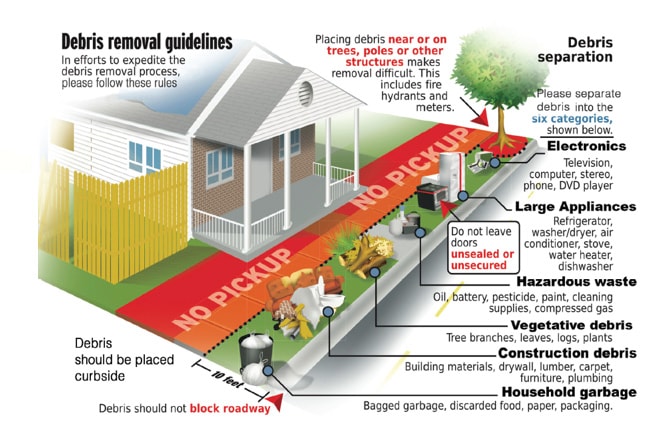
Safety Tips on Using Portable Generators
- If you use a portable generator for electricity use CAUTION to avoid carbon monoxide poisoning and fires.
- Use portable generators OUTSIDE and at least 20 feet away from buildings.
-
Do not use portable generators inside your house or garage.
-
Do not put portable generators on balconies or near doors, vents, or windows.
-
Do not use portable generators near where you or your children are sleeping.
-
Never refuel a generator while it is hot.
-
For more information, go to: www.osha.gov/OshDoc/data_Hurricane_Facts/portable_generator_safety.pdf
Am I Done?
-
If you still see or smell mold, you have more work to do. After a remediation, there should be no signs of water damage or mold growth.
-
You may need to ask a mold remediation professional to
know whether your mold problem is completely fixed. As noted in the
“Should I do this myself?” section, sampling for mold is not usually
recommended; instead, a careful inspection of the work area for
completion of the cleanup and absence of mold-related odors is usually
appropriate.
-
If you have health problems that get worse when you return home, like asthma or allergy attacks or skin or eye irritation, you may still have some mold.
JAMES CITY COUNTY, Va.
A Gloucester man has died following a construction accident in a residential construction area in the area around 4700 Fenton Mill Rd., according to a James City County Police news release.
William Joseph Jowers, 60, was sanding on the second floor of a residence around 9:30 a.m. Tuesday when he fell the floor below onto a stairwell, according to a preliminary investigation, the news release stated.
James City County Police, fire and EMS personnel responded to the scene, and Jowers was taken to Sentara Williamsburg Regional Medical Center, where he was pronounced dead.
This incident remains under investigation.
===================
JAMES CITY COUNTY, Va. (WAVY) — A 60-year-old man died Tuesday morning after falling at a construction site in James City County.
Deputy Chief Stephen Rubino with JCC police says incident happened at a new home that was under construction in the 4700 block Fenton Mill Road. Emergency responders were called to the house around 9:40 a.m.
Police say, William Joseph Jowers, a construction worker, was sanding on the second floor when he lost his balance and fell to the floor below onto a staircase.
Jowers was then taken to Sentara Williamsburg Regional Medical Center where he was pronounced dead.
Police are ruling this as an accident but it is still under investigation.
W J Jowers Construction
7050 Deer Stand Drive
Gloucester, VA 23061
W J Jowers Construction is a privately held company in Gloucester, VA and is a Single Location business.
Categorized under Home Builders. Our records show it was established in 2011 and incorporated in Virginia. Current estimates show this company has an annual revenue of 110000 and employs a staff of approximately 2.
WJ Jowers Construction in Gloucester Courthouse, VA holds a Painting And Wall Covering Ptc license (2705091712) according to the Virginia license board.