MEC&F Expert Engineers

Friday, August 4, 2017

BLAMING THE ANIMALS FOR BRUSH FIRES: Cats and squirrels commit suicide by electrocution by touching power lines, igniting brush fires in Washington State


Cats and squirrels are causing Washington fires


by: KIRO Radio Staff, MyNorthwest.com Updated: Aug 3, 2017 - 5:12 PM


Small animals like cats and squirrels are wreaking havoc in Central Washington this summer as fire crews respond to brush fires.

Two cats in Grant County have started fires, so far, this season after climbing onto electrical lines. On Aug. 2, a fire quickly spread to dry grass, and eventually to nearby outbuildings, cars and a camper.
 
“The cat apparently had crawled up the pole, got into the power lines and blew the breaker,” Grant County District 13 Fire Chief Jim Stucky said. “The cat, when it got electrocuted, of course, it started its fur on fire and it fell down onto the ground and away the grass went.”   This was a terrible way

The fire district spread word about the danger via social media this week. Grant County is about 3 hours east of Seattle, and includes the towns of Ephrata and Moses Lake. Like many Central and Eastern Washington regions, it’s experiencing a dry, summer season. The result is extremely flammable dry grass that provides fuel for wildfires and brush fires. There are currently five active wildfires in Washington state.

Animals have become a known fire hazard during this time, Stucky said, and cats are not the only culprits causing fires. He notes that birds have been problems in the past. Squirrels are also a considerable cause of fires, which also often come in contact with power lines.  Of course the poor squirrels are roasted to death by these death traps set by the reckless humans.

“Right up the road, a few miles we had another incident where a cat went up a pole,” Stucky said. “We assume it was chased up by coyotes … But that was definitely the cause.”

“Our neighboring city, Ephrata, had three squirrels in the last month start fires,” Stucky said. “We get quite a few birds and squirrels. This is the second time we had a cat do it. Usually, it’s squirrels.”


RIP the poor animals.  Millions of them have and continue to die due to human constructions and other traps, like power lines, fish nets, etc.  The wind turbines have wiped many millions of birds already.  The oceans will be devoid of fish in 50 more years.  Pretty much very soon the earth will be inundated with stupid humans blaming each other for their stupidity.

A worker died after falling down an elevator shaft in a building under construction on the University of Maryland campus in College Park, Maryland,


WASHINGTON, DC — A worker fell from a building under construction on the University of Maryland campus in College Park, Maryland, Thursday and died.

Prince George’s County Fire and EMS responded Thursday afternoon to a building under construction at the University of Maryland near the intersection of Campus Drive and Route 1, where they said the worker fell from an upper floor.

The site is off Paint Branch Drive. Police are asking people to avoid the area while they investigate.

Police have not released any additional details about the victim or what led to the fall.

University of Maryland Vice President of Administration & Finance Carlo Colella said the university’s police department and Maryland Occupational Safety and Health will investigate the incident.
“The university community is deeply saddened to learn of the death of a construction contractor working on campus today,” Collella said in a statement. “We extend our heartfelt condolences.”

==============

A construction contractor died Thursday after falling off a building under construction at the University of Maryland’s College Park campus, police said.

Francois Odil Dishmey Kelly fell while working from an upper floor of the building on the 8100 block of Paint Branch Drive, University Police said in a statement. Officers responded to the site at 1:14 p.m.

Police are investigating the death and do not suspect foul play.

"The university community is deeply saddened to learn of the death of a construction contractor working on campus today. We extend our heartfelt condolences," said Carlo Colella, Vice President of Administration and Finance at the university, in an email statement. ================

Worker Killed After Falling Down Elevator Shaft at University of Maryland College Park


A worker was killed after falling down an elevator shaft Thursday afternoon on the University of Maryland College Park campus, authorities said.

The worker fell down a shaft at a building under construction on Route 1 (Baltimore Avenue) at Campus Drive, said Mark Brady, spokesman for Prince George's County Fire & EMS.

The University of Maryland Police Department (UMPD) and Prince George's County Fire & EMS responded to the scene shortly after 1 p.m. and found the worker's body.

Police have identified him as Francois Odil Dishmey Kelly.

"We ask that you keep Mr. Dishmay Kelly's family in your thoughts and prayers during this difficult time," UMPD said in a statement.


Police do not suspect foul play in Kelly's death.

"The university community is deeply saddened to learn of the death of a construction contractor working on campus today," Carlo Colella, vice president of administration and finance, said in a statement. UMPD and Maryland Occupational Safety and Health will investigate, Colella said

A lightning bolt struck a Sun Country airplane before traveling and electrocuting Austin Dunn, a 21-year-old airport ground worker at Southwest Florida International Airport in Florida as he was hidding under the plane!


Lightning Bolt Sends Florida Airport Ground Worker to Hospital

by Ariana Brockington


A lightning bolt struck an airplane before traveling through an airport worker's body and electrocuting him.

Austin Dunn, a 21-year-old airport ground worker, was standing next to a Sun Country plane on July 22 when lightning began to strike the tarmac at Southwest Florida International Airport, video obtained by NBC2 shows.

In the video, the bolt hits the plane and then immediately electrocutes Dunn, causing him to fall to the ground. NBC2 reports Dunn has third-degree burns all over his body and spent two weeks in the hospital recovering.

Three workers were on the tarmac during the lightning storm. One man was directing the front of the aircraft and the second was operating a vehicle to move the plane onto the runway. Dunn had been working near the plane’s wing for about a minute. After the incident, his co-workers quickly tried to find someone to help.

When his family heard about the accident, they prayed for a miracle.

Autumn Dunn told NBC2 her brother had a traumatizing experience. She said she was driving when her father informed her Austin had been electrocuted. “He's my best friend,” she said as she started to cry.

“We knew he wouldn't give up,” she said. “Once we knew he was alive…It was a relief but it was definitely the scariest thing, you don't expect it ... you don't expect it.” Southwest Florida International Airport officials said lightning warning system systems were activated when Dunn was struck.


Florida has the highest number of deaths by lightning strikes.  So, always beware of these lightning storms.   This worker did the very worst thing he could do and sought shelter in a massive metal object that actually atracts lightning!  That was a no-no.


Florida ranks number one in the number of deaths due to lightning, 94% of which occur between late May and end of September.  An average of 100 people are killed in the U.S. each year (10-13 in Florida) and almost 600 injured (30 in Florida).  Lightning kills more people in the U.S. than hurricanes and tornados combined.
====================


SINCLAIR BROADCAST GROUP) -- Surveillance video captured at Southwest Florida International Airport in Fort Meyer contains chilling footage of the moment lightning struck a plane, and electrocuted an airport worker walking on the tarmac.

The victim, Austin Dunn, was hospitalized for almost two weeks following the incident.


"My dad called and he said, your brother was electrocuted, and he's at Lee Memorial, and all I asked was, 'is he alive?'" sister Autumn Dunn said.


"It was definitely the most scariest thing," Dunn said. "You don't expect it."


In the video, three workers can be seen helping a Sun Country plane back up for take off.

Austin Dunn, dressed in orange, goes to duck under the plane.

At that exact moment, lightning struck the plane's tail, travels through the body and ignites Dunn's body in an orange flash.

Dunn collapses immediately; his coworkers are seen frantically signaling for help. Southwest Florida International Airport officials said lightning warning system systems were activated when Dunn, 21, was struck. 


================


FORT MYERS, Fla. - A worker at Southwest Florida International Airport was hospitalized last month after an airplane was struck by lightning while taxiing away from a gate.

Local 10 News on Wednesday obtained cellphone video showing the moment that the lightning struck the Sun Country Airlines plane and shocked Austin Dunn.


Dunn, 21, was recently released from a Fort Myers hospital, nearly two weeks after the July 22 lightning strike.

"Once we knew he was alive, it was a relief," sister Autumn Dunn told Fort Myers ABC affiliate WZVN.

The lightning bolt struck the plane's tail, traveled through the fuselage and into Austin Dunn's body, WZVN reported. The video shows him fall to the ground immediately after the lightning struck the plane.

Officials said the airport's lightning-warning system was activated at the time. A view of the tarmac from a wider angle of the lightning strike shows that no other planes were in operation at the time.

The company that employs Dunn and is subcontracted by the airport did not reply to requests from WZVN for comment.

Sun Country has not replied to an email seeking comment.


The earth experiences about 44,000 thunderstorms every day, with approximately 1,800 storms in action at any given moment.  The most active area in the world is Java, an island of Indonesia, with an average of 223 storm days per year.
Florida is known as the lightning capital of the United States, with storms occurring approximately 100 days out of the year, compared to California's low of only 5.  Although our entire state rates as a high risk area, the most dangerous area runs from St. Augustine (north) to Lake Okeechobee (south) and from east to west coasts.  That puts our Tampa Bay area right in the middle of the danger zone.  Daily summertime showers are a fact of life in Florida but should not be taken for granted.  Florida ranks number one in the number of deaths due to lightning, 94% of which occur between late May and end of September.  An average of 100 people are killed in the U.S. each year (10-13 in Florida) and almost 600 injured (30 in Florida).  Lightning kills more people in the U.S. than hurricanes and tornados combined.
Top
WHY FLORIDA?  Partially due to its high heat levels, high humidity, and location between the Gulf and Atlantic oceans;  rain clouds plus high heat equals thunderstorms and lightning!
As Ben Franklin first proved in 1760 with just a kite, string, and a key:  lightning is electricity.  There are three basic kinds of lightning:  1) cloud-to-cloud;  2) cloud-to-ground; and 3) intra-cloud.  Charged particles gather in the lower part of the clouds and are attracted to charged particles on the ground.  If the earth's particles are positively charged and the cloud's are negative, the static electricity causes a spark to jump from the cloud to the ground.  If the opposite occurs, a positive spark spikes up to meet the negative cloud (usually seen at the front edge of the storm).  Either way, when these sparks collide, a sort of short circuit occurs and causes the bright flash we know as lightning.  In the latter example, the strike is three times hotter and many times starts a fire.  Lightning travels at the speed of light (186,000 miles per second).  This quick blast of energy only lasts just a few millionths of a second, up to 100 million volts, and reaches a peak temperature of 60,000 degrees Fahrenheit.  As a result, the air around it is super-heated and causes shock waves that crash together producing loud booms we know as thunder.  Thunder travels at the speed of sound (1,090 feet per second)  Therefore, it takes about five seconds to travel a mile.  A single bolt of lightning can discharge about 100 million bolts of electricity and can travel as far a 10 miles from a cloud.
"Divide by 5" rule:  You can determine the distance between yourself and a thunderstorm by counting the time, in seconds, between the lightning flash and the thunder, and dividing by 5; i.e., if thunder is heard 10 seconds after the flash, the storm is about two miles away.  Play it safe...if you can hear thunder, generally, you are within striking range?
When viewed from a safe distance, a thunderstorm is one of nature's most awesome and beautiful displays.  When you get caught by surprise and are forced to watch it "close up and personal," it can be a very frightening and even deadly experience! Top
In a study by the Lightning Protection Institute (LPI), it shows that more lightning casualties occur at home.  Out of 1,000 incidents, most occurred (in descending order): 1.  on the telephone
2.  in the kitchen
3.  doing laundry
4.  watching television
5.  at a door or open window
In another three-year study by LPI, damages to unprotected houses were examined.  Results showed the following strike points, in descending order of frequency: 1.  roof and projections
2.  television antenna
3.  overhead power line
4.  adjacent tree
The Lightning Protection Institute recommends the following protection standards:
  1. Lightning rods - a maximum of 20 feet apart on high points of the roof and projections
  2. Main conductors - of heavy copper or aluminum cable, interconnecting rods and grounds
  3. Bonds to metal bodies - to prevent sideflash
  4. Lightning arresters - to protect wiring and appliances from surges following powerlines
  5. Tree protection - for any tree taller than the house and within 10 feet
  6. Grounds - a least two half-inch diameter copper-clad rods sunk ten feet deep in clay soil and special grounding in sand, gravel, or rocky soil
  7. Top
Lightning is hard on trees.  Thousands of trees are struck by lightning each day.  Trees are usually the tallest objects in the landscape.  Their deep roots make them nature's natural lightning rods, able to easily pass electric current from the air down into the ground.
Taller trees are more likely to be hit, not only because of their height but also because they are more likely to suffer root or stem decay.  As a result, the plant tissue is wetter and makes a better conductor.  Lightning is nature's way of eliminating old, sick trees.  Lightning damage may be minor or severe.  Often, damaged trees become victims of further damage from insects, diseases, or wind.
  • Lightning is five times hotter than the sun's surface.
  • Lightning hits each square mile in Central Florida 40 times a year.
  • There can be as many as 500 cloud-to-cloud strikes within a 45-minute storm.
  • The average flash could light a 100-watt light bulb for more than 3 months.
    Top
  • Myth - Lightning never strikes in the same place twice. Fact - The Empire State Building is struck about 23 times in an average year.
    Myth - In medieval times church bells were rung during thunderstorms, because people thought the sound waves from the bells would suppress the lightning. Fact - This belief was discarded when one historian noted that in a 33-year period, 386 church towers were struck and 103 bellringers killed.
    Myth - Lightning follows the most direct path to the ground. Fact - It has been known to travel through clear air and strike 10 miles from the storm like a "bolt from the blue!"
    Myth - Rubber-soled shoes protect you from a lightning shock. Fact - It is unreasonable and suicidal to think that something so powerful as lightning can be stopped by a half-inch of rubber.
    Myth - Rubber tires on a car protect you from the strike. Fact - Actually, it's not the tires.  The metal body conducts the current around you, to the ground, providing windows are rolled up and you are not touching the metal.   Not the case if it's a convertible, utility, or 4x4 vehicle with a fiberglass roof!

    SULFUR IN THE AIR: Nearly three dozen rail cars carrying gas and sulfur on a CSX Corp freight train skidded off the tracks and burst into flames in Hyndman, Pennsylvania, entire town evacuated


    HYNDMAN, Pa. —

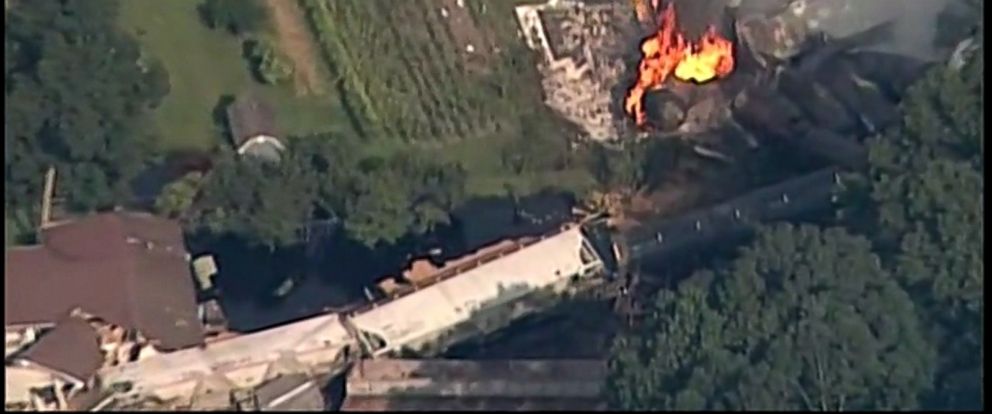
    Nearly three dozen cars of a freight train carrying hazardous materials careened off the tracks in a small Pennsylvania town Wednesday, igniting fires in some rail cars and a garage and forcing emergency officials to evacuate the whole town.

    No injuries were reported.

    At least 32 cars on the CSX freight train derailed about 5 a.m. in Hyndman, about 100 miles (161 kilometers) southeast of Pittsburgh, said CSX spokesman Rob Doolittle. The train was traveling from Chicago to Selkirk, New York.

    At least one car containing liquid petroleum gas, and one containing molten sulfur leaked and caught fire, Doolittle said. A residential garage struck during the derailment also caught fire, officials said.

    It was not immediately known what caused the train to run off the rails, and the fire continued to burn hours after the derailment.

    The only confirmed structure fire was at the garage, but video from the scene seems to show more extensive damage.

    Aerial footage of the derailment shows a number of cars stacked nearly perpendicular to the tracks while others landed in a burning, zig-zag pattern in a residential area where some structures seemed crushed and other ablaze.

    Hyndman resident Jim Shaffer told the (Cumberland) Times-News he was awakened by the sound of crashing rail cars.

    "It woke me up. It was louder than a thunderstorm," he said. "I heard the cars banging into each other. Then I heard the fire whistle."

    Bedford County 911 coordinator Harry Corley said officials ordered everyone within a 1-mile radius of the derailment to leave hours after the derailment. The order encompasses the entire town of Hyndman, and residents have been directed to a local church for help with lodging and food.

    Democratic Gov. Tom Wolf, in a phone interview from the evacuation center several miles away from the train, said some neighbors have refused to leave their homes.

    "But everyone knows where they are and they're safe at this point," Wolf said Wednesday afternoon.

    Only a few people were in the church, as most evacuees chose to go to hotels or the homes of friends or relatives, he said.

    Wolf said officials were conducting air and ground studies to determine possible health effects.

    He said area residents have "a lot of uncertainty and everyone's hoping for the best, praying for the best."

    Asked about the risk of a propane explosion, Wolf said, "There's always that possibility. I think, from what I hear, the potential of that happening has diminished somewhat."

    A number of roads are closed, and some flight restrictions are in place.

    Federal investigators arrived at the scene late Wednesday afternoon but weren't able to assess the situation because the fires were still burning.

    The National Transportation Safety Board spokesman Terry Williams said he expects them to get a better sense of the scene by Thursday.

    Amtrak suspended train service between Pittsburgh and Washington, D.C., providing buses to take passengers between the two stations.

    "CSX apologizes for the impact that this incident is having on the residents of Hyndman," Doolittle said.

    Hyndman is a town of just over 800 residents near the Maryland border.

    "CSX's top priority is to work cooperatively with first responders and other officials to protect the public's safety, and CSX personnel are on the scene assisting first responders, providing information about the contents of the train and expertise on responding to railroad incidents," Doolittle said.

    =======================

    Hyndman, Pa. (Reuters) - Rail cars carrying gas and sulfur on a CSX Corp freight train skidded off the tracks and burst into flames on Wednesday in a small Pennsylvania town, forcing hundreds of residents to flee their homes as firefighters fought the blaze.

    No injuries were reported after the crash in Hyndman, about 100 miles southeast of Pittsburgh. CSX warned customers service disruptions would last for a week over a nearly 80-mile stretch between Connellsville, Pennsylvania, and Cumberland, Maryland.

    CSX said 32 cars derailed as the train moved through the town just before 5 a.m. There was no word on what caused the crash.

    A freight car skidded into a garage that caught fire, and at least two train cars were still ablaze almost 12 hours later, said Bedford County emergency dispatcher Mike Steele.

    CSX said one rail car containing liquefied petroleum gas and one car containing molten sulfur leaked and were on fire.

    Authorities ordered the evacuation of residents in a one-mile radius, which encompasses most of the town, as emergency crews worried about the risk of an explosion, Steele said.

    Among the residents driving out of town was 53-year-old Shannon Shoemaker, who said his whole family lives within 100 yards of the derailment site.

    "They all got out safely, thank God for that," Shoemaker said.

    This was the third derailment for a CSX train since last November. It came two days after CSX Corp CEO Hunter Harrison apologized to customers for service disruptions and said some railroad employees were resisting planned cost-cutting measures.

    The train of five locomotives and 178 rail cars was traveling from Chicago to Selkirk, New York, CSX said. It said 128 cars carried mixed freight, including construction materials, paper and wood pulp.
    Friends and Hyndman residents, Robin Stair, 42 (R), Shannon Shoemaker, 53, and Stair’s dog Boe wait for a friend in a church parking lot several miles outside of an area where a CSX Corp freight train carrying flammable materials derailed as it moved through Hyndman, Pennsylvania, U.S., August 2, 2017.Maranie Staab

    John Risch, spokesman for the transportation division of the SMART Union, which represents CSX conductors, said it is incredibly difficult for a small crew to handle a train with 178 cars.

    "It's hard to keep track of where the train is, especially as it snakes behind you for more than two miles," Risch said by phone. "I am not suggesting the length of the train caused the accident but it could have been a contributing factor."

    On Monday, Harrison, the CSX chief executive officer, told customers in a memo that some employees were resisting aggressive cost-cutting measures at the No. 3 U.S. railroad.

    Authorities closed roads and issued temporary restrictions on low-flying aircraft, Pennsylvania Governor Tom Wolf's office said, adding that Wolf was on scene in Hyndman. No public water supplies or waterways were affected, his office said.

    The governor's office said about 1,000 people had to leave their homes. An emergency shelter was assembled at a local school, staffed by aid workers from the American Red Cross and the Salvation Army, authorities said.

    CSX said company hazardous substance experts were working with firefighters at the scene to contain leaks and minimize environmental damage.

    Investigators with the National Transportation Safety Board and the Federal Railroad Administration were in Hyndman, the agencies said.

    In March, a CSX freight train containing sulfuric acid and other dangerous materials partially derailed near Newburgh, New York, though the dangerous substances did not leak. Last November, two CSX trains collided and derailed in central Florida, injuring two crew members.

    The probes into those incidents were still under way, said Federal Railroad Administration spokesman Warren Flatau.

    After the New York incident, the Times Herald-Record newspaper cited officials and witnesses as saying the train derailed after striking a forklift being driven across the tracks.

    The 82-story Marina Torch building in Dubai has caught a massive fire in the United Arab Emirates


    DUBAI, United Arab Emirates (KTRK) -- Another high rise residential building has caught fire - this time in Dubai.

    The blaze is currently burning at the 82-story Marina Torch building, where it is currently Friday in the early morning hours.


    The 82-story Marina Torch building in Dubai has caught fire. (Ilsam Park/Facebook)
    One resident told ABC News that she thinks the fire broke out around the 65th floor and spread down. She said she has seen several people get out, but is not sure if there are still people trapped inside.

    The Marina Torch is the fifth tallest residential building in the world. It was completed in 2011. The waterfront tower consists of six retail spaces and 676 residential apartments.

    There was also a fire at the building in 2015.

    In June, at least 79 people were killed in a high rise fire in London. Last month, three people were killed when a fire broke out in a residential high rise building in Honolulu.


    ================


    Firefighters battled a blaze early Friday at the 84-story Torch tower near Dubai Marina in the United Arab Emirates, the Dubai Media Office said.

    Just after 3:30 a.m. Dubai Civil Defense said the fire was out after burning for about two hours. Officials said the building was being cooled.

    There were no immediate reports of injuries, the Dubai Media Office tweeted.

    Video posted to social media showed a line of fire up one side of the building and falling, flaming debris.


    Witness Samer Fathallah told CNN he thought the fire had engulfed 30 to 40 residences. Two cars in the parking deck were set on fire by falling debris, he said.

    Firefighters fought the fire from inside the building, and the crowd gathered 500 meters away could see water shooting out of the affected units.

    A video posted to Instagram from a building across the street from the Torch shows fire trucks arriving and debris covering the street. The flames in the video appear to shoot out of parts of the buildings on the middle floors.


    Tragedy strikes again


    The Torch was the site of a massive fire in February 2015.

    The fire engulfed several floors on at least three sides of the iconic building. There were no deaths or injuries, and the fire was extinguished three hours after it began, the Civil Defense Office said.

    The fire broke out in the early hours of the morning, when many people were out and enjoying the nightlife in unseasonably warm temperatures.

    Hundreds of people, many of whom were evacuated residents, were in the street while crews worked on the scene.

    The cause of the 2015 fire is unknown.

    The Torch was the world’s tallest residential tower when it was completed in 2011, according to the building’s developer, Select Group. It contains 682 residential units with 24-hour security and concierge, and six retail spaces. It has 84 floors, the developer’s website says.