MEC&F Expert Engineers

Wednesday, August 12, 2015

Hash Oil Labs and Associated Explosions/Fires on the Rise


BUTANE GAS EXPLOSION DURING THE PRODUCTION OF HASH OIL INJURES VAIL VALLEY, COLORADO MAN

APRIL 30, 2015


(Photo: Rocky Mountain HDIA)

EAGLE-VAIL, COLORADO

Colorado’s marijuana industry has taken off with a bang — literally.

An Eagle-Vail man said a malfunctioning valve in his legal hash oil cooking system caused an explosion Wednesday afternoon.

About two hours after the explosion, Ryne Wilhelmi, 24, called the Vail Daily from the local hospital to tell his side of the story.

Wilhelmi said he was outside on the back porch of his Eagle-Vail townhome when a valve failed on his closed-loop hash oil system. They’re designed to keep highly flammable butane gas from escaping.

“The valve popped, and I jumped back,” Wilhelmi said. “When I did, the static electricity in my sweatshirt ignited it.”

Wilhelmi said he was running a state-approved closed-loop system, legal in Colorado.

“It’s legal as long as you’re running a closed-loop system,” Wilhelmi said.

It’s prohibited, Sheriff says

The closed-loop system is prohibited in residential areas, the Eagle County Sheriff’s Office said in a statement.

“If you’re in a residential area, you’re endangering everyone around you, and yourself,” said Jessie Mosher, public information officer with the Sheriff’s Office.

Wilhelmi will be charged with reckless endangerment, a Class 3 misdemeanor; criminal mischief, a Class 6 felony; first degree arson, a Class 3 felony; and offenses relating to marijuana and marijuana concentrate, a Class 3 felony.

Wilhelmi was wearing shorts and a T-shirt when the explosion occurred. He said he has burns on his arms and legs.

“This is a legitimate part failure,” Wilhelmi said. “I’m all about safety and keeping (stuff) safe when it does go wrong.”

Wilhelmi said he moved quickly to ensure his neighbors’ safety.

“When the flames went up, I made everything as safe as I could,” he said. “I just went into safety mode as quickly as I could.”

“It was a very minor catch, and I did everything I could to make it safe,” he said.

When deputies with the Eagle County Sheriff’s Office arrived on scene, they suspected Wilhelmi of making butane hash oil, which caused the explosion. Butane hash oil is a highly concentrated form of marijuana. It is made with butane gas and marijuana in a pressurized metal tube.

But without proper ventilation, butane fumes can linger. All it takes is a spark of static electricity to ignite a room, local firefighters said.

Big boom

The back of Dustin Tombari’s townhome backs up to a 30-foot-wide strip of land and trees between Wilhelmi’s townhome complex and his.

Tombari said the explosion was so loud he thought it was in his own home.

Wilhelmi dragged the burner across that open space and dropped it into green grass and mud, telling Tombari he was trying to make it “safer.”

“When he dropped it, he opened a valve and a bunch of white stuff came out,” Tombari said.

Alante Shelby, 24, moved to the area from Michigan three weeks ago and lives in the townhome next to Wilhelmi.

The cooker exploded at 12:37 p.m. Wednesday, Shelby said.

“I was downstairs sleeping when I heard a boom,” Shelby said. “It sounded like a sonic boom. I looked out and saw a bunch of smoke.”

He saw a red push broom was on fire just off the porch, right under a pine tree and in a pile of wet needles.

“It’s dangerous,” Shelby said. “He was badly burned.”

Not a makeshift cooker

Wilhelm pointed out that his was not one of the makeshift hash oil operations that cause so many explosions, such as the one last year in Avon’s Liftview Apartments that blew an 8-foot hole in the kitchen drywall.

“When they use butane, the gases gather and the danger of explosions is much higher,” Wilhelmi said.

Even with a system like his, Wilhelmi said it’s not accident proof.

“Accidents happen, even with closed-loop systems that are well maintained,” he said.

Wilhelmi had not been charged with anything by mid afternoon Wednesday. The Eagle County Sheriff’s Office said Wednesday that Wilhelmi will be charged with something, but they are still investigating the case and have not yet determined the charges.

He said he was doing nothing illegal and was “totally compliant” with the deputies and firefighters.

As the scene was secured by Eagle County sheriff’s deputies and firefighters from the Eagle River Fire Protection District, an exhaust fan was blowing out from a downstairs bedroom with a Bob Marley flag hanging from the window. The smell of marijuana wafted out of the townhome from that bedroom door.

Second hash oil explosion in a year

Wednesday’s hash oil explosion in Eagle-Vail is the second in a year in Eagle County.

Joshua Rosenbaum, 22, was using one of those makeshift cookers when he blew an 8-foot hole in the kitchen drywall of his Liftview apartment in Avon. Rosenbaum was trying to produce hash oil, but instead produced an explosion when butane gas ignited.

Rosenbaum was home alone and no one was injured.

It’s a felony in Eagle County

Some prosecutors are charging hash cookers with felonies, while others say hash oil production is protected under a provision of Colorado’s legal pot law.

In Eagle County, District Attorney Bruce Brown says it’s a felony. He charged Rosenbaum with arson, a felony, to which Rosenbaum eventually pleaded guilty.

Rosenbaum received a deferred four-year prison sentence, which means that if he can stay out of trouble for four years, apologizes to everyone in the neighborhood, speaks to schools and youth organizations, does useful community service and keeps a full-time job, he won’t go to prison.

In addition to Wednesday’s Eagle-Vail explosion, similar explosions have hit Leadville, Frisco and Avon, said the District Attorney’s Office.

“As Coloradans, we should be setting an example for other states. Leave the hash oil distilling to the professionals,” Brown said when Rosenbaum was arrested and charged.

Hash oil blows up

Hash oil is typically made by packing the castoff leaves and stems of pot plants into a pipe and pouring highly flammable butane through it. The concoction is heated to make the potent oil. It’s far less expensive than buying it in stores.

The golden-colored mixture can be up to 80 percent THC, marijuana’s intoxicating chemical. Devotees say one or two drops can produce a more euphoric high than an entire joint. It can also be infused into baked goods or vaporized.

Source: http://www.vaildaily.com


//----------------///

Hash Oil Labs on Rise in Utah

Aug. 11--NORTH SALT LAKE, UTAH -- 

A 24-year-old man is accused of extracting and manufacturing butane hash oil from marijuana in his North Salt Lake home.

Davis County Sheriff's deputies were serving a warrant in North Salt Lake to arrest Randy Travis Chapman on Aug. 4, according to a probable cause statement of arrest filed with Davis County Jail.

The officer found Chapman at his home in the area of 600 N. Excalibur St., North Salt Lake.

Other than finding Chapman, officers also found containers with marijuana, a large water bong and cash in the living room, according to the document.

Officers got a search warrant and found more items, which included firearms, more containers of marijuana, plastic bags and a "black pocket book containing pay and owe records."

One room was also set up as a "clandestine lab to extract and manufacture Butane Hash Oil," according to the document. Officers confiscated a butane torch, multiple metal cans of butane gas, two different sized glass extraction tubes, coffee filters, and other items.

Extracting oil from marijuana by using butane lighters is apparently a growing trend in Utah, according to Deputy Davis County Attorney Rick Westmoreland.
The finished product is also known as BHO, dabs, crumble, shatter and hash oil, officials said. The oil is a concentrated form of tetrahydrocannabinol (TCH) -- the psychoactive ingredient in marijuana that produces the "high" users want.

That oil is different than the kind that's legal in Utah. In 2014, state lawmakers passed a bill making legal cannabidiol, an oil derived from a hemp called Alepsia and used to treat severe, debilitating epileptic conditions. It contains low levels of THC.

"In the last year, we've filed 10 to 15 cases, which doesn't sound like a lot, until you realize three years ago we had none," Westmoreland said.

Davis County Sheriff's Sgt. DeeAnn Servey said BHO "is the new cool thing to do to get high. There's not the odor of cannabis."

The concern among officials is two-fold, Westmoreland said.

The first concern is the process can cause fires and explosions. To date, there have been no reported fires in Utah caused by butane hash oil, said Doug Bitton, public information officer with Layton Fire Department.

Bitton said his department and other fire agencies across Utah receive regular reports about fires and the causes.

Surrounding states, like Colorado, have seen fires caused by people making butane hash oil, which have not only caused property damage, but also seriously injured those making the oil.

Servey said the fires are caused because the person extracting the THC oil from the marijuana has to use a butane lighter which is flammable.

The second issue that concerns officials is the quality of the finished product, Westmoreland said.

"People who make it don't know the potency," he said. "They are trying for a high potency of THC by extracting the oil to get a high, but they could end up killing themselves because of the high potency."

Chapman was booked in the Davis County Jail on one count of operating a clandestine laboratory, one count of possession of a controlled substance with the intent to distribute, two counts of possession of a controlled substance, one count of possession of a firearm by a restricted person and one count of possession of drug paraphernalia. He is being held in the Davis County Jail in lieu of a $100,000 bail.

The Davis County Attorney's Office is reviewing the case before filing formal charges.

Enbridge shut its Line 55 Spearhead pipeline and adjacent Line 59 Flanagan South pipeline, following a crude oil release in waterway along Line 55 in Shelby County, Missouri

Enbridge shut its Line 55 Spearhead pipeline and adjacent Line 59 Flanagan South pipeline, following a crude oil release along Line 55 in Shelby County, Missouri, near Shelbina on Tuesday. 
 
About 16 to 20 gallons of crude spilled, based on initial estimates, into a nearby waterway that had minimal flow and the environmental impact is being determined, the company said, adding that no injuries have been reported due to the incident.

Energy industry intelligence company Genscape earlier reported the shutdown of flow on the company's Flanagan South pipeline, Reuters reported.

Both the 193,300 barrel per day Spearhead pipeline and the 600,000 bpd Flanagan South pipeline carry oil from Illinois to the storage hub of Cushing, Oklahoma.

These are two of the main conduits for Canadian heavy crude to reach the Gulf Coast. The closure of the lines means crude may get bottlenecked in Alberta, a factor that could potentially push the Canadian crude differential even wider.

Western Canada Select heavy blend crude for September delivery last traded at $19.80 per barrel below the West Texas Intermediate benchmark, according to Shorcan Energy brokers. That compares with a settlement price of $19.40 per barrel below WTI on Monday.

It was not immediately clear how long the pipelines would remain shut.


//---------------------///


Enbridge Liquids Pipelines

Enbridge operates the largest, longest, and most complex petroleum pipeline system in the world. With approximately 25,420 kilometres (15,795 miles) of pipe, Enbridge delivers an average of more than 2.2-million barrels per day of crude oil and liquids. Our Mainline system is the largest conduit of oil into the United States. We transport 53 per cent of U.S.-bound Canadian production, a figure that accounts for 15 per cent of total U.S. crude oil imports.

Assets are 100% owned and operated by Enbridge and its affiliates except where less than full ownership/operatorship is indicated. Click here to learn Federal Energy Regulatory Commission (FERC) information about Enbridge’s pipelines located in the United States.

The following map outlines the Enbridge crude oil network (click here to view/download 504K JPG)

(To view commodity receipt and routing details for Enbridge's Mainline Network, please see the Enbridge Mainline Service Levels page)

Systems


Name Length & Details Location Capacity Ownership

Enbridge Pipelines (NW) Inc.

870 km
(540 miles)
Norman Wells, Northwest Territories to Zama, Alberta 50,000 bpd Enbridge Inc.
Click here to view or download a map detailing the Enbridge Pipelines (NW) Inc. system

Enbridge Regional Oil Sands System

1,265 km
(787 miles)
Fort McMurray, Alta., region to Hardisty, Alta., and Edmonton 1.1 million bpd Enbridge Inc.
Click here to view or download a map detailing the Enbridge Regional Oil Sands system

Enbridge Pipelines (Saskatchewan) Inc. (1)

2,463 km
(1,530 miles)
Southeastern Saskatchewan and Southwestern Manitoba 364,500 bpd Enbridge Income Fund
Click here to view or download a map detailing the Enbridge Pipelines (Saskatchewan) Inc. system

Enbridge System (Canadian Mainline)

2,306 km
(1,433 miles)
*Mainline Configuration & Capacities
Edmonton, Alberta to Montreal, Quebec *Line ends at Gretna, MB and starts again in Sarnia, ON 2.62 million bpd (in combination with Lakehead System) Enbridge Inc.
Click here to view or download a map detailing the western portion of Enbridge’s Canadian Mainline system Click here to view or download a map detailing the central portion of Enbridge’s Canadian Mainline system Click here to view or download a map detailing the eastern portion of Enbridge’s Canadian Mainline system

U.S. Mainline (Lakehead System)

 1,900 miles
(3,057 km)
*Mainline Configuration & Capacities
Neche, North Dakota to Chicago, Illinois *Plus extension across the Niagara River into the Buffalo, New York area 2.62 million bpd (in combination with Canadian Mainline) Enbridge Energy Partners, L.P.
Click here to view or download a map detailing the western portion of Enbridge's U.S. Mainline system Click here to view or download a map detailing the eastern portion of Enbridge's U.S. Mainline system

North Dakota Pipeline Company LLC

826 miles
(1,321 km)
Plentywood, Montana to Clearbrook, Minnesota 355,000 bpd
(210,000 bpd from Minot, N.D. to Clearbrook, Minn.; 145,000 bpd from Berthold, N.D. to Canada-U.S. border)
Enbridge Energy Partners, L.P.
Click here to view or download a map detailing the North Dakota Pipeline Company LLC system

Spearhead System

650 miles
(1,050 km)
Flanagan, Illinois to Cushing, Oklahoma 193,300 bpd Enbridge Inc.
Click here to view or download a map detailing Enbridge's Spearhead system

Seaway Crude Pipeline System

500 miles
(805 km)
Cushing, Oklahoma to Houston, Texas 400,000 bpd Enbridge Inc. (50%)†

Seaway Loop Crude Pipeline System

500 miles
(805 km)
Cushing, Oklahoma to Houston, Texas 450,000 bpd Enbridge Inc. (50%)†

Seaway to Beaumont/Port Arthur Crude Pipeline System

100 miles
(160 km)
Houston to Beaumont/Port Arthur, Texas 750,000 bpd Enbridge Inc. (50%)†

Pipelines

Name
Length
Start Point
End Point
Capacity
Ownership

Chicap Pipeline***

329 km
(205 miles)

Patoka, Illinois Chicago, Illinois 360,000 bpd Enbridge Inc. (43.8%)

Frontier Pipeline*

465 km (289 miles) Salt Lake City, Utah Casper, Wyoming 62,200 bpd Enbridge Inc. (77.8%)

Louisiana Liquids Pipeline

68 km
(42.3 miles)
Chalmette, Louisiana (St. Bernard Parish, Louisiana) Bayou Perot, Louisiana (Jefferson Parish, Louisiana) 20,000 bpd  Enbridge Energy Partners, L.P

Mustang Pipeline**

345 km (215 miles) Chicago, Illinois Patoka, Illinois 100,000 bpd Enbridge Inc. (30%)

Olympic Pipeline***

465 km (289 miles) Blaine, Washington Portland, Oregon 290,000 bpd Enbridge Inc. (85%)

Ozark Pipeline (2)

700 km (435 miles) Cushing, Oklahoma Wood River, Illinois 215,000 bpd Enbridge Energy Partners, L.P

Southern Lights Pipeline

2,556 km (1,588 miles) Manhattan, Illinois Edmonton, Alberta 180,000 bpd Enbridge Inc.

Tinsley Pipeline

61 km
(38 miles)
Tinsley, Mississippi (Yazoo County, Mississippi) Mayersville, Mississippi (Issaquena County, Mississippi) 12,400 bpd Enbridge Energy Partners, L.P

Toledo Pipeline

141 km
(88 miles)
Stockbridge, Michigan     Oregon, Ohio 100,000 bpd Enbridge Inc.
*Operated by Pacific Energy Partners L.P.
**Jointly operated by ExxonMobil
***Operated by BP
†Operated by Enterprise Products Partners L.P.

(1) Consists of the Saskatchewan Gathering, Westpur, Virden, and Weyburn Pipeline Systems
(2) Consists of the Ozark pipeline and storage terminals at Cushing, Oklahoma

Recent Pattern of Violations reforms by MSHA led to significant improvements in mine safety, culture change


Recent Pattern of Violations reforms by MSHA led to
significant improvements in mine safety, culture change


High violation rates drop, fewest mines identified in screening for chronic violators
ARLINGTON, VA

The Pattern of Violations reforms put in place by the U.S. Department of Labor's Mine Safety and Health Administration have been "real game changers" in protecting miners and promoting a culture focused on safety and health in mines across the nation, Joseph A. Main, assistant secretary of labor for mine safety and health, said today.


The reforms made by the agency in recent years have also led to significant improvements in mine operator compliance at troubled mines. "It's a law that now works," Main said.

Under the Federal Mine Safety and Health Act of 1977, MSHA can issue a POV notice to mine operators that show a disregard for workers' safety and health through a pattern of "Significant and Substantial" violations. One of the agency's toughest enforcement actions, a POV notice is reserved for mines that pose the greatest risk to miners' safety and health.

The agency conducts at least one POV review each year. MSHA recently conducted its third POV screening, under a rule revised in January 2013, which added to reforms the agency made in 2010. During the screening, MSHA found only one of the nation's approximately 13,600 mines — a coal operation — warranted further review, the fewest number of both coal and metal and nonmetal mines identified for additional scrutiny since the 2010 reforms. Upon completion of the review, no coal or metal and nonmetal mines met the criteria for further consideration of a POV notice.

MSHA has issued seven POV notices since the 2010 reforms. While enacted in 1977, no mine had been effectively placed on a POV until 2011, after assistant secretary Main directed the implementation of sweeping reforms to MSHA's POV procedures in the aftermath of the April 2010 Upper Big Branch coal mine explosion. The agency identified shortcomings and the need for reforms in the procedures.

"The POV reforms sent a message that chronic violator behavior would no longer be tolerated. That message translated into a dramatic reduction in the number of mines with chronic violation records," said Main. "We have also seen significant improvements in violation and injury rates at mines served with a POV notice." 

Since 2010, mines subject to a POV notice — or potential POV notice under the prior rule — showed improved compliance. The number of S&S violations issued at those mines declined 64 percent, the number of unwarrantable failure violations decreased 82 percent, total violations fell 39 percent, and the operator-reported rate of lost-time injuries decreased 50 percent.

Data also indicate that MSHA's actions have helped drive better compliance well beyond just the mines that met the criteria for further consideration for a POV notice. Between the 2010 and 2015 screenings, there was a 40 percent drop in S&S violations among the top 200 mines ranked by number of S&S issuances. 

Those mines also saw a 27 percent reduction in total violations and a 16 percent decrease in elevated enforcement actions, such as closure orders for imminent dangers or unwarrantable failures to comply with health and safety standards.
MSHA has developed online tools to help mine operators monitor compliance. They include:
  • A POV monitoring tool that allows mine operators to monitor each mine's performance each month under the POV screening criteria. Introduced by MSHA in April 2011, the tool puts operators on notice so that they can take corrective actions to improve Mine Act compliance.
  • The S&S rate calculator that enables mine operators to monitor their S&S violations and proactively implement a corrective action program to prevent S&S violations at their mines. The calculator complements the POV monitoring web tool. MSHA launched the calculator in August 2013.
MSHA encourages mine operators approaching further consideration for a POV notice under the screening criteria to submit Corrective Action Programs that include concrete, meaningful measures to address their S&S violations. MSHA will consider an operator's effective implementation of an MSHA-approved CAP as a mitigating circumstance that may justify postponing or not issuing a POV notice. On April 29, MSHA sent mine operators and other stakeholders a Program Information Bulletin to provide further information on submitting a CAP for MSHA approval. Currently, there are 13 active CAPs in place in coal and metal and nonmetal mines in the U.S.

"The POV reforms we have put in place provide mine operators with guidance on how to improve compliance if they start down the wrong path, and most importantly, to better protect our nation's miners from injury, illness and death," said Main. "In fact, a number of mines proactively implemented corrective action programs, which is what both Congress and our rule encouraged," he added. 

 //--------------------///

The Mine Act places the responsibility for ensuring the health and safety of miners on mine operators. Congress enacted the pattern of violations (POV) provision to provide MSHA with an additional enforcement tool when other tools had proven ineffective. Congress intended MSHA to use the POV provision to restore safe and healthful conditions at mines with a pattern of significant and substantial (S&S) violations. The legislative history states that Congress believed the existence of a pattern would signal to both the mine operator and the Secretary that ‘‘there is a need to restore the mine to effective safe and healthful conditions and that the mere abatement of violations as they are cited is insufficient.”

A mine operator that has a pattern of S&S violations at a mine will receive written notice from MSHA. For each subsequent S&S violation, MSHA will issue an order withdrawing miners from the affected area until the cited condition has been corrected. MSHA will terminate an operator’s POV notice when 1) an inspection of the entire mine is completed and no S&S violations are found or 2) no withdrawal order is issued by MSHA in accordance with Section 104(e)(1) of the Mine Act within 90 days of the issuance of the pattern notice. 

Mine operators can determine whether they may be subject to a POV notice by using MSHA’s Pattern of Violations Monitoring Tool. It is the responsibility of mine operators to track their violation and injury histories to determine whether they need to take action to avoid triggering a POV notice. Operators who are at risk of receiving a POV notice are encouraged to implement a corrective action program to reduce S&S violations. More information about corrective action programs can be found in MSHA’s Pattern of Violations Procedures Summary.

7 injured after a Sikorsky UH-60 Black Hawk U.S. Army helicopter crashes in the southern Japanese island of Okinawa


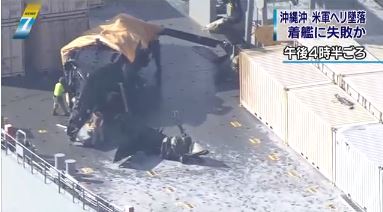
A US Army's UH-60 was crashed in the Pacific ocean, off shore of Nago city and Uruma city, Okinawa prefecture, Japan. All 17 occupants were rescued, and 7 members among them received injuries. It is reported that the accident helicopter attempted to land on a US Navy warship, but failed. The registration of the accident UH-60 is not reported, however, the figures '63' can be seen on the left side door according to the TV news videos.


TOKYO, JAPAN

A U.S. Army helicopter crashed off the southern Japanese island of Okinawa on Wednesday, injuring seven people aboard the aircraft, officials said.

The others aboard the helicopter were uninjured, said Japanese coast guard spokesman Shinya Terada. The conditions of the injured were not immediately known, he said.

U.S. Army Lt. Col. Kevin Toner said in an email that the Army was still gathering facts and that it would provide details later.

Terada said that after the crash, the damaged helicopter was sitting on a U.S. warship off the eastern coast of Okinawa, which is home to most of the U.S. troops in Japan. He said it was not immediately known whether the helicopter had crashed onto the vessel in a failed landing or if it had been plucked out of the sea after crashing there.

Japan's Defense Ministry had said earlier that the helicopter, a UH-60, crashed into the sea about 20 miles (30 kilometers) east of Kadena Air Base on Okinawa.

Japanese national broadcaster NHK showed video of the helicopter sitting on the warship, with its tail broken off and covered with an orange tarp.

The presence of thousands of U.S. troops on Okinawa — where more than half of about 50,000 American troops in Japan are concentrated — has been a source of friction. A plan formulated in 1996 between the Japanese and American governments would move Marine Corps Air Station Futenma from a populated neighborhood to a less developed area, but Okinawans worried about safety, crime and noise want the base moved off the island altogether.

Wednesday's accident coincided with Japanese Chief Cabinet Secretary Yoshihide Suga's visit to the island for talks with Okinawa Gov. Takeshi Onaga, a vocal opponent of the relocation plan.

"For those who live near (U.S.) bases, it's a serious matter," he said at the outset of the talks, reminding Suga of Okinawa's burden and risk of accommodating the U.S. military bases.


Date:12-AUG-2015
Time:13 - 14 JST
Type:Silhouette image of generic H60 model; specific model in this crash may look slightly different
Sikorsky UH-60 Black Hawk
Owner/operator:US Army
Registration:
C/n / msn:
Fatalities:Fatalities: 0 / Occupants: 17
Other fatalities:0
Airplane damage: Written off (damaged beyond repair)
Location:35km east of Kadena Air Base (DNA/RODN) -   Japan
Phase: Manoeuvring (airshow, firefighting, ag.ops.)
Nature:Military
Departure airport:
Destination airport:
Narrative:
A US Army's UH-60 was crashed in the Pacific ocean, off shore of Nago city and Uruma city, Okinawa prefecture, Japan. All 17 occupants were rescued, and 7 members among them received injuries. It is reported that the accident helicopter attempted to land on a US Navy warship, but failed. The registration of the accident UH-60 is not reported, however, the figures '63' can be seen on the left side door according to the TV news videos.
Sources: 
http://aviation-safety.net/wikibase/wiki.php?id=178552 http://www.stripes.com/news/pacific/black-hawk-copter-crashes-off-okinawa-all-aboard-rescued-1.362506
http://www3.nhk.or.jp/news/html/20150812/k10010187691000.html
http://news.tbs.co.jp/newseye/tbs_newseye2561493.html
http://headlines.yahoo.co.jp/hl?a=20150812-00050069-yom-soci
http://headlines.yahoo.co.jp/hl?a=20150812-00000039-asahi-soci
http://headlines.yahoo.co.jp/hl?a=20150812-00000070-jij-soci