MEC&F Expert Engineers

Saturday, July 11, 2015

Charleston, WV hotels sue Travelers and Charter Oak Fire Insurance over spill claim denial


Posted: Jul 09, 2015 3:23 PM EST 

By Linda Harris, Legal Reporter
 
Three South Charleston hotels that lost money because of the January 2014 chemical spill in the Elk River are suing Travelers and Charter Oak Fire Insurance for denying their claims.

The suit originally was filed in Kanawha County Circuit Court, but Travelers and Charter Oak want it moved to federal court in Charleston.

The hotels — Hospitality Ventures LLC (Hampton Inn-Southgate); Capitol Hotel Group and E&G Inc. (Holiday Inn & Suites); and Allied Hosts LLC (Wingate Inn) as well as Monarch Holdings LLC, which has an ownership stake in all three properties — said they suffered substantial damages as a result of the chemical spill, which contaminated the water supply for several hundred thousand customers in a nine-county swathe of southern West Virginia. 

The spill exposed water supply systems in the three hotels to “poisonous and toxic” chemicals, damaging water storage facilities, fixtures, pipes, toilets, drains, sinks, swimming pools and other areas, they said.

Monarch insists the damages should be covered under their insurance policy, written by Travelers and Charter Oaks in September 2013, but the claims were denied “despite multiple requests for coverage and payment of damages.”

The suit seeks a ruling that the damages and losses were covered by the policy, along with compensatory and exemplary damages to cover damages, including lost business, and clean-up costs.
Railroad Trespass Fatalities Are Increasing: Union Pacific urges veto to repealing trespass law


WISCONSIN


Union Pacific Railroad is urging Gov. Scott Walker to veto a section of the budget bill that would repeal Wisconsin’s railroad trespass law.

The change in the law comes as deaths from pedestrian trespassing is on the rise in the U.S. According to the Federal Railroad Administration Office of Safety, death from pedestrian trespassing on railroad tracks rose 21.8 percent in 2014.

The rail trespass casualty rate (deaths and injuries for every one million train miles) is 1.23, its highest level for the last decade.

“The most troubling safety problem — trespass fatalities — arises from factors outside railroad control,” said Mark Davis of Union Pacific. “While railroads have reduced employee casualty rates by 84 percent since 1980, and derailments have dropped 82 percent since 1980 to a new low, trespass fatalities are up.”

A person or vehicle is hit by a train about every three hours in the United States. In the last five years, Union Pacific has experienced eight trespasser injuries and 10 trespasser fatalities on Union Pacific property in the state of Wisconsin.

Repealing or relaxing this statute could bring unintended consequences of increasing rail trespassing incidents, and is regressive on the positive rail safety efforts taken to date, Davis said.

Trespassing on private railroad property is illegal in 39 states and the District of Columbia. Since 2009, three states adopted railroad trespass laws. Despite these laws, trespass is the leading cause of rail-related deaths in America. 

Repealing or relaxing Wisconsin’s railroad trespass law will put the safety of Wisconsin citizens at risk and is the wrong message to send, Davis said.

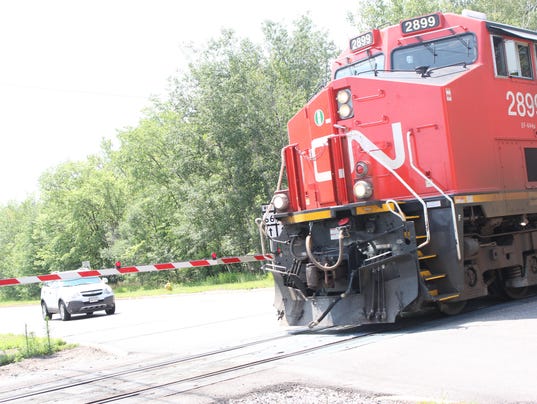
Portage County, Wisconsin judge dismissed 29 citations for train blocking crossings because he has ruled that local authorities cannot regulate it.

Portage County, Wisconsin abandons train citations

Portage County, Wisconsin judge dismissed 29 citations for blocking crossings because he has ruled that local authorities cannot regulate it.


The Portage County Sheriff's Department will no longer issue citations for trains that block road crossings for extended periods of time because a judge has ruled local authorities cannot regulate it.

Portage County Judge John Finn on June 25 dismissed 29 citations deputies wrote over the past two years to Canadian National Railroad, which successfully claimed federal law prevents local governments from interfering with interstate railroad movement.

The decision frustrates Portage County Chief Deputy Dan Kontos, who believes trains now can block any road for any period of time they choose without repercussions.

"We are basically back to square one," Kontos said. "We do not have a tool to prevent the railroad from blocking the crossings."

A similar ruling was made Wednesday by a Wood County Judge Todd Wolf, who dismissed 32 citations written by deputies for Canadian National trains accused of blocking intersections in Auburndale.


Numbers tell the tale of Kontos's frustration. The Sheriff's Office took 205 complaints and issued 25 citations for trains blocking roads in 2014 and, as of July 7, had received 154 complaints and issued 35 citations in 2015. The fine for each citation was $181.60, Kontos said.

"I know there were citations that the railroad paid because it was more of an inconvenience to fight them," he said.

But at some point, Canadian National decided to fight, and won. Other citations still pending will not be prosecuted as a result of the judge's ruling, Kontos said.

Patrick Waldron, a spokesman for Canadian National, said in a written statement that the railroad "remains sensitive to the concerns of the communities through which we operate and we continue to work to minimize the number of blocked crossings throughout Wisconsin."

The Sheriff's Office will continue to record complaints about trains blocking crossings, but will not dispatch a deputy or take any enforcement action, according to a news release.

"It's frustrating for the folks who live out there (in rural Portage County)," Kontos said. "It hurts the businesses that are affected. It inconveniences motorists and it certainly has interfered with emergency responders."

One of the residents of rural Portage County frustrated by trains blocking roads is Jim Vitort, 67, who owns a farm about a mile west of Junction City. He built a trail a mile long, through his own pasture, to get around a stopped train in case of an emergency.

"They told us if we had an emergency, they would move the train right away," Vitort said.

There have been emergencies, though, Vitort said, and the trains have either been slow to move, or haven't moved at all. It took more than three hours for a train to move when a tractor started on fire at his farm, Vitort said.

Kontos, too, said he was frustrated by the impact halted trains can have on responders in emergency situations.

"In law enforcement, we're in the business of solving problems," he said. "This is one problem we can't solve."

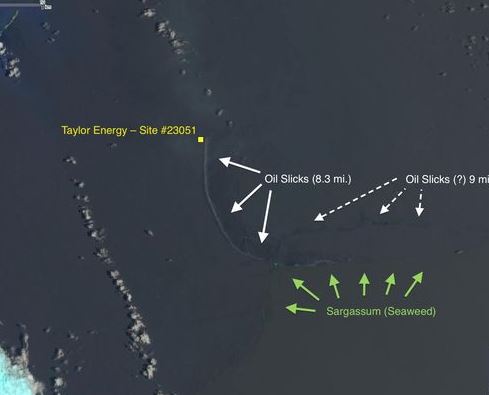
Ongoing Oil Discharge at Taylor Energy’s Mississippi Canyon 20A (MC-20A) well site resulting from damage to the oil production platform and 25 connected wells during Hurricane Ivan in 2004.


Taylor Energy U.S. Coast Guard Fact Sheet

Coast_Guard_Logo
13 May 2015
U. S. Coast Guard Fact Sheet
Taylor Energy Oil Discharge at MC-20AWell Site and Ongoing Response Efforts
The U.S. Coast Guard, as the Federal On Scene Coordinator (FOSC) under a Unified Command (UC) which includes the Bureau of Safety and Environmental Enforcement (BSEE), the Bureau of Ocean Energy Management (BOEM), and the Responsible Party, Taylor Energy, has monitored and responded to discharges from Taylor Energy’s Mississippi Canyon 20A (MC-20A) well site resulting from damage to the oil production platform and 25 connected wells during Hurricane Ivan in 2004. The multi-agency effort has worked continuously to prevent and control the discharge, improve the effectiveness of containment around the leaking oil, and mitigate environmental impacts.

Taylor Energy is the Responsible Party required to pay for oil spill recovery and response costs under the Oil Pollution Act of 1990 (OPA). As the Responsible Party, Taylor Energy has a continuing legal obligation to respond to the ongoing oil discharge from the MC-20A well site and must comply with the Coast Guard’s Administrative Orders.

The FOSC is responsible for directing and overseeing all response operations associated with the discharge of oil into the Gulf of Mexico from the Taylor Energy MC-20A well site. The Coast Guard, as the FOSC, facilitates UC meetings with Taylor Energy and federal inter-agency representatives, including BSEE and BOEM, to ensure an effective response posture is being maintained at the field level. The UC’s collaborative efforts have resulted in the removal of the platform deck, removal of subsea debris, decommissioning of the oil pipeline, and intervention of nine of the 25 impacted wells.

Unified Command Activities and Key Milestones
  • Oil that is discharging into the Gulf of Mexico from the well site is rising to the ocean surface and causing a visible oil sheen. From 2004-2008, the Coast Guard’s involvement in Taylor Energy was minimal due to no observed sheen in the vicinity of the MC-20A well site. However, in 2008, after the MC-20A site was identified as the source of daily sheen reports, a UC was established with Taylor Energy, USCG, BSEE, & BOEM to direct response efforts for the on-going releases from the Taylor Energy MC-20A well site.
  • In 2008, the Coast Guard issued Taylor Energy an Administrative Order that required Taylor Energy to, among other things, conduct daily overflights of the MC-20A well site to visually monitor the oil discharges. Taylor contracts daily overflights of the area, with support from Coast Guard pollution responders and BSEE personnel, to monitor the discharge and report findings regarding the presence and estimated volume of oil on the ocean surface to the National Response Center (NRC). In the even
  • In 2009, a subsea containment system (domes placed over projected leaking well sites) was installed on the seafloor at the MC-20A site.
  • By 2011, efforts had been taken to plug nine of the wells, with 16 wells remaining to be addressed. In addition, subsea debris, including the platform deck, was removed and the oil pipeline was decommissioned.
  • In March 2012, an incident action plan (IAP) was approved by the UC that established standard procedures for monitoring the site and responding to discharges.
  • In 2012, due to problems with the original containment system, the FOSC issued an Administrative Order requiring the design, construction, and installation of a new containment dome that will more effectively capture the on-going discharge from the site. Along with the design specs, the AO directs Taylor Energy to submit a written plan including a projected timeline for fabrication and installation. As of May 1, 2015, the final engineering design of the new dome is not complete, and the dome has not been installed.
  • In 2013, the last remaining operational containment dome was decommissioned due to damaged components and lack of efficiency/recovery of oil.
  • In August 2014, the UC led a joint aerial observation workshop that included the Coast Guard, BSEE, NOAA, and Taylor Energy’s representatives and contractors. At that workshop, the aerial observation methodology used to estimate quantity and rate of discharge was reviewed and revised. The Coast Guard and NOAA have placed observers on the Taylor Energy-contracted flights to verify the new approach is being adhered to. The Coast Guard believes that the consistency of sheen size and rate of discharge estimates from reporting parties has improved since this workshop.
  • In addition to Taylor Energy’s flights, the Coast Guard and NOAA periodically conduct their own overflights to validate sheen reporting methodology and retain independent oversight.
  • The reported extent (size, dimensions, character) of the observed oil is a result of very dynamic and highly variable environmental conditions such as sea state, wind speed, and water currents. Calculations of daily oil volume are estimates based on observations of percent cover, sheen color, and dimensions. As such, there is some natural variability in reports.
  • Based on data collected from nearly daily overflights since September 2014, oil sheens have been observed and reported by Taylor Energy to be as large as 1.5 miles wide and 14 miles long, with an average of 1 mile wide and 5.5 miles long, covering an average area of 8 square miles. Over this period, the daily volume of oil discharging from the MC-20 well site has fluctuated between a low of less than one barrel (1 barrel = 42 gallons) to a high of 55 barrels of oil (2,329 gallons). The average reported daily oil volume on the sea surface over the past seven months has been in the range of over 2 barrels (84 gallons); the volume on over 75 days was greater than 1 barrel, including 23 days of volume greater than 3.8 barrels (160 gallons) and 4 days greater than 35 barrels (1,470 gallons). These spill size and volume estimates are based on reports submitted by Taylor Energy’s contractors to the NRC. All NRC reports can be viewed at www.nrc.uscg.mil.
  • The Coast Guard, working with the UC members, is committed to exploring all options to control and contain the oil that is discharging from the well site and to ensure Taylor Energy will work to permanently stop the ongoing oil spill. The Coast Guard remains committed to Responsible Party oversight and coordination to:
    • Contain and recover as much discharge product as possible; 
    • Mitigate environmental impacts; and
    • Pursue all available response options.
     
 
/////////////////////---------------------  
 
 
Taylor Energy Oil Discharge at MC-20 Site and Ongoing Response Efforts

  • BSEE Logo 150px boem_logo

    The Department of the Interior’s Bureau of Safety and Environmental Enforcement (BSEE) and the Bureau of Ocean Energy Management (BOEM) have worked with the U.S. Coast Guard under a Unified Command to monitor and respond to discharges from Taylor Energy’s Mississippi Canyon 20 (MC-20) site since the oil production platform and 25 of 28 connected wells were impacted and damaged during Hurricane Ivan in 2004. The multi-agency effort has worked continuously to prevent and control the oil discharge, improve the effectiveness of containment around the source of the oil discharge, and mitigate environmental impacts.

    BSEE and the Coast Guard have also worked closely with representatives of Taylor Energy to mitigate the impacts of the discharge associated with the felled platform. Collaborative efforts have resulted in removal of the platform deck, removal of subsea debris, decommissioning of the oil pipeline, and efforts to plug nine of the 25 impacted wells. Despite these efforts, there is an ongoing oil discharge from Taylor Energy’s MC-20 site.

    Based on data collected from nearly daily overflights since September 2014, oil sheens have been observed and reported by Taylor Energy to be as large as 1.5 miles wide and 14 miles long, with an average of 1 mile wide and 5.5 miles long, covering an average area of 8 square miles. 

    Over this period, the daily volume of oil discharging from the MC-20 site has fluctuated between a low of less than one barrel of oil (1 barrel = 42 gallons) to a high of 55 barrels (2,329 gallons). The average reported daily oil volume on the sea surface over the past seven months has been over 2 barrels (84 gallons); the volume on over 75 days was greater than 1 barrel, including 23 days of volume greater than 3.8 barrels (160 gallons) and 4 days greater than 35 barrels (1,470 gallons). These spill size and volume estimates are based on reports submitted by Taylor Energy’s contractors to the National Response Center (NRC). All NRC reports can be viewed at www.nrc.uscg.mil.

    BSEE’s current estimate is that the oil discharge from the site, if left unchecked, could continue for 100 years or more.

    The specific source(s) of discharge at the MC-20 site are not fully known. However, because the discharge volume is greater than can reasonably be accounted for by oil released from sediment only, oil is most likely emanating from one or more of the 25 wells.

    Taylor had originally been ordered by the Minerals Management Service (MMS) in October 2007 to permanently plug and abandon all the wells by June 2008. In November 2007, MMS issued Taylor an order to provide supplemental bonding to guarantee performance of Taylor’s decommissioning obligations at the site. In December 2007, MMS ordered Taylor to prevent any 2 further hydrocarbon seepage from the MC-20 site. In February 2008, MMS sent Taylor a Notice of Incident of Noncompliance for failure to provide the required supplemental bonding.

    The Department of the Interior and Taylor Energy entered into a Trust Agreement in 2008 wherein Taylor Energy committed funds to fulfill obligations under the Outer Continental Shelf Lands Act (OCSLA) regarding the MC-20 site. By entering into the Agreement, Taylor Energy fulfilled its supplemental bonding obligations and resolved the pending administrative citation with respect to those obligations. Decommissioning of the wells at the site, required under the regulations and the 2008 Trust Agreement, has not yet been completed. For example, not all of the wells have been permanently plugged and abandoned. Future work to be performed under the Trust Agreement will be determined based on site conditions and the availability of applicable technology.

    In addition to its obligations under OCSLA, pursuant to the Oil Pollution Act (OPA) and BOEM regulations, Taylor Energy is required to provide evidence of financial responsibility (e.g., bond, insurance) demonstrating that it can fulfill its OPA obligations (e.g. removal, compensation for damages) for oil spills from the MC-20 site.

    Significant uncertainty exists about future events, including discharge sources, cross-flows, pressure recharge in the oil reservoirs, evolving technology, and suitable remedial measures.

    There is still more that can be done by Taylor to control and contain the oil that is discharging from the MC-20 site. BSEE and BOEM are committed to working with the Unified Command to contain and stop the ongoing oil spill.

Ongoing Oil Discharge at Taylor Energy’s Mississippi Canyon 20A (MC-20A) well site resulting from damage to the oil production platform and 25 connected wells during Hurricane Ivan in 2004.


Taylor Energy U.S. Coast Guard Fact Sheet

Coast_Guard_Logo
13 May 2015
U. S. Coast Guard Fact Sheet
Taylor Energy Oil Discharge at MC-20AWell Site and Ongoing Response Efforts
The U.S. Coast Guard, as the Federal On Scene Coordinator (FOSC) under a Unified Command (UC) which includes the Bureau of Safety and Environmental Enforcement (BSEE), the Bureau of Ocean Energy Management (BOEM), and the Responsible Party, Taylor Energy, has monitored and responded to discharges from Taylor Energy’s Mississippi Canyon 20A (MC-20A) well site resulting from damage to the oil production platform and 25 connected wells during Hurricane Ivan in 2004. The multi-agency effort has worked continuously to prevent and control the discharge, improve the effectiveness of containment around the leaking oil, and mitigate environmental impacts.

Taylor Energy is the Responsible Party required to pay for oil spill recovery and response costs under the Oil Pollution Act of 1990 (OPA). As the Responsible Party, Taylor Energy has a continuing legal obligation to respond to the ongoing oil discharge from the MC-20A well site and must comply with the Coast Guard’s Administrative Orders.

The FOSC is responsible for directing and overseeing all response operations associated with the discharge of oil into the Gulf of Mexico from the Taylor Energy MC-20A well site. The Coast Guard, as the FOSC, facilitates UC meetings with Taylor Energy and federal inter-agency representatives, including BSEE and BOEM, to ensure an effective response posture is being maintained at the field level. The UC’s collaborative efforts have resulted in the removal of the platform deck, removal of subsea debris, decommissioning of the oil pipeline, and intervention of nine of the 25 impacted wells.

Unified Command Activities and Key Milestones
  • Oil that is discharging into the Gulf of Mexico from the well site is rising to the ocean surface and causing a visible oil sheen. From 2004-2008, the Coast Guard’s involvement in Taylor Energy was minimal due to no observed sheen in the vicinity of the MC-20A well site. However, in 2008, after the MC-20A site was identified as the source of daily sheen reports, a UC was established with Taylor Energy, USCG, BSEE, & BOEM to direct response efforts for the on-going releases from the Taylor Energy MC-20A well site.
  • In 2008, the Coast Guard issued Taylor Energy an Administrative Order that required Taylor Energy to, among other things, conduct daily overflights of the MC-20A well site to visually monitor the oil discharges. Taylor contracts daily overflights of the area, with support from Coast Guard pollution responders and BSEE personnel, to monitor the discharge and report findings regarding the presence and estimated volume of oil on the ocean surface to the National Response Center (NRC). In the even
  • In 2009, a subsea containment system (domes placed over projected leaking well sites) was installed on the seafloor at the MC-20A site.
  • By 2011, efforts had been taken to plug nine of the wells, with 16 wells remaining to be addressed. In addition, subsea debris, including the platform deck, was removed and the oil pipeline was decommissioned.
  • In March 2012, an incident action plan (IAP) was approved by the UC that established standard procedures for monitoring the site and responding to discharges.
  • In 2012, due to problems with the original containment system, the FOSC issued an Administrative Order requiring the design, construction, and installation of a new containment dome that will more effectively capture the on-going discharge from the site. Along with the design specs, the AO directs Taylor Energy to submit a written plan including a projected timeline for fabrication and installation. As of May 1, 2015, the final engineering design of the new dome is not complete, and the dome has not been installed.
  • In 2013, the last remaining operational containment dome was decommissioned due to damaged components and lack of efficiency/recovery of oil.
  • In August 2014, the UC led a joint aerial observation workshop that included the Coast Guard, BSEE, NOAA, and Taylor Energy’s representatives and contractors. At that workshop, the aerial observation methodology used to estimate quantity and rate of discharge was reviewed and revised. The Coast Guard and NOAA have placed observers on the Taylor Energy-contracted flights to verify the new approach is being adhered to. The Coast Guard believes that the consistency of sheen size and rate of discharge estimates from reporting parties has improved since this workshop.
  • In addition to Taylor Energy’s flights, the Coast Guard and NOAA periodically conduct their own overflights to validate sheen reporting methodology and retain independent oversight.
  • The reported extent (size, dimensions, character) of the observed oil is a result of very dynamic and highly variable environmental conditions such as sea state, wind speed, and water currents. Calculations of daily oil volume are estimates based on observations of percent cover, sheen color, and dimensions. As such, there is some natural variability in reports.
  • Based on data collected from nearly daily overflights since September 2014, oil sheens have been observed and reported by Taylor Energy to be as large as 1.5 miles wide and 14 miles long, with an average of 1 mile wide and 5.5 miles long, covering an average area of 8 square miles. Over this period, the daily volume of oil discharging from the MC-20 well site has fluctuated between a low of less than one barrel (1 barrel = 42 gallons) to a high of 55 barrels of oil (2,329 gallons). The average reported daily oil volume on the sea surface over the past seven months has been in the range of over 2 barrels (84 gallons); the volume on over 75 days was greater than 1 barrel, including 23 days of volume greater than 3.8 barrels (160 gallons) and 4 days greater than 35 barrels (1,470 gallons). These spill size and volume estimates are based on reports submitted by Taylor Energy’s contractors to the NRC. All NRC reports can be viewed at www.nrc.uscg.mil.
  • The Coast Guard, working with the UC members, is committed to exploring all options to control and contain the oil that is discharging from the well site and to ensure Taylor Energy will work to permanently stop the ongoing oil spill. The Coast Guard remains committed to Responsible Party oversight and coordination to:
    • Contain and recover as much discharge product as possible; 
    • Mitigate environmental impacts; and
    • Pursue all available response options.