MEC&F Expert Engineers

Wednesday, January 28, 2015

OSHA fines 4 companies after fatal fish plant explosion

OSHA fines 4 companies after fatal fish plant explosion

January 27, 2015
 
— Fines totaling $187,620 have been proposed against four companies related to a deadly explosion at Omega Protein last year.

The Occupational Safety and Health Administration says in a news release that two temporary workers hired to cut and weld pipes at the Moss Point plan on July 28, 2014, had no training to know that the storage tank beneath them contained explosive methane and hydrogen sulfide gases.

The explosion blew the lid off the 30-foot-high tank, killing a worker who was on top of it and injuring another.
Omega Protein produces fish oils and fish meal for human consumption and for use in aquaculture, agriculture and industrial applications.

The Mississippi Press reports (http://bit.ly/1BshBTe) the companies are Accu-Fab & Construction Inc., Omega Protein, and JP Williams Machine & Fabrication, all in Moss Point, and Global Employment, in Pascagoula.

The companies have 15 business days to appeal.

"The Omega Protein plant explosion shines a spotlight on how critical it is for employers to verify, isolate and remove fire and explosion hazards in employee work areas," Eugene Stewart, OSHA's area director in Jackson, said in the news release.

Accu-Fab, a metal fabricator, was contracted by Omega Protein to manufacture and erect a waste water storage tank that required modification of existing pipes. A staffing agency, Global Employment Services, provided Accu-Fab with the employees needed at Omega. JP Williams Machine, which provides industrial service and repair, was on-site the day of the explosion performing unrelated maintenance activities.

OSHA issued 13 citations to Omega Protein for willful, repeated and serious safety violations.
"The health and safety of our employees and contractors is an absolute priority for Omega Protein, and we take these finding very seriously," company spokesman Ben Landry said in a statement.

OSHA issued a willful citation for exposing employees to fire and explosion hazards due to Omega management's failure to inform Accu-Fab that the storage tank contained waste water that could generate hydrogen sulfide and methane gases, which can be highly explosive and toxic, even at low concentrations.

"The majority of the findings in the OSHA report have already been remedied, some of which were resolved on the spot during the OSHA site visits last summer," Landry said. "The last remaining items are already in the process of being addressed."

He said the company does not agree with the full OSHA report's conclusions.
"The company expects it will request a conference with OSHA and will appeal parts of its determination," Landry said.

OSHA cited Accu-Fab for one willful violation for failing to train workers on chemical hazards in the work area, such as hydrogen sulfide, methane, welding gas and paints.
Global Employment Services was issued a serious citation for this same hazard.
JP Williams was issued one serious citation for improperly storing oxygen and acetylene cylinders.

NTSB: Systemic flaws in safety oversight of gas pipelines. Conflicts of interest prevent the improvemnet of safety or "When the wolf is guarding the hen house".

NTSB: Systemic flaws in safety oversight of gas pipelines.  Conflicts of interest prevent the improvement of safety or "When the wolf is guarding the hen house".

January 27, 2015
Gas Line Accidents
FILE - In this image Dec. 11, 2012 file photo, provided by the West Virginia State Police, shows a fireball erupting across Interstate 77 from a gas line explosion in Sissonville, W.Va. Accident investigators issue a report and safety recommendations based three powerful gas transmission line explosions in California, Florida and West Virginia. In each case, the gas company failed conduct inspections or tests that might have revealed weaknesses in the massive pipelines. In the California accident, 9 people were killed and 70 homes destroyed. In the West Virginia incident, the stretch of pipeline that ruptured, igniting a fire that destroyed three homes and damaged several others, hadn’t been inspected or tested for 24 years.

WEST VIRGINIA STATE POLICE — AP Photo 

— Three powerful accidents in recent years highlight weaknesses in the oversight of how natural gas providers maintain the largest pipelines in their networks, accident investigators said Tuesday as they issued more than two dozen safety recommendations.

A major effort a decade ago by the federal government to check a rise in violent pipeline failures in "high-consequence" areas where people are more likely to be hurt or buildings destroyed has resulted in a slight leveling off of such incidents, but no decline, the National Transportation Safety Board said.
And while the frequency of such accidents remains low, they are still more likely to occur in more densely populated areas despite increased safety efforts in those areas, the report found.


More safety improvements are needed "to prevent catastrophic gas transmission line accidents from ever happening again," said Chris Hart, the acting NTSB chairman.
A steady increase in pipeline explosions and fires in the 10 years prior to 2003 prompted the Pipeline and Hazardous Materials Safety Administration to adopt safety standards in 2004 for inspecting and maintaining the physical integrity of pipelines, with priority given to high consequence areas.

Since then, state-regulated pipelines — those that don't cross state borders — have had a 27 percent higher incident rate than federally regulated pipelines that traverse more than one state, the report said.

From 2010 to 2013, incidents were overrepresented in high-consequence-area pipelines compared to less-developed areas where the risk to people and property is less, the board said.

Three accidents since 2010 illustrate many of the systemic problems, the board said. On September 9, 2010, a massive section of pipeline was blown out of the ground, igniting a giant pillar of fire in San Bruno, a San Francisco suburb. Nine people were killed and 70 homes destroyed. The blast was so powerful that residents initially thought there had been an earthquake or jet crash. Because there were no automatic or remotely controlled valves, more than an hour passed before the gas could be shut off.

On Dec. 11, 2012, near Sissonville, W.Va., a stretch of pipeline ruptured, igniting a fire that destroyed three homes, damaged several others and melted the asphalt off a nearby stretch of highway. The pipeline hadn't been inspected in 24 years.

A similar pipeline ruptured on May 4, 2009, near Palm City, Florida. The blast tossed 106 feet of buried pipeline into the air. It landed in the right-of-way between two major highways — Interstate 95 and the Florida Turnpike. Incredibly, no fire was ignited even though 36 million cubic feet of gas escaped and two other large gas lines were buried parallel to the one that ruptured. One policeman was injured. Damage to the pipe's protective coating had gone undiscovered, and a shut-off valve had failed to close.

In each of the accidents in the three states, the gas companies failed to conduct inspections or tests that might have revealed weaknesses in the massive pipelines, the NTSB found in a report that also reflected federal safety data and interviews with state inspectors and industry officials.


The concern then and now is that aging pipelines will rupture in populated areas. The U.S. is crisscrossed by nearly 300,000 miles of gas transmission pipelines, more than half of which were installed before 1970. The pre-1970 pipelines have a significantly higher failure rate because they have been exposed to environmental forces longer and newer pipelines have been made with improved safety technology, the board said.

There is wide variation in states' approaches to pipeline safety oversight in high-consequence areas, and there isn't enough federal-to-state and state-to-state coordination between inspectors, the board said.

The board issued 28 recommendations as the result of the report, most of them to federal regulators. They urged states to adopt more costly pipeline inspection methods that are more likely to find problems. They also urged federal inspectors to work more closely with state inspectors and establish a mentoring program for them. The board found that state inspectors often lack the expertise in some areas necessary to safety oversight.

The board also urged improvements to a national pipeline mapping system so that states and operators could better determine which areas should be designated high consequence and therefore given more attention.


1 person killed, 3 utility workers injured in gas leak explosion at home in Cordova, Alabama


1 person killed, 3 utility workers injured in gas leak explosion at home in Cordova, Alabama

January 27, 2015

CORDOVA, Ala. (WIAT) — One person was killed inside a home in Cordova after a gas explosion Tuesday afternoon, according to the Walker County Coroner’s Office. Two utility workers were injured in the explosion, according to Cordova Mayor Drew Gilbert.

The Walker County Coroner’s Office says the deceased is 69-year-old Hilliard Minor.

The explosion happened at a home on McCrory Street. Three Cordova utility workers were working at the location when the explosion happened. Gilbert says two were taken to the hospital and are said to be in stable condition.

//________________________________________//

Police and rescue personnel remain along McCrory Street in Cordova investigating a gas explosion that killed a man and injured three utility workers. The homeowner, Hilliard Minor, died on the scene and his home was completely destroyed.

The City of Cordova posted the following message on its Facebook page:


"Gas leak explosion on McCrory Street. Please stay clear of the area surrounding school, McCrory Street, and Branch Street. CPD and CFD on the scene."


According to the city, all gas lines have been shut off. Also, Tuesday's city council meeting has been postponed due to the explosion. 

The utility workers went to a hospital and they all are expected to recover. Hilliard was 69-years-old.

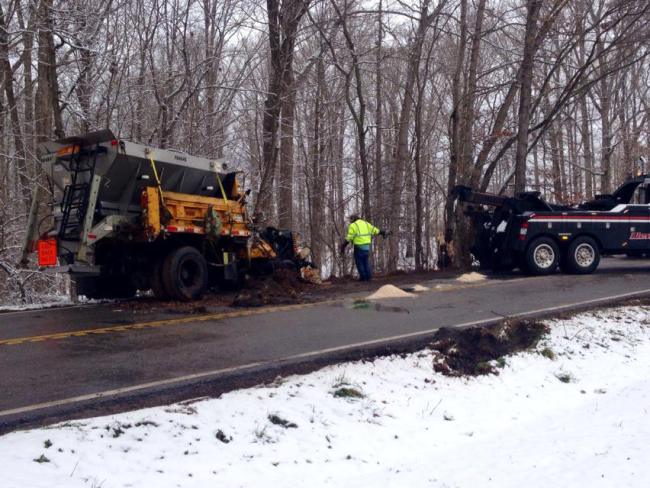
VDOT Snow Plow Involved In Accident On Route 522 In Powhatan


VDOT Snow Plow Involved In Accident On Route 522 In Powhatan


Published: January 27, 2015


                            B8X1ZczIMAA1Fze                    
POWHATAN, Va. (WRIC) — A VDOT truck was involved in an accident Tuesday in the midst of winter weather.

State Police say the call for the accident came in around around 9:30 a.m.  at Madiens Road, about a quarter of a mile north of Jefferson Woods Road.

The crash involved a VDOT snow plow. At the time, the plow was spreading sand onto the roadway when it ran off the road to the right, came back onto the road, ran of the road left and then struck a tree.

There were no other vehicles involved in the crash.

The man behind the wheel of the snow plow, 47-year-old Durlin Harris of Powhatan, was transported to VCU Medical Center with non-life threatening injuries. He was wearing a seatbelt.

Maidens Road (Route 522) is closed while crews clean up.

Robbers Crash Into Wells Fargo Museum in San Fransisco to Steal Gold Nuggets

Robbers Crash Into Wells Fargo Museum in San Fransisco to Steal Gold Nuggets

   
  January 27, 2015


Three suspects abandoned the stolen S.U.V. used in the heist and then drove off in a sedan.

Three suspects abandoned the stolen S.U.V. used in the heist and then drove off in a sedan.Credit Kristin Bender/Associated Press

Three masked robbers smashed a stolen sport utility vehicle into the entrance of Wells Fargo’s corporate museum in the heart of San Francisco’s financial district on Tuesday, then held a security guard at gunpoint and made off with gold nuggets from a display case, the San Francisco police said.

The police are investigating the bold and apparently well-coordinated robbery early Tuesday at the Wells Fargo History Museum, which is on the street level of the bank’s corporate headquarters.

The three robbers abandoned the S.U.V. and fled in a sedan that the police said was either parked nearby or could have been driven by a fourth person who was waiting with a getaway car.

While the police say their preliminary estimates of the nuggets’ value is about $10,000, the gold has sentimental value to the bank, which takes its history seriously. The police say the nuggets date to the early days of Wells Fargo, which was founded during the gold rush of the 19th century.

Wells Fargo operates 10 corporate museums around the country, including in Alaska, Phoenix and Charlotte, N.C.

The bank’s San Francisco museum includes a stagecoach used by Wells Fargo in the 1860s as well as works of art by notable Western artists, according to the museum’s website. A bank spokesman said the stagecoach was not damaged in the heist.

The website also mentions that the museum has “real gold from California gold country regions,” and a photo shows dishes of gold flakes with labels like “Dead Man’s Creek.”

This is the second time in less than two weeks that robbers in San Francisco have used a vehicle as a battering ram. On Jan. 19, thieves crashed a U-Haul truck into the Patagonia store near Fisherman’s Wharf and loaded it with stacks of clothing before driving off, said Grace Gatpandan, a spokeswoman for the San Francisco police.

The biggest cost of the robbery at the Wells Fargo museum might not have been the lost gold but the damage to the entrance. The police said early estimates of the damage were more than $200,000.

“We’re disturbed this happened to the Wells Fargo History Museum but are grateful no team member was harmed,’’ a Wells Fargo spokesman said in a statement. “Rest assured, the museum will reopen so it can continue to serve the thousands of visitors and Bay Area residents who visit it each year.”​