MEC&F Expert Engineers

Thursday, June 28, 2018

​NTSB is investigating the passenger vehicle that struck motorcycle in Dumfries, VA on April 12, 2018. The collision occurred between a 2012 Honda Civic car driven by a 47-year old male and a 2006 Yamaha XV1900 CT motorcycle operated by Master Sergeant Jerre S. Thomas II, 57, who died in the crash

Preliminary Report: Highway HWY18FH012

  • Accident No: HWY18FH012
  • Accident Type: Office of Highway Safety
  • Location: Dumfries, VA
  • Date: 4/12/2018


​NTSB is investigating the passenger vehicle that struck motorcycle in Dumfries, VA on April 12, 2018.


Executive Summary


The information in this report is preliminary and will be supplemented or corrected during the course of the investigation.

About 8:15 a.m. (local time) on Thursday, April 12, 2018, a two-vehicle collision occurred on northbound Interstate (I-95) near milepost 151.4 in Dumfries, Prince William County, Virginia. In this area, the roadway consists of three travel lanes. The roadway is delineated on the far-right lane with a solid white line and edged with a 11-foot paved shoulder. The far-left lane of the roadway is delineated by a solid yellow line, has a 2-foot paved shoulder which transitions to an 11-foot earthen shoulder. The earthen shoulder is edged by a metal guardrail. On the other side of the far-left guard rail are the high occupancy vehicle (HOV) lanes, which at the time, were selected as northbound travel lanes.[1] The HOV lanes are located between the northbound and southbound lanes. The crash occurred just south of the entrance to the HOV lanes. The posted speed limit is 65 mph.

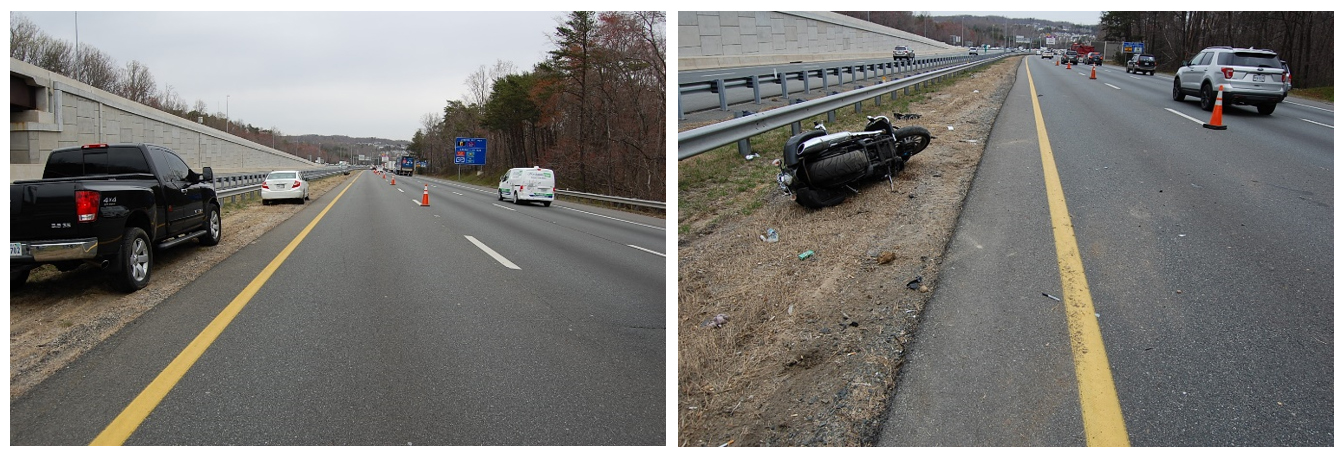
The collision occurred between a 2012 Honda Civic car driven by a 47-year old male and a 2006 Yamaha XV1900 CT motorcycle operated by a 57-year old male. The motorcycle was traveling in the far-left lane and the car was traveling adjacent to the motorcycle in the center lane. According to a statement provided by the car driver, he did not see the motorcycle before he made a lane change to the left and struck the motorcycle. The motorcycle exited the roadway to the left, went into the shoulder area, struck the guardrail, re-entered the highway, and fell over on its side. The motorcycle operator was transported to Sentara Northern Medical Center with life-threatening injuries and later died. The car driver was not injured.

View of the area of the crash location on northbound I-95 (left photograph) and motorcycle at final rest (right photograph). (Source- Virginia State Police)


The car driver was restrained by the available lap/shoulder belt and the motorcycle operator was wearing a Department of Transportation approved helmet at the time of the crash. The motorcycle operator was on his way from his home in Quantico, Virginia, to work at Fort Belvoir, approximately 24 miles to the north. Reportedly, the motorcycle operator frequently commuted to work on his motorcycle and traveled this identical route on I-95 and would also utilize the HOV lanes. There is no cost for motorcycles to travel on the HOV lanes in this section of I-95.

All aspects of the crash remain under investigation as the NTSB determines the probable cause, with the intent of issuing potential safety recommendations to prevent similar crashes. The NTSB is working alongside the Virginia State Police to compile a complete and accurate account of the crash.

1. HOV lanes are transitioned to northbound lanes from 6:00 a.m. to 9:00 a.m. and then reversed to southbound lanes from 3:30 p.m. to 6:00 p.m. Retrieved from: http://www.virginiadot.org/travel/hov-novasched.asp#I-95 Express Lanes


Probable Cause
The information in this report is preliminary and will be supplemented or corrected during the course of the investigation. 


=======================

Motorcyclist dies after I-95 crash in Prince William Co.


By Sarah Beth Hensley | @SarahBethHens

April 13, 2018


WASHINGTON — A 57-year-old motorcyclist died in a two-vehicle crash on Interstate 95 in Prince William County Thursday, Virginia State Police said.

On Thursday morning, Jerre S. Thomas II — a 57-year-old Quantico, Virginia, resident — was riding a 2006 Yamaha XV1900CT motorcycle on northbound I-95 near mile marker 151 when a 2012 Honda Civic changed lanes and hit the motorcycle, police said. That caused the motorcycle to drive off the roadway.

Thomas attempted to regain control and re-enter the interstate, but the motorcycle fell on its side and Thomas was thrown off it.

Emergency crews transported Thomas to Sentara Northern Virginia Medical Center with life-threatening injuries. He later died from his injuries.

The driver of the Honda was no injured, police said. Charges for the 47-year-old driver are pending.

Virginia State Police are investigating the crash.


====================


Jerre S. Thomas, II

December 11, 1960 ~ April 12, 2018 (age 57)

Obituary
Service Details
Tribute Wall
Flowers & Gifts

Master Sergeant Jerre S. Thomas, II, Retired US Marine Corps, died on April 12, 2018 in Quantico, VA.

Jerre was born December 11, 1960 in York, PA, a son of Jerre S. Thomas and Francine Boyd Thomas Miler. MSgt Thomas was a career Marine Corps Veteran, who served honorably for 20 years. He was a Master Instructor of Photography, and his military career included time at the White House with the Military Press Corp during the Presidencies of George H.W. Bush and Bill Clinton. He retired from active duty 2000 and went to work for the DOD, where he became Chief of Audiovisual Services for the Defense Threat Reduction Agency. He was also a member of the Quantico, VA Town Council.

He is survived by his mother, Francine Miler and his step-father, Edward "Ned" Miler of Summerville, SC; his girlfriend of eight years, Abigail Kohn and her daughter, Esme Anna Kohn of Falls Church, VA; his three children, Allison G. Thomas of Beaufort, SC, Justin W. Calandra (Kelly) of Richmond, VA, and Nathaniel S. Thomas, also of Richmond, VA; three grandchildren, Brianna Christine Leaha Thomas, James Lee Smith, IV, Ian Michael O'Toole Smith, all of Beaufort, SC; sister, Tracy Thomas Mitman (Ed) of Summerton, SC; two nephews, Matthew Mitman of Bowman, SC and James Mitman (Jennifer), and their two sons of Summerville, SC; aunt, Barbara Thomas of York, PA, and her daughter and two granddaughters of New Orleans, LA; step-brothers, Michael Miler of Spring, TX, and Mark Miler (Anna) of Littlestown, PA, and their daughter, Allison Miler of York, PA; and a step-sister, Diana Spencer of Montgomery, TX. Jerre is predeceased by his father, Jerre S. Thomas.


Monday, June 25, 2018

OSHA cited JK Excavating & Utilities Inc. after an employee died in a shoreless trench collapse. OSHA has proposed penalties of $202,201, and placed the company in its Severe Violator Enforcement Program.


June 22, 2018

U.S. Department of Labor Cites Excavating Company
Following Fatal Trench Collapse

LEBANON, OH – The U.S. Department of Labor’s Occupational Safety and Health Administration (OSHA) cited JK Excavating & Utilities Inc. after an employee suffered fatal injuries in a trench collapse. OSHA has proposed penalties of $202,201, and placed the company in its Severe Violator Enforcement Program.

OSHA investigators determined that employees at a residential construction site in Morrow, Ohio, were working in trenches up to 16-feet deep without adequate cave-in protection. OSHA cited the company for failing to use protective systems to prevent a cave-in; implement methods to remove accumulating water; properly use ladders to enter and exit the trench; prevent employees from working beneath a suspended trench box; ensure employees wore hard hats; and make provisions for prompt medical attention in the event of injury.

“A trench can collapse in seconds, burying workers under the weight of thousands of pounds of soil,” said Ken Montgomery, OSHA Cincinnati Area Office Director. “This tragedy was preventable, and could have been avoided if the employer had installed required protective systems to prevent a trench cave-in.”

The company has 15 business days from receipt of its citations and penalties to comply, request an informal conference with OSHA’s area director, or contest the findings before the independent Occupational Safety and Health Review Commission.

Under the Occupational Safety and Health Act of 1970, employers are responsible for providing safe and healthful workplaces for their employees. OSHA’s role is to ensure these conditions for America’s working men and women by setting and enforcing standards, and providing training, education and assistance. For more information, visit https://www.osha.gov. 

JK Excavating & Utilities, Inc is a privately held company in Lebanon, OH and is a Single Location business. 
 

Saturday, June 23, 2018

Tens of thousands of crude oil contaminate Doon, Iowa after a BNSF freight train hauling crude oil from Alberta, Canada derailed 33 cars just south of Doon, Iowa.


Doon, Iowa — 


Early Friday morning, June 22, 2018, a freight train hauling crude oil from Alberta, Canada derailed 33 cars just south of Doon.


We had a chance to talk to Amy McBeth who is a BNSF spokesperson on-scene at the derailment site. We asked her if a cause has been determined for the derailment.
She says it is not yet known how much crude oil has leaked into the floodwaters near the mouth of the Little Rock River where it joins the Rock River.


She says they’re not sure how long it will take to clean up the area, repair the track, and get trains running again. She says she knows they’ll certainly be there for the next few days. Trains are being re-routed as much as possible around the area. There were no injuries in the incident, according to McBeth.


Some of the oil has flowed down the Rock River to Rock Valley, where they were already experiencing major flooding issues, according to Rock Valley Mayor Kevin Van Otterloo. The Iowa DNR has instructed Rock Valley to shut down their wells, partially due to the oil spill. Van Otterloo says the City of Rock Valley is currently getting their residential water supply from Rock Valley Rural Water. City officials say there has been no interruption of water service or quality to Rock Valley residents.

Iowa Governor Kim Reynolds toured northwest Iowa on Saturday and issued a disaster proclamation, partially for help needed in derailment cleanup efforts. The proclamation says that reports forwarded to the Iowa Homeland Security and Emergency Management Department indicate response, recovery, and remediation efforts to clear the derailment require the construction of a temporary road to reach the derailed cars. It says Burlington Northern Santa Fe contractors need to complete construction of this temporary road as soon as possible to limit the impact to the public peace, health, and safety of citizens. So the Governor issued a Proclamation of a State of Disaster Emergency.


2nd update posted Jun 22, 2018 at 6:17 p.m.

Doon, Iowa — We’re now hearing from the railroad company about the derailment of the Burlington Northern Sante Fe Railroad train into floodwaters south of Doon Friday morning, and the subsequent oil spill.

BNSF spokesperson Amy McBeth released this statement to KIWA regarding the accident:

“At approximately 4:30 a.m. this morning a freight train hauling crude oil from Alberta, Canada derailed 33 cars just south of Doon, Iowa. Some of the cars were compromised, but the exact number is uncertain at this time. BNSF is working with local authorities on our response to the situation. Our hazardous materials and environmental experts are on the scene and have mobilized response equipment throughout the day. We are containing the oil that was spilled as close to the incident as possible using containment booms and recovering it with skimmers and vacuum trucks. We regret any inconvenience this incident has caused and are working directly with those impacted. There were no injuries reported. Further updates will be provided when available.”

First update posted 12:30 p.m. 6/22/2018:

Doon, Iowa — The derailment of the Burlington Northern Sante Fe Railroad train into floodwaters south of Doon Friday morning has caused a major oil spill.

The tanker cars were loaded with crude oil, which is leaking into the flood waters. Lyon County Sheriff Stewart Vander Stoep says the large oil slick threatens an already difficult flood situation for the downstream city of Rock Valley.


He is not sure how successful they have been in capturing the oil. The Little Rock River flows into the Rock River which is at flood stage in the city of Rock Valley. Vander Stoep says the D-N-R is on site and has staff arriving downstream to monitor the flow of the crude oil plume. In addition to their current attempts to contain the crude oil, Vander Stoep says the railroad is sending a crew in for clean up.

Environmental Program Supervisor and Spencer Field Office Superintendent Kenneth Hessenius says they are monitoring the situation.
e.

Hessenius is also concerned about the plume reaching Rock Valley He says the number of rail cars leaking may not be known for a long time as many of them are partially submerged in the flooded Little Rock River. He says he will know more as time goes by and more information becomes available.

Aerial photos of the oil spill are courtesy of Phil Kooima…………………..


Original post 10:08am 6/22/2018
Doon, Iowa — A derailment on the Burlington Northern Santa Fe Railroad south of Doon has caused mandatory evacuations in the area.
The area of Garfield Avenue between 270th Street (the county line) and 280th Street, south of Doon has been evacuated. Authorities believe the cargo may be crude oil.
Lyon County Sheriff Stewart Vander Stoep tells us the situation as of 9:00 this morning.

He says that the cause is undetermined, but he would guess that it was flood-related.
The Sheriff tells us that since the wind was from the north, they didn’t have to evacuate Doon. But he says the smell is “really bad.”
Rock Valley mayor Kevin Van Otterloo says the swift floodwaters have quickly brought some of the oil about seven miles down the Rock River to Rock Valley.
Thanks to Lyon County Sheriff’s Office for the top photo and the one below:
 

THE CORRUPT AND/OR INCOMPETENT FORMER JUDGE MARGARET MCVEIGH CONSPIRED TO VIOLATE HOMEOWNER'S POSSESSORY RIGHTS; ALTHOUGH NO EJECTMENT ACTION WAS FILED BY THE ANTI-TRUST CONSPIRATORS, SHE FORCED A HOMEOWNER OUT OF HIS HOME


 THE CORRUPT AND/OR INCOMPETENT FORMER JUDGE MARGARET MCVEIGH CONSPIRED TO VIOLATE HOMEOWNER'S POSSESSORY RIGHTS; ALTHOUGH NO EJECTMENT ACTION WAS FILED BY THE ANTI-TRUST CONSPIRATORS, SHE FORCED A HOMEOWNER OUT OF HIS HOME


STATE OF NEW JERSEY
            Plaintiff,  

v.

BASILIS N. STEPHANATOS,
                                    Defendant
SUPERIOR COURT OF NEW JERSEY
LAW DIVISION - BERGEN COUNTY
Indictment No. 11-09-00810-I
Criminal Action
ILLEGAL REMOVAL BY THE PASSAIC COUNTY SHERIFF BECAUSE NO EJECTMENT ACTION WAS FILED

TO:      Passaic County Prosecutor’s Office
 401 Grand Street
 Paterson, New Jersey 07505
 Attn: Assistant Prosecutor Stephen Bollenbach

   Hon. James J. Guida, J.S.C.
   Bergen County Courthouse
   10 Main Street, 4th Floor
   Hackensack, NJ 07601

THE HON. ARNOLD L. NATALI, JR., P.J.CH. THE PRESIDING JUDGE IN MIDDLESEX COUNTY SAYS THAT TO REMOVE DR. STEPHANATOS FROM HIS RESIDENCE, THE PLAINTIFF MUST HAVE FILED AN EJECTMENT ACTION

Dear Judge Guida:
This letter is not pertaining to the Judgment of Foreclosure.  The attack on the Judgment of Foreclosure is for the Appellate and Supreme Court to review.  In addition, the Office of Foreclosure has re-opened the case F-9241-09 and the Hon. Judge Thomas Laconte will be ruling on the Motion to Vacate the Final Judgment Based on Fraud on the Court. 
This letter pertains to the most important issue in this case, i.e., the illegal ex-parte judgment of possession and the ex-parte writ of possession.  In New Jersey and in all other states, the person that has possession of a property, also has at least 95 percent of the legal rights.  This is the law of property.
REQUEST TO CORRECT THE COURT WRITINGS/OPINIONS/RECORDS
First I want for the Court to correct its writings, rulings and the record to reflect that the reference to “eviction” in this case is not appropriate, as this was not a landlord/tenant case.  This was an ejectment action.  This is a very critical clerical error that must be corrected, as it could result in unfair trial or mistrial.
UNDISPUTABLE FACT
As you know from the facts of this case, Dr. Stephanatos was refusing to leave his residency until he exhausted the appeals.  This is the undeniable fact.
AN ORDER FROM A LAW DIVISION JUDGE FOLLOWING AN EJECTMENT ACTION WAS REQUIRED TO REMOVE DR. STEPHANATOS FROM HIS RESIDENCE
I have been trying to tell you through my briefs that New Jersey law required that American Tax Funding, LLC (ATF) and their lawyer, Robert Del Vecchio, Esq. obtain an order of removal from a Law Division.  You have been refusing to listen.  To that effect, I have been talking to lawyers here in New Jersey for assistance with this very, very, very critical issue.  The lawyers (Wilentz, Goldman, et al and Greenbaum, Rowe, et al) unequivocally stated that this Court is dead wrong.  They provided me with the following document, entitled “Practice Manual, 2017 Edition, Middlesex County Chancery Division, General Equity Part.”  They said that the Practice Manual has been co-authored by the Hon. Arnold L. Natali, Jr., P.J.Ch. the presiding judge in that county and the Hon. Arthur Bergan, JSC.
Page 28, of that manual says the following regarding actions commonly misfiled in the Chancery Division, like what ATF and Robert Del Vecchio did in my case:
Actions Commonly Misfiled in the Chancery Division
1. Ejectment
Ejectment actions, though similar to eviction actions, are intended to remove an occupant from your property when that occupant is not technically a "tenant."  An example is where a property owner has a live-in significant other or family member who refuses to move out of the property when asked to do so.  In these cases, there was never a true landlord-tenant relationship, so to remove the occupant, the plaintiff must file an ejectment action pursuant to N.J.S.A. 2A:35-1 et seq. These are usually heard by the sitting landlord-tenant division judge; however, they are technically a Special Civil Division matter under R. 6:1-2 because monetary damages can be awarded against the occupant.  See Exhibit A. (Note: Rule 6:1-2 (a)(4) was introduced by the Supreme Court in 2012, after the events of June 28, 2011; so, a summary proceeding could not have been filed in 2011, but a full-blown plenary proceeding – which the Sheriff and ATF/Del Vecchio avoided.  This was a huge mistake on their part, as an ejectment action must have been filed).
Exhibit B includes the May 2017 instructions from the Law Division, Special Civil Part entitled: “How to apply for a writ of possession (order to remove an illegal occupier from your property)”. 
Under the instructions on “Who should use this packet”, the Law Division states:
 You may use this packet if you are the owner or proper legal resident of real property and you are being denied the rightful uninterrupted use of the property by person(s) who never had or no longer has permission to remain in the subject premises AND a landlord/tenant relationship DOES NOT exist between you and the person(s) you are seeking to remove.
As you know from the facts of this case, Dr. Stephanatos was refusing to leave his residency until he exhausted the appeals.  This is the undeniable fact.  Therefore, according to the Practice Manual (Exhibit A) and the Law Division packet of instructions (see Exhibit B), to remove him from his residence, ATF, LLC/Robert Del Vecchio, Esq. should have filed an ejectment action with the Passaic County Law Division, Special Civil Part.  But they did not.  Instead, they obtained an ex-parte Writ of Possession FOR UNCONTESTED CASES, WHILE THIS WAS A CONTESTED OCCUPIED PROPERTY WHERE DR. STEPHANATOS WAS REFUSING TO LEAVE.  Even a blind mouse can see the difference between what is required by law and what the sheriff/ATF, LLC/Robert Del Vecchio did.
The ex-parte judgment of possession and writ of possession obtained through a self-certification by Robert Del Vecchio, Esq. has no language that says to remove Dr. Stephanatos from his residence.  Therefore, the Sheriff did not have the authority to remove him by force from his home.  By contrast, the writ documents included in Exhibit B, do include the “removal” language: 
If the defendant(s) fail to vacate the premises on or before the date specified herein, the plaintiff may seek the issuance of a Writ of Possession from the Special Civil Part Office no more than ------ days thereafter, directing the County Sheriff to subsequently remove the defendant(s) within 14 days of the issuance of the Writ of Possession.
In conclusion, Dr. Stephanatos could have been removed only through an ejectment action and only after proper notice and court hearing took place before a Law Division judge.  None of these statutory procedures were followed here.
I also include below a brief prepared attorney MICHAEL D. MIRNE, Esq.  He also states that an ejectment action must be filed in order to remove an occupant who is not a tenant.
BRIEF OF THE LAW OFFICE OF MICHAEL D. MIRNE, L.L.C.
 Ejectments  - In order to remove an occupant who is not a tenant, we must file an Ejectment action
We are frequently asked about the rules regarding Evictions and Ejectments. Both types of actions are used to remove occupants from properties.  But eviction actions are only appropriate in cases where the occupants are tenants. Generally, an occupant will be considered a tenant in any case where there is an agreement (whether written or oral) that the occupant will pay rent for the use of the premises.  In order to remove an occupant who is not a tenant, we must file an Ejectment action. As Ejectment Actions near their lockout dates, some Defendants have resorted to extreme means to remain in their foreclosed houses. In today’s article, we will discuss some of those efforts.
Historically, ejectment actions were cognizable only as plenary hearings in Law Division or in Chancery Division. However, it was clear that the procedural rules of both Divisions, which allow for lengthy and comprehensive pretrial discovery, were not very well suited for matters where there was no issue of title, and where the Plaintiff was not seeking any monetary relief. Consequently, it was brought to the attention of the New Jersey Supreme Court’s Special Civil Part Rules Committee, on which I serve, that there was no Court Rule or Statutory provision that would permit Ejectment Actions to quickly proceed in a Summary manner, while avoiding the usual pitfalls and delays of plenary proceedings.
The Committee ironically turned its attention to a Statute, which was originally designed to assist tenants who were illegally locked out. It was the Forcible Entry and Detainer Act, found in N.J.S.A 2A:39-1, et. seq.  However, since it was clear that actions brought under this section could be used in any matter in which a property was used “without the consent of the party in possession,” the Committee concluded that N.J.S.A. 2A:39-5 was applicable to all matters where an occupant remains in a property without consent of the owner after a demand to vacate.  (NOTE TO JUDGE GUIDA:  I HAVE BEEN TELLING THE COURT THAT THIS IS THE STATUTE TO USE TO REMOVE A PERSON FROM A PROPERTY, BUT YOU HAVE BEEN REFUSING TO LISTEN.  YOU STATED THAT THESE STATUTES ARE APPLICABLE TO TENANTS ONLY.  JUDGE GUIDA YOU ARE WRONG, DEAD WRONG;  YOU MUST REVERSE YOUR ORDERS BECAUSE YOU HAVE THE OBLIGATION TO FOLLOW THE LAW).
Accordingly, in 2012, the Supreme Court of New Jersey introduced Court Rule 6:1-2 (a)(4) to allow the filing of Ejectment Actions as a Summary proceeding before the Special Civil Part of the Court, thus enabling a Plaintiff to secure a Court date within just a few weeks of filing.
Following the 2012 Court Rule Amendment, it has been brought to our attention that some attorneys are erroneously being told that their Ejectment actions must be filed in the Foreclosure Docket. However, there is no such restriction in the old rule or the amended Court Rule. In order to fully address this issue, we must start by examining the treatment of Ejectment Complaints prior to the Court Rule amendment.  In the matter of Chase Manhattan Bank v. Josephson, et. als. 135 N.J. 209 (1994), the New Jersey Supreme Court noted that in order for a purchaser “to gain possession, [he or she] must obtain an order for possession from the Superior Court.” The Court further stated that the Order could be obtained “either in an action for possession pursuant to N.J.S.A. 2A:35-1 or as part of the action to foreclose the mortgage.” [Emphasis added]. Accordingly, while some Ejectments were sought under the foreclosure docket, the vast majority of Ejectment Actions continued as Law Division matters, even in cases where the purpose of the Ejectment was to remove a former owner following a foreclosure action. The use of the Ejectment Complaint to remove occupants following a foreclosure, therefore, continued in Law Division, without much objection until the recent Court Rule change.
However, since the Court Rule change, our office has been asked to quash numerous Motions on behalf of occupants, who have argued that the Ejectment Process following a foreclosure must be conducted under the Foreclosure docket. In the matter of 206 Wynatt, L.L.C. v. Nixon and Lee, et. als., Ocean County Docket Number DC-395-15, the Defendants filed multiple Motions with the Court, first claiming that they were in the process of challenging the foreclosure action, and later claiming (falsely) that an appeal in the New Jersey Appellate Division was pending. When those Motions were not successful, the Sheriff’s office scheduled a lockout date. The Defendants responded by filing an emergent application with the Appellate Division to stay the lockout. The Appellate Court denied the Defendants’ application and allowed the Ejectment to continue. Most importantly, the two appellate judges who reviewed the Defendants’ appeal found no significance in the fact that this Ejectment followed a foreclosure. It was therefore clear that the prior foreclosure could not be used as a reason for removing an Ejectment action from the Special Civil Part.
More recently, in the matter of Revell v. Schmidt, Docket No. MRS-DC-1234-17, the Defendant, who was previously foreclosed upon under Docket No. MRS-F-45240-09, brought an emergent Motion before the Chancery Division, 2 days prior to lockout, arguing that the Foreclosure Docket retains jurisdiction upon foreclosure action, which extends not only to the lender who is the Plaintiff in the Foreclosure action, but also to subsequent purchasers.  The Defendant, through counsel, further argued that the filing of the Ejectment matter in Special Civil Part violated New Jersey’s Entire Controversy Doctrine. As counsel for the Plaintiff in this matter, I noted that the action could have been brought under the original Foreclosure docket, but there was absolutely no requirement that we should do so. Reciting the Court’s logic in Josephson (supra), I pointed out that the Ejectment could proceed as either part of the Foreclosure Docket, or as a separate action in the Law Division (or in this case, the Special Civil Part). After several hours of oral argument, Judge Brennan rendered a decision, in which he ruled in favor of the Plaintiff and allowed the Ejectment action to continue.
Law Office of Michael D. Mirne, L.L.C.
3200 Sunset Ave
Ocean, NJ 07712
Phone: (732) 988-7200 Fax: (732) 776-7444
CONCLUSION
In conclusion, all the Chancery Court Judges and the lawyers I consulted agree that an ejectment action should have been filed to remove Dr. Stephanatos from his residence.
The requirement to apply for an ejectment action (with a full notice, plenary hearing, etc.) fully vindicates Dr. Stephanatos who has been telling this Court that the Law Division Judge decides the removal of persons from residential properties, when the person refuses to leave.  An ex-parte judgment of possession and ex-parte writ did not authorize the sheriff to remove Dr. Stephanatos and were in fact in violation of state criminal statutes: See NJ Rev Stat § 2C:33-11.1 (2013) - Certain actions relevant to evictions, disorderly persons offense that deal specifically with residential real properties.   That statute also states that a Warrant for Removal is required for residential properties.  The Passaic County Sheriff committed a criminal offense in violation of that statute by entering Defendant’s property without a warrant for removal and removing him from his residential premises.
But due to your biases against Dr. Stephanatos, you have been refusing to follow the law. 
The conspirators knew that Dr. Stephanatos “was not going anywhere” (as per the grand jury testimony of Ronald Lucas), yet they failed to follow the clearly established New Jersey Laws regarding Ejectment from a residential property. 
See N.J.S.A. 2A:39-1 Unlawful entry prohibited.
No person shall enter upon or into any real property or estate therein and detain and hold the same, except where entry is given by law, and then only in a peaceable manner. With regard to any real property occupied solely as a residence by the party in possession, such entry shall not be made in any manner without the consent of the party in possession unless the entry and detention is made pursuant to legal process as set out in N.J.S.A. 2A:18-53 et seq., as amended and supplemented

This mandatory procedure was circumvented by the Passaic County Sheriff and the criminal conspirators to their detriment:  they were in fact acting as trespassers.  See Mushback v. Ryerson, 11 N.J.L. 346, 351 (Sup.Ct.1830); Borromeo v. Diflorio, A-3979-07T2, decided August 9, 2009  “[I]n New Jersey it has been the established principle, ․ making lands liable to be sold for the payment of debts, that the right of the sheriff to sell and convey lands, is a mere naked power, so that to render a title under his deed available, every requisite of the law must be shown to have been complied with[.]”  Todd v. Philhower, 24 N.J.L. 796, 800 (E. & A. 1854).  From these authorities, we conclude the requirements in the statute are not merely directory but mandatory, such that the failure to comply with a statutory provision affects subsequent actions.).  
Hopefully, you will follow the Practice Manual and the Law Division packet that instruct very clearly as to the applicable law and proper procedures for removing a person from a residential property, i.e., the filing of an ejectment action in the Law Division.  I expect that you will revise your ruling accordingly and state that Dr. Stephanatos could only have been removed from his residence only after a Law Division judge ordered him to do so and only after a proper notice and hearing.  This would have taken months to complete and would have given the opportunity for Dr. Stephanatos to adjudicate his appeals.  No plenary proceeding ever took place to adjudicate the issue of possession, due to the fraudulent and criminal activities of Robert Del Vecchio, Esq.  See NJ Rev Stat § 2C:33-11.1 (2013).  What you did here is absolutely criminal, unethical and unconscionable.  The government’s behavior raises issues of duress, outrageous government conduct, etc.

A worker was injured when two train cars at a private line at the Superior Silica Sands, Inc. sand and silica plant in South Bexar County, Texas derailed


SAN ANTONIO, Texas —


A worker was injured when two train cars at a private line in South Bexar County derailed Saturday.

Emergency crews were called to a sand and silica plant on the 24,068 Pleasanton Road, San Antonio, Texas around 9:30 a.m. Saturday.

A Bexar County spokesperson said cars were being loaded when two of the cars somehow detached from the other cars and began to roll. The cars then derailed, one of them falling on its side.

Details about the age and identity of the worker and that person's condition were not released.


Superior Silica Sands is a top four provider of high-quality frac sand for oil and gas well completions in the energy services industry. We have mines and production facilities in Clinton and New Auburn, Wisconsin, and Kosse, Texas. At these facilities, we produce the coarsest ratios of Northern white sands and quality Native Texas sand. The combination of our three plants, plus numerous transload locations throughout North America, gives us the ability to produce over 4.2mm tpy of in-demand, high-quality frac sand. Because we are centrally located, we can efficiently and economically ship our sands throughout most parts of North America.

SSS/EMES acquired the San Antonio, TX mine and dry plant operation on April 12, 2017. This acquisition comes with a unique history, where mining for concrete roads and bridges began by Mr. Dave Lehr prior to 1900, and transportation at that time was primarily by horse and wagon! A rail line, SAU&G, was introduced in 1912, and the location was purchased by the Osburn family, sometime later, upon Mr. Lehr’s death. The plant changed ownership again in 1959 when the Tooke family purchased the plant and property, and they continued to mine for industrial, construction and sports sands, delivering to domestic and export markets until SSS’ acquisition.

The San Antonio plant has a production capacity for 600,000 TPY of wet sand and 300,000 TPY of finished dry sand. SSS is undergoing an upgrade plan at this site that will eventually include a full scale 3MM TPY dry plant, with expected completion in mid-2018. Upon completion of this new dry plant, the San Antonio operation will have a total frac sand capacity of 3.7MM tons per year of 100M and 40/70 mesh product. In addition, this site will continue to product sand for the construction, foundry and sports markets.

Our San Antonio Plant has over 80MM tons of sand reserves consisting mostly of API spec’d 40/70 and 100M. Located near the heart of the Eagle Ford basin, this site offers direct trucking to the wellsite, as well as low-cost transportation into the Permian Basin via the Union Pacific Rail mainline.