
By MIKE DAVIS mdavis@kibaytimes.com
Sep 8, 2016
CENTREVILLE, MD — An employee with the Southern States agriculture supply cooperative was seriously injured at 10:50 a.m. on Tuesday, Sept. 6, when an empty barrel exploded while he was attempting to cut the lid off, according to a report from the Maryland State Fire Marshal’s Office.
Jeffrey Brian Walbert sustained injuries to his face and head when the 55-gallon barrel exploded in the building’s interior garage. A co-worker called for help, according to the report.
Maryland State Police, Goodwill Volunteer Fire Company and county paramedics responded and treated Walbert on the scene for about 10 minutes before he was transported to the University of Maryland Shock Trauma Center in Baltimore, according to the fire marshal’s office. Walbert was in serious condition Wednesday afternoon, according to hospital spokesman Michael Schwartzberg.
Tpr. Keith Majerowicz said hydraulic oil residue was “probably” in the barrel, and when Walbert used a blow torch to cut the top off, the pressure built up inside with nowhere to go and eventually it exploded.
Majerowicz said Walbert was attempting to cut the top third of the barrel off because “they were going to drain the oil out of a large piece of farm equipment and they need something that could hold 35 gallons and the barrel itself was too tall to fit under there, so they needed to cut the top off.”
Southern States, located at 1002 Hope Road in Centreville, sustained no damage to its structure or contents, the report said.
The incident remains under investigation.
Southern States manager Duane Orr declined to comment.


The surprising reason Hurricane Hermine claims could cost insurers much more
by Caitlin Bronson | Sep 06, 2016
Hurricane Hermine – the first such storm to hit the Southeast US in more than a decade – is likely to result in manageable losses for property insurers, but changes in the industry landscape may end up costing carriers more than anticipated.
The Assignment of Benefits (AOB) legal tool was introduced in Florida as a way to allow contractors to bill and be paid by insurers directly for work performed, without involving the insured homeowner. It was meant to prevent homeowners from having to pay money upfront or deal with a sometimes complicated claims process, but insurers have long argued that repair vendors have taken advantage of AOB by artificially increasing the cost of claims, and even suing the insurer if it refuses to pay the bills.
In the wake of serious damage from Hurricane Hermine, inflated AOB claims are expected to make the storm an expensive one for property insurers.
“The private insurance industry has thus far absorbed the inflated claims associated with AOB, but with a significant storm like this one, AOB could be a big issue,” Howard Mills, global insurance regulatory leader at Deloitte, told Insurance Business America Friday. “If we have a lot of insured losses, the market could see some significant disruption.”
AOB abuse has already led to significant rate hikes in South Florida, both from private insurers and the state-run insurer Citizens Property Insurance Corp. Though state lawmakers have considered several reform proposals, no material changes have yet been enacted.
Still, Mills believes there’s no doubt insurers will be able to weather Hermine claims with ease. The industry is well-capitalized, and new advances in claims handling – including drone technology – should make the process speedy and satisfactory for consumers.
“We’ll see a much faster data return on this storm then we have in the past,” Mills said. “Insurers will be looking to showcase their new technological capabilities, and we should have a very clear picture of impact pretty early on.”
The only concern is that with many months left in the 2016 hurricane season, anxiety levels among carriers are likely to be heightened following Hermine.
“In 2005, you had Katrina, Rita and Wilma back-to-back-to-back,” Mills said. “The industry will likely be nervous given that we’ve still got a long way to go this season and the temperatures are very warm.”

A tractor-trailer hit an overpass, blocking the outbound entrance to MLK Drive near the Philadelphia Museum of Art. (WPVI)
Friday, September 09, 2016 12:45PM
FAIRMOUNT PARK (WPVI) -- A tractor trailer sustained significant damage after hitting an overpass near the Philadelphia Museum of Art.
It happened before 8:30 a.m. Friday at the outbound entrance to Martin Luther King Drive adjacent to the art museum.
Police tell Action News the driver hit the overpass leading from the Spring Garden Street bridge to Eakins Oval and became stuck.
Video from Chopper 6 HD showed the big rig stopped just past the overpass after workers freed it.
The front section of the trailer's metal roof had been peeled back, and a worker was using an ax to remove the damaged section.
Both lanes leading from Eakins over to the outbound MLK Drive were closed for several hours as the work continued.
There was no immediate word if the driver would face charges.
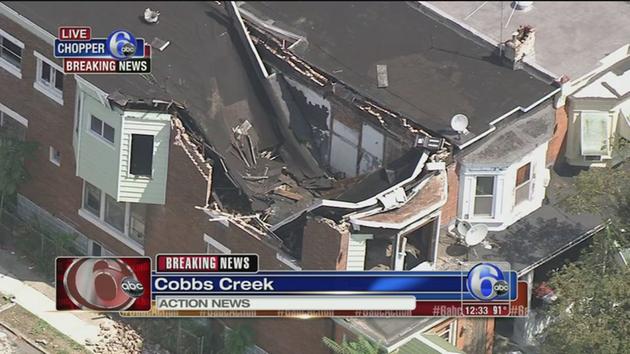
Chopper 6 HD was over a partial house collapse at 60th and Locust streets. (WPVI)
Friday, September 09, 2016 01:10PM
COBBS CREEK (WPVI) -- Philadelphia firefighters were on the scene of a partial house collapse in the city's Cobbs Creek section.
It happened before 12:15 a.m. Friday at 60th and Locust streets.
Video from Chopper 6 HD showed bricks and rubble on the sidewalk adjacent to the row house at the end of the block.
The roof and part of the second floor wall had given way.
Action News is told the house was vacant. No injuries have been reported.
An investigation is underway into what led to the collapse. It looks as if the wood frame has rotted away leading into the collapse. Too much water intrusion that went unchecked over the years.
Friday, September 09, 2016 06:05AM
DETROIT -- Nissan is recalling over 120,000 cars and SUVs in the U.S. because brake fluid could leak and cause fires.
In some cases owners should park their vehicles outside until they are fixed.
The recall covers certain 2015 to 2017 Murano SUVs and 2016 to 2017 Maxima large cars that are equipped with intelligent cruise control. Also included are some 2015 and 2016 Murano hybrids.
Nissan says seals on antilock brake pumps can leak fluid onto a circuit board. That can cause an electrical short, which could lead to a fire. If fluid leaks, the antilock brake warning light could stay on for 10 seconds after startup. Owners who see that should park outside and call their dealer.
Nissan says several vehicles caught fire. Dealers will replace defective pumps for free.
========
The average car or truck has a number of flammable and highly dangerous fluids under the hood: gasoline
or diesel fuel, engine oil, transmission fluid, power steering fluid,
brake fluid and even engine coolant. All of those fluids are circulating
when the car is on, and all of them can catch fire pretty easily if
their lines, hoses or reservoirs take a hit.
So even though one of the
car's vital liquids is unlikely to start spewing or dripping out of
nowhere -- generally, something else has to go wrong first -- the fact
that all of these fluids are flammable to begin with is a problem in and
of itself. Combined with another aggravating factor, like a car crash
or a failed part, the result could be a fire.
Though such a blaze is
most likely to start in the engine bay, where all of these dangerous
liquids are concentrated, keep in mind that some of them, like fuel and brake fluid, are moved along the entire length of the car.
Leaks in the fuel system are the most common cause of vehicle fires, so that's why they take the top spot on our list [source: Metropolitan Forensics]. As we've already seen, any number of complicating factors can cause a fuel leak, but they're tricky because fuel leaks can also arise on their own and with very little warning.
A fuel system leak is really dangerous. We've already discussed that a lot of a car's fluids have corrosive, poisonous and flammable properties, but gasoline is among the worst. Gasoline at a temperature of just 45 degrees Fahrenheit (7.2 degrees Celsius) or above can quickly catch fire from a simple spark. It happens all the time in a running car, after all, but it's contained by the engine.
And gasoline that reaches 495 degrees Fahrenheit (257.2 degrees Celsius) will ignite by itself. It's easy to see how fuel dripping onto hot metal and plastic parts can cause a fast-spreading fire. The best way to reduce chances of a fuel system fire is to make sure the car is properly maintained and to keep it out of the situations we've already described.
And if you ever smell gas in or around your car, find and fix the leak immediately!


