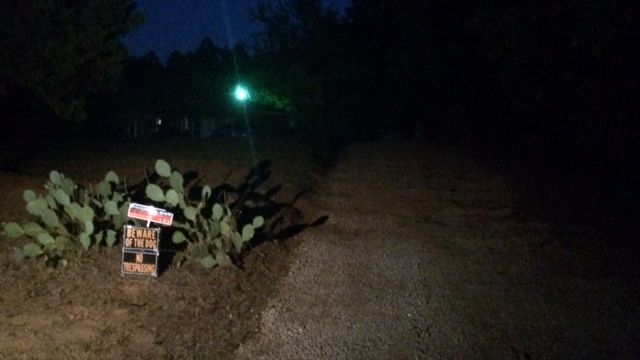
 (July 20, 2016/Fox Carolina)
TOWNVILLE, SC (FOX Carolina) - Posted: Jul 20, 2016 9:10 PM EST Updated: Jul 20, 2016 10:33 PM EST
The coroner was called to the scene of a fatal ATV crash on Wednesday night.
(July 20, 2016/Fox Carolina)
TOWNVILLE, SC (FOX Carolina) - Posted: Jul 20, 2016 9:10 PM EST Updated: Jul 20, 2016 10:33 PM EST
The coroner was called to the scene of a fatal ATV crash on Wednesday night.
Dispatch said the crash happened on Hatton Ford Road in Townville on Wednesday night. The coroner says the victim was transported to the hospital.
The coroner says the victim later died at the hospital.
The coroner later identified the victim as Shannon Spearman, 33. The man had a 4-year-old on the back of the ATV.
Spearman went over a small hill on Hatton Ford Road and the ATV flipped over, according to the coroner. Spearman's family found the two, but thankfully the child was not injured.
Spearman was not wearing a helmet, according to the coroner. He died from a fractured neck.
Stay with foxcarolina.com for the latest in this developing story.
Copyright 2016 FOX Carolina (Meredith Corporation). All rights reserved.
Marine vet hit, killed while helping driver on Interstate 10 'died a hero'
Dillon Collier, KENS 5 8:43 p.m. EDT July 18, 2016
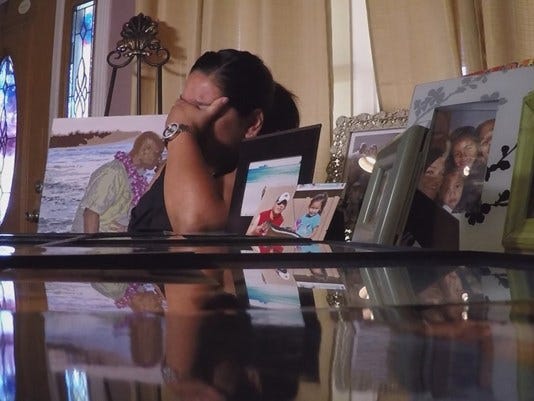
(Photo: Dillon Collier/KENS)
SAN ANTONIO – A San Antonio man hit and killed early Saturday morning in a chain reaction crash on Interstate 10 has been identified as retired Marine Staff Sgt. Arturo "Arty" Elias.
Elias, 35, and another man pulled over along I-10 near Vance Jackson just before 4 a.m. to help the driver of a Dodge Durango that was stalled across lanes of the highway.
Elias, the second good Samaritan and the driver of the Durango were then hit by a second vehicle, according to preliminary information provided Monday by the San Antonio Police Department.
The other good Samaritan remains in critical condition at University Hospital.
<!--iframe-->
A driver involved in the crash, 47-year-old Conception Rodriguez, died as a result of her injuries.
SAPD has not released what vehicle Rodriguez was driving.
No criminal charges have been filed in the case and SAPD detectives are still conducting their crash investigation, according to a department spokeswoman.
Elias, a father of three and 12-year veteran of the U.S. Marine Corps, died instantly, his family confirmed.
"It's just not real. It doesn't feel real. He must have seen something really bad to have stopped," said Elias' wife Michelle, who learned of her husband's death as she traveled with one of the couple's children.
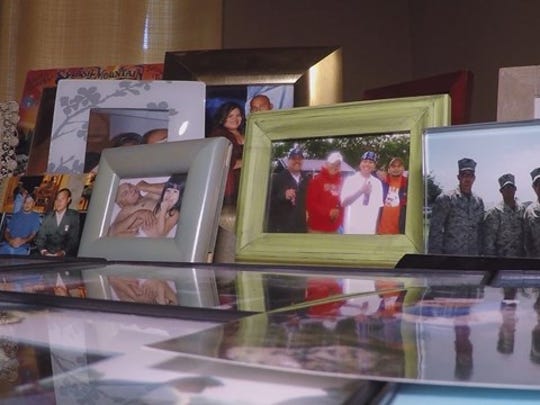
Elias family photos (Photo: Dillon Collier/KENS)
Elias received several medals and commendations during his time with the Marine Corps, including the National Defense Service Medal.
Five Diamonds Little League is planning a memorial service to remember Elias, who coached for the league.
A GoFundME page has been set up to help pay for Elias' funeral expenses.
Former Inspectors Describe Dangerous Flaws in Construction of Spectra Energy'sTexas Eastern Gas Pipeline
By Sharon Kelly • Tuesday, July 19, 2016 - 13:22

In April, a massive explosion ripped through rural Salem Township, Pennsylvania when natural gas from a pipeline buried in a field suddenly ignited.
The Salem Township explosion offers a glimpse at how dangerous a natural gas pipeline accident can be — the blast when the 30-inch pipeline ignited blew a 12-foot deep hole in the ground and scorched 40 acres, sending one man to the hospital with burns on 75 percent of his body.
“It looked like you were looking down into hell,” a local fire chief, Bob Rosatti, told ABC News. “As far across my windshield as I could see was just a massive fireball.”
That incident is just the latest accident for Texas Eastern Transmission, a Spectra Energy subsidiary running the pipeline that exploded. In the last decade, Texas Eastern has caused dozens of accidents, resulting in over $13.7 million in property damage, according to Pipeline and Hazardous Materials Safety Administration (PHMSA) records.
A preliminary PHMSA report into the Salem Township explosion revealed that the pipeline at the explosion site had become corroded, and highlighted problems with the coating on a weld made in 1981 (though the final results of the federal investigation are still pending).
Meanwhile, Spectra is working on a billion dollar pipeline expansion project — the “Algonquin Incremental Market” (AIM) pipeline, which will dramatically extend the reach of the Texas Eastern Transmission network — the same pipeline system that exploded in Salem Township.
Two former inspectors on the AIM project have come forward, alleging serious problems and lawbreaking during the construction of the AIM pipelines that put the safety of workers and the public at risk.
After unexpected delays put construction behind schedule, workers were pressured to complete sections of the pipeline quickly, leading to dangerous cut corners, the former inspectors explained.
These allegations are especially worrisome given that the AIM pipeline's path takes it past the Indian Point nuclear power plant right outside New York City, and into New England.
When the AIM project is completed — which Spectra says will happen in November — those 42” pipelines, a foot wider than the one that exploded in Salem Township destroying a home roughly 1,500 feet away (an estimate that hasn't been verified, PHMSA preliminarily estimated a burn radius of about a quarter of a mile), will carry highly pressurized natural gas within 1,200 feet of Indian Point's nuclear reactor #3.
DeSmog obtained audio recordings of interviews conducted by grassroots activists and reporters with the two whistleblowers. Both of the former inspectors independently contacted activists at The FANG Collective over their concerns about safety, environmental and historic preservation violations they personally witnessed during construction of Spectra's AIM project, which they describe as rushed and extraordinarily unsafe.
DeSmog also interviewed one of the whistleblowers, who provided new information about risks taken by Spectra during pipeline construction.
In the recordings, the whistleblowers, both of whom have said they want to remain anonymous, detail a litany of concerns including injured workers and accidents on AIM job sites.
“We've had guys break their legs, burns, cuts, near misses, dropped objects, slough off in holes, working in standing water in holes, not monitoring spaces, huge violations,” Whistleblower One, a former safety inspector on the AIM project, said.
Even more troubling than the individual workplace safety violations are the consequences of Spectra's repeated practice, as described by that whistleblower, of burying pipes before weld inspection results can be viewed — which means that if x-rays reveal weld problems, inspectors are put in an ethical bind.
In the recordings — excerpts from which are posted online and which include interviews conducted by The FANG Collective and others — Whistleblower One describes it like this:
“They're short cutting things. They're not inspecting stuff properly. They're covering stuff up before an inspector's had a chance to look at it. So what — so that inspector just watched me get fired. That inspector just watched me get fired for doing my job. Do you think that same inspector is going to go 'look man, we're gonna need you to dig that all back up so we can check the flange'? He ain't going to say that. He ain't gonna say that. Even though that's the only way for me to verify — number one, it needs to be un-dug and taken completely apart. And then put back together. Q: Where - where - so that's like a specific- ? A: Oh that happens all the time. That's what I'm saying.”
That whistleblower adds:
“You know, people think that welds are weak. Welds are strong. The weld's the strongest part of the pipe. You got a flanged connection, that's weak. Every weld is cataloged. I know who did the weld, when they did the weld, what was their rod temperature, what was the surface temperature of the metal before they welded it. I know when it was x-rayed, how it was x-rayed. I know what the film looked like and I can go back and get it. OK? Now what you don't do is you don't weld a pipe or bolt something up or doing something like that and bury it underground, all done. And now what? Now you don't have that information. So now you're asking a guy, a Level 3 NDT [non-destructive testing] guy, to say, 'it's fine.' Because if it ever fails, it's coming back on him. But he's got a family to feed too. And that's the situation that I was in. I was being asked to look the other way on safety issues.”
Normally, companies wait until x-ray films are developed and inspected before burying welded pipes, industry experts say.
“The biggest problem is that once the pipe is in the ground, the burden of proof is on the inspector,” said Don Deaver, a pipeline and oil and gas industry expert who worked for Exxon Pipeline Company for over three decades and was asked about the whistleblowers' allegations by DeSmog.
“It's a big deal.”
Mr. Deaver also reviewed a photograph provided by Whistleblower Two, depicting a wood-and-dirt bridge crossing over a pipeline trench. That bridge could only support a 40-ton load but was crossed by a 50-ton rig, which “broke the bridge,” according to the whistleblower.
“I've never seen anything like it,” Mr. Deaver said, noting that if the whistleblower's description of the incident is accurate, the four pipelines in that trench could easily have been damaged.
The last step before completely burying pipelines is supposed to be hydrostatic testing — which generally involves pumping pipelines full of water at higher than the maximum pressure they’re designed to withstand for many hours and then checking for leaks or stress points — according to Spectra company documents.
But according to Whistleblower Two, that hydrostatic testing was not properly supervised at the site where he worked.
Both inspectors described other alleged lawbreaking at job sites, including the desecration of an indigenous historical site, and a safety culture that was callous rather than careful.
Whistleblower One described workers illegally hauling potentially contaminated scrap metals to recycling yards to make some pocket change on the side. And then there were the preventable accidents, like an excavator flipping over and a crane that dropped its “headache ball,” striking a plate that fortunately wasn't pressurized — but if it had been, that accident could have resulted in a catastrophic deadly explosion.
“It was a mad house,” the second whistleblower told DeSmog, estimating that between 30 and 50 inspectors out of roughly 150 were fired or quit the project, an unusually high turnover rate. Asbestos covered pipes were cut without proper safety measures, hydrostatic testing was done without supervision from qualified inspectors, and pipeline sections with faulty coatings were buried even though that risks exposing bare metal to the elements, the former inspector said. “They wanted gas to flow and that's it, period.”
In the rush to build out pipelines nationwide over the last several years, the pipeline accident rate has skyrocketed, according to watchdog groups. Gas pipelines built between 2000 and 2010 had an accident rate of 1.289 per 10,000 miles; pipes laid since then have a rate of 6.64 per 10,000 miles, according to the Pipeline Safety Trust.
“With all the advances in technology and engineering over the past couple of decades, we would hope to see a real drop in the rate of pipeline failures,” Samya Lutz, a trust spokesperson told Al Jazeera in December. “But that is not the case.”
The movement against the AIM pipeline expansion has been gaining traction.
In February, New York Governor Andrew Cuomo urged the federal government to stop construction, citing ongoing problems at the Indian Point nuclear reactor and announcing that New York state planned to conduct its own review of the project’s risks.
In May, Sentators Chuck Schumer and Kirsten Gillibrand also urged the Federal Energy Regulatory Commission to suspend AIM construction.
“As I have said before, I have serious concerns with the Algonquin gas pipeline project because it poses a threat to the quality of life, environmental, health and safety of residents across the Hudson Valley and New York State without any long-term benefit to the communities it would impact,” said Sen. Schumer. “It presents even more safety concerns given its proximity to Indian Point.”
The Indian Point nuclear power plant is just 45 miles north of midtown Manhattan, so if a serious accident did occur, millions of people could be in harm’s way.
“Instead of responding to the concerns from the community,” said Nick Katkevich of The FANG Collective, which has sponsored protests and civil disobedience against the pipeline citing the risk of a nuclear meltdown or other catastrophe, “Spectra sped up construction and cut corners, making the project even riskier.”
Officials from Entergy Corp., which owns Indian Point, have said that the larger AIM pipeline will be buried deeper than the existing one and covered with concrete slabs.
Representatives for Spectra declined to respond to questions from DeSmog about the allegations from its former inspectors.
When previously asked about some of the allegations by Al Jazeera, Marylee Hanley, a Spectra spokesperson, “wrote in an email that the company follows 'federal, state and applicable local regulations as well as our own rigorous standards and procedures.' Contractors are required to report safety incidents on the job, she said, which are 'investigated and documented, and critical learnings are shared within the organization.'”
Spectra has been caught skipping pipeline tests in the past
In a May 2, 2013 letter, PHMSA told Spectra it planned to fine the company for skipping periodic pipeline integrity tests required by law.
“When asked to produce the records showing the evaluations and assessments needed to assure the integrity of Line 10 and Line 15 of its pipeline, SET [Spectra Energy Transmission] could not comply,” PHMSA wrote. “SET’s manager for pipeline integrity of the Northeast Region, Roderick Rheume, explained that SET could not provide the records because SET had never conducted the evaluations.”
A year before, Spectra's Texas Eastern Transmission subsidiary was in hot water for neglecting vital inspections. “By failing to inspect removed pipe, an operator can easily miss visible signs of corrosion that could result in a pipeline failure,” PHMSA wrote on December 21, 2012 as it cited the company, adding that “PHMSA investigators observed disbonded coating, atmospheric corrosion, and severe pitting in some locations” along the Texas Eastern pipeline in Louisiana.
Pipeline leaks not only pose the risk of catastrophic explosions, they also carry climate changing consequences. Natural gas is mostly made of the greenhouse gas methane, which warms the atmosphere 86 times as much as CO2 in the first two decades after it leaks.
Leaks in the nation's roughly 300,000 miles of “transmission pipelines” — or pipelines like the Texas Eastern that carry highly pressurized gas over long distances — can be harder to detect on site because the sulfuric-smelling odorant mercaptan is generally mixed into gas after it leaves the transmission lines.
Between 2010 and 2015, 12.8 billion cubic feet of methane leaked from the nation's natural gas gathering and transmission lines in nearly 700 incidents reported to PHMSA. Those incidents also killed 70 people and injured 300.
And since oftentimes companies can simply pass the cost of leaked gas on to consumers, there is less incentive to proactively hunt for leaks once gas lines are laid.
“Nationally, consumers paid at least $20 billion from 2000-2011 for gas that was unaccounted for and never used,” a 2013 Congressional staff report concluded.
As for the AIM project, the former inspectors say that state and federal laws governing pipeline safety were repeatedly broken and corners were cut, with worrisome consequences.
“I have had inspectors that have come up to me in the field and have said to me that there is a pipe buried underground that was not inspected appropriately. And the reason that it was not excavated and inspected is that it cost too much money,” said Whisteblower One. “The right thing for the inspector to do is to make them dig it back up. That’s the right thing to do. With the pressure you receive from Spectra, you will never do that.”
EXCERPT FROM RECORDED INTERVIEW: You do what's called NDT, non-destructive testing, where you use an x-ray or an ultrasonic or sheer wave or you use something to penetrate that weld, just like you penetrate your body with x-rays to see your skeleton structure to make sure you — the structure of that weld is appropriate, because the weld is multiple passes of a specific type of welding rod, right? Well what you're looking for is porosity, which is air in the weld or you're looking for gaps or holes or something structurally wrong with the weld that would lead it to fail in the future. That is to be done on every weld and recorded in film. That is that chain of custody, needs to be recorded and locked away before that pipe is ever recovered. Before it is ever covered back with earth and soil, OK? So before you put that pipe — you know, you open the ground, you take the pipe out, OK, that's fine, but before the new pipe goes in, every weld is inspected, every flange is torqued, and the torque is proven to be true, and then you coat the pipe and make sure the pipe is coated in such a way with the cathodic protection, that corrosion will not hurt the pipe long-term [UNCLEAR]. That's what you do on a modern scenario. So how is it that you have a pipe that is completely buried and you are just now receiving the film? You are just now receiving the film? Now the problem is, if the film looks good, everything's cool, no harm no foul, everything's awesome. But if you receive that film and there is a problem with that weld, are you more or less likely to report it if it's going to lead to a multi- multi- thousand dollar repair? Because you're going to have to pay for those guys to go back out there, dig that up, do what they should have done the first time, and so on and so forth. So at the end of the day, you've now put this inspector in a bad situation, because he doesn't know what to do. The right thing for the inspector to do is to make them dig it back up. That's the right thing to do. But the pressure that you receive from Spectra, he will never do that. Because — you might get em to do that that one time, but if you ever do that again, you're out of here, I'll get somebody else. Don't ever do that again. And that's the situation I was put in.
Q: So you reported one of these x-rays to Spectra and - which led to having to spend thousands of dollars to do it correctly?
A: Oh, that's one of many scenarios that I shared with him. Was how is it that the Level 3 NDT tech at my office in [REDACTED] is only receiving it now, receiving the film for a pipe that was buried on Wednesday. And now it's Tuesday of the next week. How is that possible? How could you say that the Level 3 on the site has reviewed that pipe? How is it possible that he's reviewed the x-ray? The pipe's buried. It's not possible.
Q: So you actually reported that to them? Or is this after you left?
A: No, that's been reported.
Q: What- have you had like direct, like — your boss, is he a Spectra employee?
A: No he's also a [REDACTED] guy. My boss was. So he's a contractor just like me.
Q: And did they fix that pipe in New York, or –?
A: I have no idea.
Q: Do you know where it was exactly?
A: Nope. No idea. I was told not to worry about it. Above my pay grade.
Video Credit: “Published on Apr 29, 2016: Sky 4 over the site of the gas pipeline fire in Salem Township where the site looks like a giant bomb crater in a battlefield” via YouTube.


Report: Corrosion may be factor in Salem pipeline explosion
By Debra Erdley | Wednesday, May 4, 2016, 12:30 p.m.
The federal agency investigating the natural gas pipeline explosion Friday in Salem that sent a fireball 300 feet into the air said a preliminary investigation suggests a pattern of corrosion indicating a possible flaw in material coating the weld joints may have been a factor.
The Pipeline and Hazardous Materials Safety Administration, which has been in Salem investigating the explosion in concert with Spectra Energy Corp., which operates the pipeline, outlined its preliminary findings in a corrective action order issued Tuesday to the Houston-based company.
The failed pipe section was sent to an independent metallurgist for analysis, and a third-party metallurgist contracted by Spectra was at the blast site Friday, according to the eight-page order.
Spectra spokesman Creighton Welch said that when the pipeline that exploded was installed in 1981, the type of tape coating applied to the line “was an accepted and preferred method of coating the pipeline weld joints.”
He said Spectra “employs a robust integrity management program that meets or exceeds all federal regulations,” and the last inspection of the line in 2012 showed no areas in need of repair.
Despite the findings, the federal agency said the cause of the blast has yet to be determined and the investigation is ongoing.
Susan Waller, Spectra vice president for stakeholder outreach and sustainability, stressed that the findings are very preliminary.
“It's key for all of us to realize this is a very complicated process,” Waller said at a news conference Wednesday afternoon convened near the blast site. She said Spectra investigators are working with federal investigators as well as third-party engineers, environmentalists and scientists testing soil and air.
“We're going to be here as long as it takes to make this right for the community and everyone involved. ... Anything that the public sees, please call us,” she said, repeating the 855-210-7732 hot line the company has established for inquiries.
The federal agency administrator, Marie Therese Dominguez, said she met with agency investigators and Spectra representatives when she visited the Salem blast site Sunday.
“This explosion was devastating — it injured one person, destroyed one home, and caused a fire that burned within a quarter-mile radius,” Dominguez said in a statement. “We have directed the operator to take several immediate actions to determine the root cause of the failure and to ensure the integrity of three nearby pipelines before they can be restarted.”
The agency gave Spectra 30 days to complete testing and analysis of the failed pipe as well as analysis of soil samples and any foreign materials.
The agency's order detailed the conditions at the blast site where the explosion sent a 24.5-foot section of 30-inch stainless steel pipe flying 100 feet and left a crater 12 feet deep, 30 feet wide and 50 feet long.
Spectra officials said as a precaution after the blast they released natural gas from three adjacent pipelines — one 30 inches wide, another 36 inches wide and the last 24 inches wide — on the right of way that runs through the Randy Gillis farm.
The blast damaged three homes, destroyed a fourth home and left a 26-year-old man with extensive burns. It charred acres of crop and pasture land surrounding the crater and left a section of Route 819 from Route 22 to Evergreen Drive closed indefinitely while PennDOT assesses damage. About 3,200 vehicles a day travel the highway.
Robert Rosatti, chief of the Forbes Road Volunteer Fire Company, said PennDOT concurred that it would be best to keep the road closed, both for public safety and to keep traffic to a minimum as nearly 50 staffers from Spectra, the federal safety agency and assorted engineers and third-party experts tackle the massive investigation and cleanup. He said Salem Township supervisors, Spectra officials and local first responders hope to host a town hall meeting next week to address questions from the community.
PHMSA's order calls for Spectra to uncover and inspect at least two sections of pipeline on either side that ruptured. If damage is discovered on those sections, “additional pipe must be exposed until at least 10 feet of undamaged pipe is exposed and examined.” The company will be required to excavate two sections of the other three lines in both directions from the blast area and examine them for damage.
The order details repair procedures and outlines a gradual return to transmission on the lines once the agency has Spectra's plans.
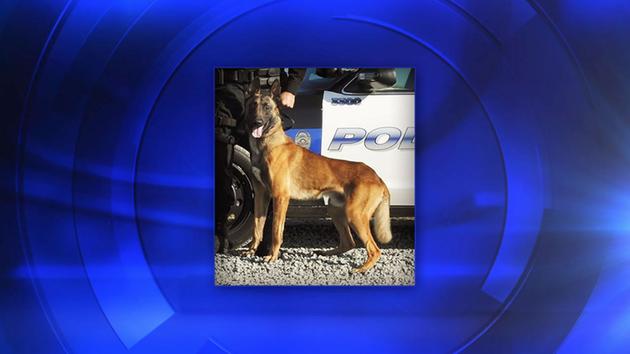
Porterville Police K-9 "Idol"
Updated 31 mins ago
FRESNO, Calif. (KFSN) -- Porterville Police announced that K-9 "Idol" died in the back of a Porterville Police vehicle on Wednesday after the air conditioner shut off.
Police said that Idol's handler placed him in the patrol car with the air conditioning on after a training session to cool him down. After about 1 1/2 hours, the handler returned to find Idol deceased in the back. He said the car was no longer running and the air conditioner was off. The K-9 unit did have a warning system to alert the handler when temperatures in the car became unsafe, but it did not activate.
Tulare County Sheriff's Office investigators were not able find out why the car turned off, but they did find the temperature warning system was faulty. Sheriff's investigators said there was no criminal act, and no charges will be filed against the handler.
The Porterville Police Department said they are now in the process of refitting all K-9 units with new warning systems and implementing safety procedures.
Stay with Action News and ABC30.com for more on this story.


