MEC&F Expert Engineers

Monday, September 14, 2015

DAH!! A Tarp Does Not Constitute a Roof for Insurance Claim Purposes in California

A Tarp Does Not Constitute a Roof for Insurance Claim Purposes in California

Some Californians have faith that El Niño will bring about major storms later this year. While I am a skeptic, many homeowners being proactive by electing to repair or replace their existing roofs in advance of El Niño should do so before any serious rain.

When roofing work is performed, tarps or plastic sheeting are commonly used to cover exposed portions of the roof, albeit temporarily. Well, what happens if, during a rain storm, the plastic sheeting blows open allowing rain to enter the property? Is there coverage for the resulting interior damage? This was addressed by the court in Diep v. California Fair Plan Association.1 In Diep, the insurance policy provided in relevant part:
Company shall not be liable for loss to the interior of the building(s) or the property covered therein caused: (1) by rain, snow, sand or dust, whether driven by wind or not, unless the building(s) covered or containing the property covered shall first sustain an actual damage to roof or walls by the direct action of wind or hail and then shall be liable for loss to the interior of the building(s) or the property covered therein as may be caused by rain, snow, sand or dust entering the building(s) through openings in the roofs or walls made by direct action of wind or hail.
The above language is commonplace in practically all property policies which provides coverage for interior property damage and contents only if wind or hail first creates openings allowing rain (in the case of a rain storm) to intrude into the property. In other words, it is not sufficient for rain to find its way into the property without the prerequisite damage to the roof or walls.


The court in Diep held that if the tarp or plastic sheeting constituted a roof, then there would be coverage if the wind blew the sheeting open allowing rain to enter. However, after working through some dictionary definitions of "roof," the court deemed that plastic sheeting was only a nonstructural "band-aid" and therefore could not be construed as a roof since a roof is considered a "permanent part of the structure it covers."

Important to the court's analysis was that the breach of the roof was not caused by wind or hail, but by workers who removed the portion of the roof needing the repair prior to placing the plastic sheeting to the open areas.2 Hence, the court found that plastic sheeting does not constitute a roof and thus, there was no covered occurrence.

It is important to note that courts in states other than California have ruled whether a tarp can be construed as a roof. The majority of those courts that have dealt with the issue have held that tarps do not constitute roofs. If you are a policyholder uncertain as to your own claim or case, consult with an insurance professional. As is often the case, there is no uniformity among the states on any given issue.

1 Diep v. California Fair Plan Association (1993) 15 Cal. App. 4th 1205.
2 If a tarp is used by the property owner to safeguard the property following a storm which caused damage to the roof and subsequent winds blew off the tarp, then this would be a different scenario. Coverage should be afforded if the damage occurs when the property owner is mitigating his damages by taking further protective measures.

Obviously here the lawyers made a killing by presenting that stupid tarp argument to the court and receiving huge fees.  The big loser here is the insured who lost his money and his property got damaged.  Cheers mate.

New Jersey Insurance Coverage Litigation - Direct Actions against Insurance Companies


Direct Actions against Insurance Companies

Posted: 11 Sep 2015 09:14 AM PDT

Labor Day has just passed as I write this, and this summer (that went by too quickly) was a busy one for the New Jersey appellate courts, insurance-wise. The New Jersey Supremes, for example, dealt with a question often posed by our clients in construction defect cases: Namely, can a claimant proceed directly against a defendant’s insurance company? (That is, sue the defendant’s insurance company directly instead of, or in addition to, suing the defendant?) In fact, as I was working over the holiday (ugh) I got a call from a potential client whose general contractor messed up her house pretty badly, and whose homeowners’ carrier is giving her a hard time about paying for the damage, which includes water infiltration and mold as the result of the GC’s shoddy work. (Why was I talking to a prospective client on Labor Day? Because, when you own your own firm, every day is “Labor Day”.) She asked whether she could sue the GC’s insurance carrier directly, since she didn’t think the GC had any money.

The answer, at least in New Jersey, is generally no. The new Supreme Court decision is Ross v. Lowitz. The facts: Home heating oil leaked from a neighbor’s underground storage tank onto the property of John and Pamela Ross. In addition to suing the current and former owners of the neighboring property, the Rosses also sued the insurance companies who provided homeowners’ coverage to the former owners of the neighboring property, for bad faith in not resolving the loss fully. The Rosses argued that they were third-party beneficiaries under the neighbors’ policies, and therefore were entitled to bring a direct claim.

But the Court disagreed, writing: “It is a fundamental premise of contract law that a third party is deemed to be a beneficiary of a contract only if the contracting parties so intended when they entered into their agreement. Here, there is no suggestion in the record that the parties to the insurance contract at issue had any intention to make plaintiffs, then the neighbors of the insured, a third-party beneficiary of their agreements. Nor does migration of oil from [the neighbors’] property to plaintiffs’ residence retroactively confer third-party beneficiary status on plaintiffs. The insurer’s duty of good faith and fair dealing in this case extended to their insured, not to plaintiffs.”

To the extent that the neighbors’ liability coverage (as opposed to first-party coverage) is implicated, though, this doesn’t make sense. Of course the purpose of liability insurance is to confer a benefit upon an injured third-party. I guess with the Court really meant to say was, unless there is specific intent to confer a benefit on a specific claimant, then third-party beneficiary status does not exist.

The coverage aspect of the Ross case only dealt with the question of whether a third party could sue for bad faith. It remains to be seen how the case will be applied in other contexts. Generally, until now, a claimant would have to take a judgment against a defendant in a specified amount, prove that the defendant is insolvent and cannot pay the judgment, and then request permission from the trial court to pursue the defendant’s liability carrier directly.

You can read the Ross case here.

Another case that came down this summer is 213-15 76th Street Condo Assn. v. Scottsdale Ins. Co. , a federal court decision that stemmed from a Superstorm Sandy related first-party wind damage claim. The case involved the question of whether recovery of attorneys’ fees is permitted in first-party cases in New Jersey. The policyholder argued that discovery “might” show that the insurance company acted in bad faith in handling the claim, and that attorney’s fees should be allowed as damages in bad faith cases. The (quirky) rule in New Jersey (R.4:42-9) is that attorneys’ fees are recoverable by a successful claimant in a third-party (liability) coverage lawsuit, but not specifically in a first-party case.

The Court basically punted, writing: “Under New Jersey law, counsel fees may be awarded when an insurer refuses to indemnify or defend its insured’s third-party liability to another, but an insured who brings direct suit against his insurer for coverage is not entitled to a fee award… Plaintiff asserts that a bad faith claim would support its request for attorneys’ fees, [but] the complaint does not contain any allegations that defendant acted in bad faith… There is no basis for plaintiffs request for attorneys’ fees at this time.” (Emphasis added.)

I’m not sure why defense counsel would waste time filing a motion to strike a claim for attorneys’ fees before an application for attorneys’ fees is actually made, but I guess nothing succeeds like success. Presumably the carrier felt that striking the claim for attorneys’ fees would reduce the settlement value of the case from the plaintiff’s perspective.

You can read the 213-15 76th Street case here.


Dunbar Asphalt to Clean up 29-Acre Portion of Sharon Steel Superfund Site, Hermitage, Pa.


SEPTEMBER 14, 2015


PHILADELPHIA, PA


The U.S. Environmental Protection Agency today announced a proposed settlement the government has reached with Dunbar Asphalt Products, Inc., to clean up a 29-acre portion of the Sharon Steel Corporation Superfund Site in Hermitage, Pa. The cleanup will better protect workers from exposure to contaminants on the site and prevent airborne releases of the contaminants.

“This settlement advances the cleanup work at Sharon Steel, allows for two local businesses to continue operating, and protects workers’ health and the local community,” said EPA Regional Administrator Shawn M. Garvin. “Getting this cleanup work underway builds on the progress we’re steadily making in the overall cleanup and reuse of this property.”

Under this proposed settlement, Dunbar will pay the costs to cover exposed slag with asphalt or clean fill to prevent releases of heavy metals and polyaromatic hydrocarbons (PAHs), and ensure there is no exposed waste. Dunbar will also reimburse EPA for future costs related to the cleanup of this 29-acre portion of the site. EPA estimates that it would have cost the agency $1.7 million to clean up this portion of the site if a settlement had not been reached with Dunbar.

Dunbar and Williams Brothers Trucking Company are each operating businesses at the site. EPA selected a process that allows the businesses to continue operating while the protective remedy is being installed.

The entire Sharon Steel Site covers about 325 acres in Mercer County. Sharon Steel Corp. used this area to dispose of slag and other waste generated from the company’s steel-making operations at its nearby Farrell Works plant. The slag and other wastes contaminated soil and groundwater. In 1998, EPA added the site the National Priorities List of sites that have known, or are threatened by, releases of hazardous substances, pollutants, or contaminants.

The proposed settlement is subject to a 30-day public comment period which started Sept. 11, 2015, and requires court approval before becoming final.

EPA is paying to clean up other areas at this Superfund site.

For proposed settlement and how to comment:

http://www.justice.gov/enrd/consent-decree/us-v-dunbar-asphalt-products-inc. Additional information about the Sharon Steel Corporation (Farrell Works Disposal Area) Superfund Site is at: http://www.epa.gov/reg3hwmd/npl/PAD001933175.htm

23,000 displaced, homes destroyed, people/animals killed, severe air quality from 2 massive wildfires in Northern California


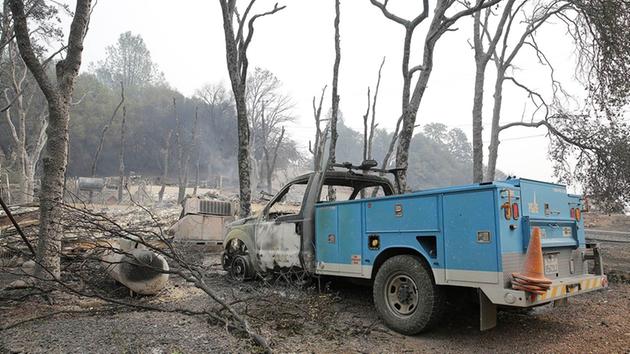
Valley Fire destruction
A burned Pacific Gas and Electric truck sits outside a number of homes destroyed by fire Sunday, Sept. 13, 2015, in Hidden Valley, Calif. (Eric Risberg)
An explosive wildfire burned largely unchecked Monday after incinerating hundreds of homes and other buildings throughout rural communities north of California's Napa Valley, leaving at least one person dead and sending tens of thousands fleeing down flame-lined streets.

But it's not the only one. A second massive blaze, less than 200 miles away, destroyed 135 homes as it spread through Amador and Calaveras counties in the Sierra Nevada. That fire was 30 percent contained.

Both fires have displaced 23,000 people, Mark Ghilarducci, director of the Governor's Office of Emergency Services, said at a news conference Monday. He says one person died in the wildfire about 20 miles north of the famed Napa Valley, and others are unaccounted for, but didn't have further details.

The fire exploded in size within hours as it chewed through brush and trees parched from four years of drought, destroying 400 homes, two apartment complexes and 10 businesses since igniting Saturday, Cal Fire spokeswoman Lynn Valentine said. By Monday morning, crews had gained 5 percent containment of the 95-square-mile blaze.

Residents fled from Middletown, a town of more than 1,000 residents, dodging smoldering telephone poles, downed power lines and fallen trees as they drove through billowing smoke. Several hundred people spent Sunday night at the Napa County Fairgrounds and awoke to a breakfast of eggs, bacon, and doughnuts.

Evacuees milled around eating, picking up donated clothing and walking their dogs. Nancy O'Byrne, 57, was evacuated from her home in Middletown, but it's still standing.

"I am very, very, very lucky. I have my house," she said, her dog Nellie at her side.

Still, she was worried.

"This place is getting steadily fuller," she said surveying the fairgrounds, where tents were pitched and RVs were parked everywhere.

Michael Alan Patrick, 53, had been at the fairgrounds since Saturday and lost his house in the blaze. When it broke out, he had been sitting in a park with his friends.

"It was like looking through a tunnel. You could see the flames coming," he said. "There was this big old pine tree, it lit up and it went whoosh and it was gone."

Whole blocks of houses burned. On the west side of town, house after house was charred to their foundations, with only blackened appliances and twisted metal garage doors still recognizable.

Valentine said most of the destruction occurred in Middletown and Hidden Valley Lake, as well as among numerous homes along a shuttered state highway. Wind gusts that reached up to 30 mph sent embers raining down on homes and made it hard for firefighters to stop the Lake County blaze from advancing, officials said.

Four firefighters who are members of a helicopter crew suffered second-degree burns during the initial attack on the fire. They remained hospitalized in stable condition.

The fire continued to burn in all directions, triggering the evacuation of a stretch along Highway 281, including Clear Lake Riviera, a town of about 3,000 residents. It was threatening critical communications infrastructure as well as a power plant, Cal Fire said.

Gov. Jerry Brown on Sunday declared a state of emergency to free up resources. He had already declared a state of emergency for the separate 111-square-mile wildfire about 70 miles southeast of Sacramento that has turned the grassy, tree-studded Sierra Nevada foothills an eerie white.

Ghilarducci, of the Governor's Office of Emergency Services, said this summer's fires are the most volatile he has seen in 30 years of emergency response work. The main cause behind the fast-spreading fires is dry conditions from the drought.

"The bushes, the trees have absolutely no moisture in them, and the humidities are so low that we are seeing these 'fire starts' just erupt into conflagrations," Ghilarducci said.

Lake County saw devastation in just the last two months. In late July, a wildfire east of Clear Lake destroyed 43 homes as it spread across 109 square miles. As firefighters drew close to surrounding that blaze, another fire erupted several miles from the community of Lower Lake on Aug. 9 and more than doubled in size overnight.

Residents in the area had to evacuate from their homes two times in as many weeks.

East of Fresno, the largest wildfire in the state continued to march away from the Sierra Nevada's Giant Sequoia trees, some of which are 3,000 years old, fire spokesman Dave Schmitt said. The fire, which was sparked by lightning on July 31, has charred 211 square miles and was 36 percent contained Sunday, the U.S. Forest Service said.

Firefighters have maintained a precautionary line around Grant Grove, an ancient grove of Giant Sequoia trees, and set prescribed burns to keep the flames from overrunning it. The grove is named for the towering General Grant tree that stands 268 feet tall.

Cancer-Causing Substances in the Workplace and Home -Crystalline Silica


Cancer-Causing Substances in the Workplace and Home -Crystalline Silica


What is crystalline silica?
Crystalline silica is a basic component of soil, sand, granite, and many other minerals.  It is used extensively in many industrial applications because of its unique physical and chemical properties.  Quartz is the most common form of crystalline silica.  Cristobalite and tridymite are two other forms of crystalline silica.  All three forms may become respirable size particles when workers chip, cut, drill, or grind objects that contain crystalline silica.  During the last few years, thousands of workers have been exposed to crystalline silica during hydraulic fracturing activities because several thousand tons of pure crystalline silica are injected into the subsurface at every single gas well to keep the shale fractures open.
Sand, the most common size fraction of natural crystalline silica, has many applications. For example, it may be used in foundry castings, Portland cement, abrasives and sandblasting materials, and hydraulic fracturing.  It may also be used as a raw material for the production of silicon and ferrosilicon metals, or as a filter for large volumes of water, i.e. in municipal water and sewage treatment plants.  When sand has more than 98% silica and low iron content it can be used for glass and ceramic production.  Flours are formed by the grinding or quartz, quartzite, sand and sandstone. Flours are very fine grades of crystalline silica and are used in the ceramic and pottery industry, in the manufacturing of chrysotile cement, as a filler in rubber and paints and as an abrasive in soaps and cleaners.


What are the hazards of crystalline silica?
Silica exposure remains a serious threat to more than 2 million U.S. workers, including more than 100,000 workers in high risk jobs such as abrasive blasting, hydraulic fracturing, foundry work, stonecutting, rock drilling, quarry work and tunneling.  The seriousness of the health hazards associated with silica exposure is demonstrated by the fatalities and disabling illnesses that continue to occur in sandblasters and rockdrillers.  Crystalline silica has been classified as a human lung carcinogen. Additionally, breathing crystalline silica dust can cause silicosis, which in severe cases can be disabling, or even fatal.  The respirable silica dust enters the lungs and causes the formation of scar tissue, thus reducing the lungs’ ability to take in oxygen.  There is no cure for silicosis.  Since silicosis affects lung function, it makes one more susceptible to lung infections like tuberculosis.  In addition, smoking causes lung damage and adds to the damage caused by breathing silica dust.
What are the symptoms of silicosis?
Silicosis is classified into three types:  chronic /classic, accelerated, and acute.
Chronic/classic silicosis, the most common, occurs after 15–20 years of moderate to low exposures to respirable crystalline silica.  Symptoms associated with chronic silicosis may or may not be obvious; therefore, workers need to have a chest x-ray to determine if there is lung damage.  As the disease progresses, the worker may experience shortness of breath upon exercising and have clinical signs of poor oxygen/carbon dioxide exchange.  In the later stages, the worker may experience fatigue, extreme shortness of breath, chest pain, or respiratory failure.
Accelerated silicosis can occur after 5–10 years of high exposures to respirable crystalline silica.  Symptoms include severe shortness of breath, weakness, and weight loss.  The onset of symptoms takes longer than in acute silicosis.
Acute silicosis occurs after a few months or as long as 2 years following exposures to extremely high concentrations of respirable crystalline silica.  Symptoms of acute silicosis include severe disabling shortness of breath, weakness, and weight loss, which often leads to death.


Where are construction workers exposed to crystalline silica?
Exposure occurs during many different construction activities.  The most severe exposures generally occur during abrasive blasting with sand to remove paint and rust from bridges, tanks, concrete structures, and other surfaces.  Other construction activities that may result in severe exposure include: jack hammering, rock/well drilling, hydraulic fracturing, frac sand mining and loading and unloading, concrete mixing, concrete drilling, brick and concrete block cutting and sawing, tuck pointing, tunneling operations.
Where are general industry employees exposed to crystalline silica dust?
The most severe exposures to crystalline silica result from abrasive blasting, which is done to clean and smooth irregularities from molds, jewelry, and foundry castings, finish tombstones, etch or frost glass, or remove paint, oils, rust, or dirt form objects needing to be repainted or treated.  Other exposures to silica dust occur in cement and brick manufacturing, asphalt pavement manufacturing, china and ceramic manufacturing and the tool and die, steel and foundry industries.  Crystalline silica is used in manufacturing, household abrasives, adhesives, paints, soaps, and glass.  Additionally, crystalline silica exposures occur in the maintenance, repair and replacement of refractory brick furnace linings.
In the maritime industry, shipyard employees are exposed to silica primarily in abrasive blasting operations to remove paint and clean and prepare steel hulls, bulkheads, decks, and tanks for paints and coatings.


How is OSHA addressing exposure to crystalline silica?
OSHA has an established Permissible Exposure Limit, or PEL, which is the maximum amount of crystalline silica to which workers may be exposed during an 8-hour work shift (29 CFR 1926.55, 1910.1000). OSHA also requires hazard communication training for workers exposed to crystalline silica, and requires a respirator protection program until engineering controls are implemented.  Additionally, OSHA has a National Emphasis Program (NEP) for Crystalline Silica exposure to identify, reduce, and eliminate health hazards associated with occupational exposures.
What can employers/employees do to protect against exposures to crystalline silica?
Replace crystalline silica materials with safer substitutes, whenever possible.
Provide engineering or administrative controls, where feasible, such as local exhaust ventilation, and blasting cabinets.  Where necessary to reduce exposures below the PEL, use protective equipment or other protective measures.
Use all available work practices to control dust exposures, such as water sprays.
Wear only a N95 NIOSH certified respirator, if respirator protection is required.  Do not alter the respirator. Do not wear a tight-fitting respirator with a beard or mustache that prevents a good seal between the respirator and the face.
Wear only a Type CE abrasive-blast supplied-air respirator for abrasive blasting.
Wear disposable or washable work clothes and shower if facilities are available. Vacuum the dust from your clothes or change into clean clothing before leaving the work site.
Participate in training, exposure monitoring, and health screening and surveillance programs to monitor any adverse health effects caused by crystalline silica exposures.
Be aware of the operations and job tasks creating crystalline silica exposures in your workplace environment and know how to protect yourself.
Be aware of the health hazards related to exposures to crystalline silica.  Smoking adds to the lung damage caused by silica exposures.
Do not eat, drink, smoke, or apply cosmetics in areas where crystalline silica dust is present.  Wash your hands and face outside of dusty areas before performing any of these activities.
Remember: If it’s silica, it’s not just dust.


How can I get more information on safety and health?
OSHA has various publications, standards, technical assistance, and compliance tools to help you, and offers extensive assistance through workplace consultation, voluntary protection programs, strategic partnerships, alliances, state plans, grants, training, and education.  OSHA’s Safety and Health Program Management Guidelines (Federal Register 54:3904-3916, January 26, 1989) detail elements critical to the development of a successful safety and health management system. This and other information are available on OSHA’s website.
For one free copy of OSHA publications, send a self-addressed mailing label to OSHA Publications Office, 200 Constitution Avenue N.W., N-3101, Washington, DC 20210; or send a request to our fax at (202) 693–2498, or call us toll-free at (800) 321–OSHA.
To order OSHA publications online at www.osha.gov, go to Publications and follow the instructions for ordering.
To file a complaint by phone, report an emergency, or get OSHA advice, assistance, or products, contact your nearest OSHA office under the U.S. Department of Labor listing in your phone book, or call toll-free at (800) 321OSHA (6742). The teletypewriter (TTY) number is (877) 889–5627.
To file a complaint online or obtain more information on OSHA federal and state programs, visit OSHA’s website.
This is one in a series of informational fact sheets highlighting OSHA programs, policies, or standards. It does not impose any new compliance requirements. For a comprehensive list of compliance requirements of OSHA standards or regulations, refer to Title 29 of the Code of Federal Regulations. This information will be made available to sensory-impaired individuals upon request. The voice phone is (202) 693–1999. See also OSHA’s website at www.osha.gov.