MEC&F Expert Engineers

Saturday, July 18, 2015

The pilot's decision to rotate the propeller by hand without properly securing the airplane resulted in the crash of CESSNA 182T, registration: N53310 in ST MARYS, PA

NTSB Identification: GAA15CA057
14 CFR Part 91: General Aviation
Accident occurred Sunday, May 03, 2015 in ST MARYS, PA
Probable Cause Approval Date: 07/08/2015
Aircraft: CESSNA 182T, registration: N53310
Injuries: 1 Minor, 1 Uninjured.
 
NTSB investigators used data provided by various entities, including, but not limited to, the Federal Aviation Administration and/or the operator and did not travel in support of this investigation to prepare this aircraft accident report.

According to the pilot, following pre-flight inspection he attempted to start the engine with the electrical starter but was unable to get the engine to turn over. He turned the magnetos to the off position and then got out of the airplane to "turn the prop through," but was not attempting to hand prop the engine.

When the pilot rotated the propeller by hand, the engine started and the airplane immediately began moving forward. He attempted to enter the airplane but was unable to stop the airplane before it impacted an airport building.

A passenger was sitting in the front right seat of the airplane and was able to evacuate the airplane after it collided with a building. The pilot stated that he should have chocked the wheels, but he was not planning on starting the engine.

According to the airport manager who responded within minutes after the accident, he observed the ignition key selected to the left magneto, and then turned the key off during the post-accident emergency response. The airport manager also reported that the throttle was in the full forward position and the mixture was in the full rich position.

During a post-accident examination, a Federal Aviation Administration Aviation Safety Inspector found no anomalies with the ignition wiring system or magneto P-leads. The airplane sustained substantial damage to the left wing and fuselage.

The National Transportation Safety Board determines the probable cause(s) of this accident as follows:
  • The pilot's decision to rotate the propeller by hand without properly securing the airplane.

On July 7, 2015, at 1100 eastern daylight time, a Cessna 150M, N3601V, and a Lockheed-Martin F-16CM, operated by the U.S. Air Force (USAF), collided in midair near Moncks Corner, South Carolina. The Cessna was destroyed during the collision, and both the private pilot and passenger were fatally injured.


NTSB Identification: ERA15FA259B
14 CFR Armed Forces
Accident occurred Tuesday, July 07, 2015 in Moncks Corner, SC
Aircraft: LOCKHEED-MARTIN F-16CM, registration: 96-0085
Injuries: 2 Fatal, 1 Uninjured.
 
This is preliminary information, subject to change, and may contain errors. Any errors in this report will be corrected when the final report has been completed. NTSB investigators either traveled in support of this investigation or conducted a significant amount of investigative work without any travel, and used data obtained from various sources to prepare this aircraft accident report.

On July 7, 2015, at 1100 eastern daylight time, a Cessna 150M, N3601V, and a Lockheed-Martin F-16CM, operated by the U.S. Air Force (USAF), collided in midair near Moncks Corner, South Carolina. The Cessna was destroyed during the collision, and both the private pilot and passenger were fatally injured. The damaged F-16 continued to fly for an additional 3 minutes until the pilot activated the airplane's ejection system. 
 
The F-16 was destroyed following the subsequent collision with terrain and post-impact fire, while the pilot landed safely and was uninjured. Visual meteorological conditions prevailed, and no flight plan was filed for the Cessna, while the F-16 was operating on an instrument flight rules flight plan. The Cessna departed from Berkley County Airport (MKS), Moncks Corner, South Carolina, at 1057, and was destined for Grand Strand Airport (CRE), North Myrtle Beach, South Carolina; the personal flight was conducted under the provisions of Title 14 Code of Federal Regulations Part 91. The F-16 had departed from Shaw Air Force Base (SSC), Sumter, South Carolina about 1020.

According to the USAF, after departing from SSC, the F-16 proceeded to Myrtle Beach International Airport (MYR), Myrtle Beach, South Carolina, where the pilot conducted two practice instrument approaches before continuing the flight to Charleston Air Force Base/International Airport (CHS), Charleston, South Carolina. According to preliminary air traffic control (ATC) radar and voice communication data provided by the Federal Aviation Administration (FAA), the F-16 pilot contacted the approach controller at CHS about 1052 and requested to perform a practice tactical air navigation system (TACAN) instrument approach to runway 15. The controller subsequently instructed the F-16 pilot to fly a heading of 260 degrees to intercept the final approach course. At 1055, the controller instructed the F-16 pilot to descend from his present altitude of 6,000 feet to 1,600 feet. About that time, the F-16 was located about 34 nautical miles northeast of CHS.

At 1057:41, a radar target displaying a visual flight rules transponder code of 1200, and later correlated to be the accident Cessna, appeared in the vicinity of the departure end of runway 23 at MKS, at an indicated altitude of 200 feet. The Cessna continued its climb, and began tracking generally southeast over the next 3 minutes. For the duration of its flight, the pilot of the Cessna did not contact CHS approach control, nor was he required to do so. At 1100:18, the controller advised the pilot of the F-16, "traffic 12 o'clock, 2 miles, opposite direction, 1,200 [feet altitude] indicated, type unknown." The F-16 pilot responded and advised the controller that he was "looking" for the traffic. At 1100:26, the controller advised the F-16 pilot, "turn left heading 180 if you don't have that traffic in sight." The pilot responded by asking, "confirm 2 miles?" Eight seconds later, the controller stated, "if you don't have that traffic in sight turn left heading 180 immediately." Over the next 18 seconds, the track of the F-16 began turning southerly.

At 1100:49, the radar target of the F-16 was located 1/2 nautical mile northeast of the Cessna, at an indicated altitude of 1,500 feet, and was on an approximate track of 215 degrees. At that time, the Cessna reported an indicated altitude of 1,400 feet, and was established on an approximate track of 110 degrees. At 1100:52 the controller advised the F-16 pilot, "traffic passing below you 1,400 feet." At 1100:54, the radar reported altitude of the F-16 remained at 1,500 feet and no valid altitude information was returned for the radar target associated with the Cessna. At that point the targets were laterally separated by about 1,000 feet. No further radar targets were received from the Cessna, and the next radar target for the F-16 was not received until 1101:13. At 1101:19, the F-16 pilot transmitted a distress call, and no subsequent transmissions were received. Air traffic control radar continued to track the F-16 as it proceeded on a roughly southerly track, and after descending to an indicated altitude of 300 feet, radar contact was lost at 1103:17 in the vicinity of the F-16 crash site.

The wreckage of the Cessna was recovered in the vicinity of its last observed radar target, over the west branch of the Cooper River. Components from both airplanes were spread over an area to the north and west of that point, extending for approximately 1,200 feet. The largest portions of the Cessna's airframe included a relatively intact portion of the fuselage aft of the main landing gear, and the separate left and right wings, all of which were within 500 feet northwest of the airplane's final radar-observed position. Portions of the cabin interior, instrument panel, fuel system, and engine firewall were found distributed throughout the site. The engine, propeller, and nose landing gear assembly were not recovered. The lower aft engine cowling of the F-16 was also recovered in the immediate vicinity of the Cessna's aft fuselage, while the F-16's engine augmenter was recovered about 1,500 feet southwest. Small pieces of the F-16's airframe were also distributed throughout the accident site.

Both of the Cessna's wings displayed uniform leading edge crush damage throughout their spans that was oriented aft and upward. Paint transfer and rub markings oriented in a direction from the airplane's left to right were observed on the upper forward surfaces of both wings. Both fuel tanks were ruptured, and evidence of heat damage and paint blistering were observed on the upper surface of the right wing. Flight control continuity was traced through overload-type cable separations from the cabin area to each flight control surface. Measurement of the pitch trim actuator showed a position consistent with a 3 to 4-degree deflection of the tab in the nose down direction, and measurement of the flap actuator showed a position consistent with the flaps having been in the retracted position.

The F-16 wreckage site was located about 6 nautical miles south of the Cessna wreckage site. The F-16 wreckage path was about 700 feet long and oriented roughly 215 degrees, with portions of the airframe distributed along the wreckage path. The wreckage displayed significant ground impact and post-impact fire-related damage. A crash-survivable memory unit (CSMU) was recovered from the wreckage, and the digital flight control system seat data recorder (DFLCS SDR) was recovered from the airplane's ejection seat. Both memory units were forwarded to the airframe manufacturer for data extraction under the supervision of an NTSB Vehicle Recorder Specialist.

The weather conditions reported at MKS at 1055 included calm winds, 10 statute miles visibility, scattered clouds at 2,600 feet agl, a temperature of 30 degrees C, a dew point of 22 degrees C, and an altimeter setting of 30.15 inches of mercury.


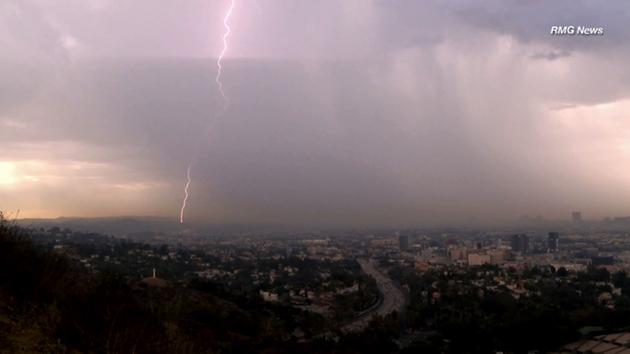
Lightning, thunderstorms shut down Greater Los Angeles area beaches, thousands without power


A lightning strike over Los Angeles is caught in a photo on Saturday, July 18, 2015.
A lightning strike over Los Angeles is caught in a photo on Saturday, July 18, 2015. (KABC)
Lightning and severe thunderstorms left thousands without power and temporarily shut down beaches across the Southland on Saturday.

About 16,000 Southern California Edison customers were impacted by the power outage, including communities in Arrowhead, Redlands, Wildomar, Victorville, Foothill, Menifee, Compton and Whittier, according to the Los Angeles Department of Water and Power. Not all power outages, however, were related to rain.

Crews are working to restore the power in the affected areas, but it could take several hours.

Beaches across the Southland, including those in Ventura, Los Angeles and Orange counties, were temporarily shut down due to threats of lightning strikes. Dangerous surf and rip currents were also reported.

Several beaches and piers reopened at 6 p.m.

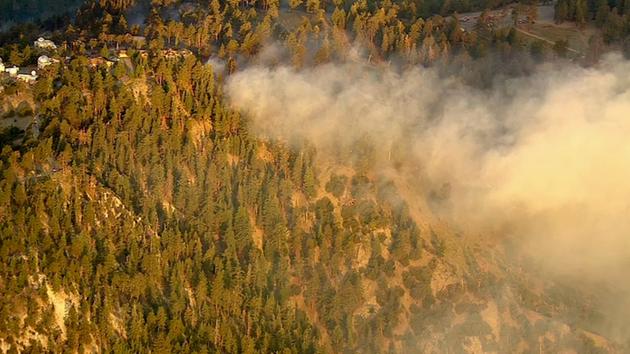
Pine Fire in Angeles National Forest grows to 200 acres; 35 percent contained


Smoke from the Pine Fire billows above the trees in the Angeles National Forest on Saturday, July 18, 2015.
Smoke from the Pine Fire billows above the trees in the Angeles National Forest on Saturday, July 18, 2015. (KABC)
A fast-moving brush fire in the Angeles National Forest near Wrightwood threatened structures and caused hundreds of evacuations from multiple campgrounds. The fire is 35 percent contained, according to the U.S. Forest Service.

The fire, dubbed the Pine Fire, was reported at about 9:30 p.m. Friday in heavy timber in the 24500 block of North Angeles Crest Highway, according to Los Angeles County firefighters. About 150 firefighters were on scene.

The flames have burned 200 acres. Highway 2 (Angeles Crest Highway) from Wrightwood to Big Pines was reported shut down. Highway 2 was also shut down from Islip Saddle to the Los Angeles County line.

About 90 Girl Scouts evacuated from Table Mountain Campground and 300 campers were evacuated from Lion's Campground, AFY Campground and Christian Summer Camp, Los Angeles County sheriff's officials said. About 130 of the campers were deaf and hard-of-hearing children.

All were taken by Los Angeles Sheriff's Department vans and jail buses headed to Serrano High School, 9292 Sheep Creek Road in Phelan.

No human injuries were immediately reported. Pine trees, though, are burning alive.

ExxonMobil Gave Millions to Climate-Denying Lawmakers to Sabbotage Worldwide Efforts to Plan for Climate Change


Published in Oil Industry News on Saturday, 18 July 2015

Graphic for ExxonMobil Gave Millions to Climate-Denying Lawmakers in Oil and Gas News
ExxonMobil gave more than $2.3m to members of Congress and a corporate lobbying group that deny climate change and block efforts to fight climate change – eight years after pledging to stop its funding of climate denial, the Guardian has learned.

Climate denial – from Republicans in Congress and lobby groups operating at the state level – is seen as a major obstacle to US and global efforts to fight climate change, closing off the possibility of federal and state regulations cutting greenhouse gas emissions and the ability to plan for a future of sea-level rise and extreme weather.

Exxon channeled about $30m to researchers and activist groups promoting disinformation about global warming over the years, according to a tally kept by the campaign group Greenpeace. But the oil company pledged to stop such funding in 2007, in response to pressure from shareholder activists.

“In 2008 we will discontinue contributions to several public policy groups whose position on climate change could divert attention from the important discussion on how the world will secure energy required for economic growth in an environmentally responsible manner,” Exxon said in its 2007 Corporate Citizenship report.

But since 2007, the oil company has given $1.87m to Republicans in Congress who deny climate change and an additional $454,000 to the American Legislative Exchange Council (Alec), according to financial and tax records.
In a statement to the Guardian this week, Exxon spokesman Richard Keil reiterated: “ExxonMobil does not fund climate denial.”

Alec, an ultra-conservative lobby group, has hosted seminars promoting the long-discredited idea that rising carbon dioxide emissions are the “elixir of life”, and was behind legislation banning state planners in North Carolina from considering future sea-level rise.

Campaigners said Exxon’s support for members of Congress and lobby groups that deny climate change was at odds with the company’s public position that it is committed to acting on the threat posed by global warming.

“If they are going to be serious about what they say about believing in the science of climate change, they should actually take action and show they are genuine,” said David Turnbull, campaign director of Oil Change International, which compiled the data on Exxon contributions to members of Congress at the Guardian’s request.

A majority of Republicans in the House of Representatives and the Senate deny climate change or oppose action to fight climate change, according to the Center for American Progress.

Exxon’s beneficiaries in Congress include the Oklahoma senator Jim Inhofe, who called global warming a hoax, and who has received $20,500 since 2007, according to the Dirty Energy Money database maintained by Oil Change International.

Exxon funded the Mississippi senator Roger Wicker, who cast the single no vote earlier this year against a symbolic “sense of the Senate” resolution that climate change was real and not a hoax. The resolution passed 98-1. Wicker, who received $14,000 from Exxon, voted no.

Exxon also gave a total of $868,150 to Republican senators who voted against another symbolic resolution that human activity was a significant driver of climate change.

Each of the 49 Republican senators who voted no received at least $5,000 from Exxon, according to Oil Change figures.

Exxon has also continued to fund Alec, which works to block climate legislation in state legislatures, according to figures compiled by the Climate Investigations Center from the oil company’s own disclosures in its annual Worldwide Giving Reports and foundation tax filings.

Alec has for decades worked to block action on climate change, by drafting bills for state legislatures aimed at dismantling environmental regulations. The lobby group hosted a summit last December featuring a speaker who called carbon dioxide emissions “the elixir of life”.

“The ongoing rise in atmospheric carbon dioxide should be welcomed with opened arms,” Craig Idso, founder of the Center for the Study of Carbon Dioxide and Global Change, told about 100 state legislators and corporate executives at the summit, according to InsideClimate News. Such claims have been dismissed in their entirety by scientists. 

The ultra-conservative Alec claims to support “free market environmentalism” and on its website accuses campaign groups of conflating this with climate denial. However, the website refers to climate change as a “historical phenomenon”, and states – contrary to fact – that its causes are a matter of continued debate. When asked directly, an Alec spokesman declined to say whether the lobby group saw climate change as a threat, and declined to say whether it stood by Idso’s views.

“Alec is a forum for the exchange of ideas and continuing education of state legislators. All viewpoints are welcome. Indeed,” Wilhelm Meierling, an Alec spokesman, said in an email. “Today, legislators want to learn from as many viewpoints as possible in order to make the best possible decision for the people they represent.”

He said Exxon did not underwrite the “continuing education workshop” with Idso.

Alec suffered a string of defections over its position on climate change during the last year, with companies such as Rupert Murdoch’s News Corp, BP America, Microsoft, Facebook and Yahoo resigning their memberships.

Google accused the lobbying group of lying about climate change.
Exxon would not discuss its membership in Alec. However, the company said it was serious about confronting climate change and does not fund climate denial. In 2007, the oil company committed to ending its support for a network of think tanks and activist groups that deny the science underlying climate change or have worked to block action against climate change.

Keil, the Exxon spokesman, said in an email: “We are taking action in a range of ways – by reducing greenhouse gas emissions in our operations, helping consumers reduce their emissions, and by supporting research at leading US universities into both increased emissions reduction capability and research into alternative energy sources.”

Keil did not respond to specific questions about Exxon’s financial support for members of Congress who deny climate change, about its support for Alec, or about funding of the Idso seminar.

“I don’t believe we underwrite specific Alec functions, and, as should be abundantly clear from my past statements to you, we believe climate change is real and warrants action, we’re taking steps to address it, which I’ve also provided you voluminous detail on, and we don’t embrace the views of those who deny climate change or think it isn’t a serious matter,” Keil wrote in an email.

He went on: “Because The Guardian has abandoned objective journalism and has a clear agenda regarding climate change, it can no longer be trusted to do the job its readers have a right to expect, which is to provide accurate and unbiased coverage on this important topic.”

Corporate funding of climate denial is seen as a major barrier to US action on climate change – and dividing the US from Europe in addressing global warming.

“If Exxon was very clear about this, it would be a big help,” said Jeff Sachs, president of the Earth Institute and an adviser to the United Nations on climate change. “If this is what they believe, they ought to make it known and they ought to make it known very publicly because we have the entire Republican party in denial and fighting tooth and nail every step of the way against reasonable action. Exxon could make a very big difference.”
Source: www.theguardian.com