Proposed OSHA regulations target fatal disease that remains daily risk for many workers
June 29, 2015
Originally published on June 30, 2015 9:52 am
Over
two million American workers are exposed to silica dust in industries
like construction, mining, road repair and sand blasting. WXXI’s
Michelle Faust reports the Occupational Safety and Health Administration
- OSHA - is now pushing for tougher limits on
how much silica dust they can be exposed to in the workplace. But the
proposed rules will come too late for many workers who’ve already
contracted the potentially fatal lung disease, silicosis.
“It was one particular job that was
up in Rome, New York. We had these big brick buildings and we had to
remove a lot of the damaged brick…And that’s how I got sick.”
Chris
Johnson from Port Byron, New York learned about silicosis the hard way.
He’s a mason and worked in construction since he graduated from high
school, like his father, uncles, and cousins. He was 29-years old on the
job that changed his life.
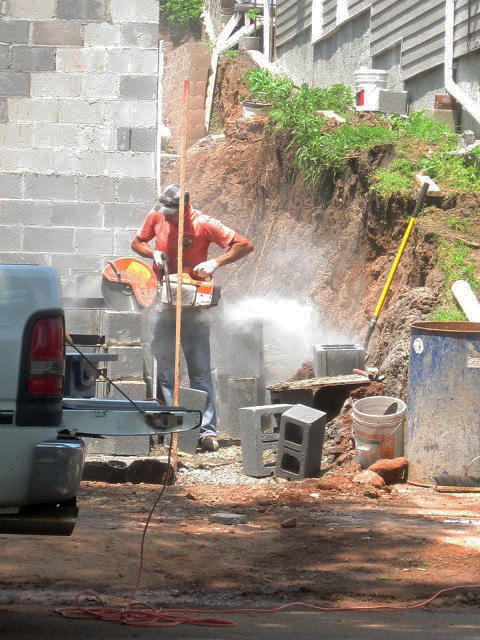
The white disposable masks Johnson wore on the job were supposed to protect him.
“After every time I got done cutting you’d have stuff up in your nostrils that you’d blow out.”
The
tiny dust particles that ended up in Johnson’s lungs were silica - one
of the most common earth minerals. Job’s like his that call for drilling
or cutting into bricks or mortar send tiny silica particles into the
air. In Johnson’s case, the exposure was so acute silicosis came on in
just a few months. For most people who contract the disease--it’s
plagued stone workers since the Ancient Greeks - it develops over five
to ten years.
Dr. Bill Beckett was Johnson’s physician. He says workers can’t see or feel the silica they’re inhaling.
“And
it doesn’t really bother you, but the dust is building up in your
lungs. So, after a period of what may be months or years, there is
enough silica dust stuck in your lungs that it can cause permanent
damage. And by then, it’s too late to do anything about it.”
The U.S. Department of Labor produced the film Stop Silicosis way
back in 1938 and in its narration, “A wave of fear was sweeping the
country. Silicosis was taking its toll from the ranks of American
Workers The cause of the disease: dust. The results of the disease:
disablement, poverty, death. The cure for the disease: none.”
Nearly 80 years on since that film was made, there are still 1600 new cases of silicosis every year and around 100 fatalities.
It’s time says David Michaels, Assistant Secretary at OSHA, to put tougher regulations in place.
“Silica
is probably the major chemical exposure out there that we know of
that’s causing hundreds of workers to get sick every year that we have a
totally antiquated standard for. When we issued that standard, and once
it goes into effect, it’s going to prevent hundreds of cases of
silicosis every year, and save hundreds of lives, both from silicosis
but also lung cancer.”
Keeping
the silica out of workers lungs is a matter of keeping the dust down
with water or vacuum. In some cases workers would need to wear a
respirator.
In a letter to Michaels the industry calls it the
most expensive OSHA rule ever, with an estimated 4.9 billion dollar
price tag threatening more than 50,000 jobs.
But
Michaels and OSHA disagree with industry numbers. They say they’re
committed to working with the Obama administration to get them adopted
despite a lengthy bottle neck in the Office of Management and Budget as
the rules are reviewed.
“President
Obama has made it very clear – he is committed to getting the silica
standard out while he’s president. And we will work with him and the
White House to make sure that happens.”
Michael’s
acknowledges that OSHA’s rate of inspections - around 40,000 a year -
has been static over the past decades and that the new standards will
rely largely on employers to implement them.
Now
aged 40, married and with three stepchildren, Chris Johnson's life
expectancy is an open question. Although financially secure for the
moment, He’ll never work again.
Looking back, he wishes he could have avoided the whole process.
“So
if you can protect yourself and wear a respirator rather than it
affecting your whole entire life, and possible death, I think it’s five
seconds taking the respirator and putting it on, it’s more important.”
This story was reported and produced through a partnership with the Center for Public Integrity. For more on this story visit publicintegrity.org
///-------------------////
Cancer-Causing
Substances in the Workplace and Home -Crystalline Silica
What is crystalline silica?
Crystalline silica
is a basic component of soil, sand, granite, and many other minerals. It is used extensively in many industrial
applications because of its unique physical and chemical properties. Quartz is the most common form of crystalline
silica. Cristobalite and tridymite are
two other forms of crystalline silica.
All three forms may become respirable size particles when workers chip,
cut, drill, or grind objects that contain crystalline silica. During the last few years, thousands of
workers have been exposed to crystalline silica during hydraulic fracturing
activities because several thousand tons of pure crystalline silica are
injected into the subsurface at every single gas well to keep the shale
fractures open.
Sand, the most
common size fraction of natural crystalline silica, has many applications. For
example, it may be used in foundry castings, Portland cement, abrasives and
sandblasting materials, and hydraulic fracturing. It may also be used as a raw material for the
production of silicon and ferrosilicon metals, or as a filter for large volumes
of water, i.e. in municipal water and sewage treatment plants. When sand has more than 98% silica and low
iron content it can be used for glass and ceramic production. Flours are formed by the grinding or quartz,
quartzite, sand and sandstone. Flours are very fine grades of crystalline
silica and are used in the ceramic and pottery industry, in the manufacturing
of chrysotile cement, as a filler in rubber and paints and as an abrasive in
soaps and cleaners.
What are the hazards of crystalline silica?
Silica exposure
remains a serious threat to more than 2 million U.S. workers, including more
than 100,000 workers in high risk jobs such as abrasive blasting, hydraulic
fracturing, foundry work, stonecutting, rock drilling, quarry work and
tunneling. The seriousness of the health
hazards associated with silica exposure is demonstrated by the fatalities and
disabling illnesses that continue to occur in sandblasters and
rockdrillers. Crystalline silica has
been classified as a human lung carcinogen. Additionally, breathing crystalline
silica dust can cause silicosis,
which in severe cases can be disabling, or even fatal. The respirable silica dust enters the lungs
and causes the formation of scar tissue, thus reducing the lungs’ ability to
take in oxygen. There is no cure for
silicosis. Since silicosis affects lung
function, it makes one more susceptible to lung infections like tuberculosis.
In addition, smoking causes lung damage and adds to the damage
caused by breathing silica dust.
What are the symptoms of silicosis?
Silicosis is classified into three types: chronic /classic, accelerated, and acute.
Chronic/classic silicosis, the most common, occurs after 15–20 years of
moderate to low exposures to respirable crystalline silica. Symptoms associated with chronic silicosis
may or may not be obvious; therefore, workers need to have a chest x-ray to
determine if there is lung damage. As
the disease progresses, the worker may experience shortness of breath upon
exercising and have clinical signs of poor oxygen/carbon dioxide exchange. In the later stages, the worker may
experience fatigue, extreme shortness of breath, chest pain, or respiratory
failure.
Accelerated silicosis can occur after 5–10 years of high exposures
to respirable crystalline silica.
Symptoms include severe shortness of breath, weakness, and weight
loss. The onset of symptoms takes longer
than in acute silicosis.
Acute silicosis occurs after a few months or as long as 2
years following exposures to extremely high concentrations of respirable
crystalline silica. Symptoms of acute
silicosis include severe disabling shortness of breath, weakness, and weight
loss, which often leads to death.
Where are construction workers exposed to crystalline
silica?
Exposure occurs during many different
construction activities. The most severe
exposures generally occur during abrasive blasting with sand to remove paint
and rust from bridges, tanks, concrete structures, and other surfaces. Other construction activities that may result
in severe exposure include: jack hammering, rock/well drilling, hydraulic
fracturing, frac sand mining and loading and unloading, concrete mixing,
concrete drilling, brick and concrete block cutting and sawing, tuck pointing, tunneling
operations.
Where are general industry employees exposed to crystalline
silica dust?
The most severe exposures to crystalline
silica result from abrasive blasting, which is done to clean and smooth
irregularities from molds, jewelry, and foundry castings, finish tombstones,
etch or frost glass, or remove paint, oils, rust, or dirt form objects needing
to be repainted or treated. Other exposures
to silica dust occur in cement and brick manufacturing, asphalt pavement
manufacturing, china and ceramic manufacturing and the tool and die, steel and
foundry industries. Crystalline silica is
used in manufacturing, household abrasives, adhesives, paints, soaps, and
glass. Additionally, crystalline silica
exposures occur in the maintenance, repair and replacement of refractory brick furnace
linings.
In the maritime industry, shipyard employees are
exposed to silica primarily in abrasive blasting operations to remove paint and
clean and prepare steel hulls, bulkheads, decks, and tanks for paints and
coatings.
How is OSHA addressing exposure to crystalline silica?
OSHA has an established Permissible Exposure Limit,
or PEL, which is the maximum amount of crystalline silica to which workers may
be exposed during an 8-hour work shift (29 CFR 1926.55, 1910.1000). OSHA also
requires hazard communication
training for workers exposed to crystalline silica, and requires a respirator protection
program until engineering controls are implemented. Additionally, OSHA has a National Emphasis
Program (NEP) for Crystalline Silica exposure to identify, reduce, and
eliminate health hazards associated with occupational exposures.
What can employers/employees do to protect against exposures
to crystalline silica?
■ Replace crystalline silica materials
with safer substitutes, whenever possible.
■ Provide engineering or
administrative controls, where feasible, such as local exhaust ventilation, and
blasting cabinets. Where necessary to
reduce exposures below the PEL, use protective equipment or other protective
measures.
■ Use all available work practices to
control dust exposures, such as water sprays.
■ Wear only a N95 NIOSH certified
respirator, if respirator protection is required. Do not alter the respirator. Do not wear a
tight-fitting respirator with a beard or mustache that prevents a good seal
between the respirator and the face.
■ Wear only a Type CE abrasive-blast
supplied-air respirator for abrasive blasting.
■ Wear disposable or washable work
clothes and shower if facilities are available. Vacuum the dust from your
clothes or change into clean clothing before leaving the work site.
■ Participate in training, exposure
monitoring, and health screening and surveillance programs to monitor any
adverse health effects caused by crystalline silica exposures.
■ Be aware of the operations and job
tasks creating crystalline silica exposures in your workplace environment and
know how to protect yourself.
■ Be aware of the health hazards
related to exposures to crystalline silica.
Smoking adds to the lung damage caused by silica exposures.
■ Do not eat, drink, smoke, or apply
cosmetics in areas where crystalline silica dust is present. Wash your hands and face outside of dusty
areas before performing any of these activities.
■ Remember: If it’s silica, it’s not
just dust.
How can I get more information on safety and health?
OSHA has various
publications, standards, technical assistance, and compliance tools to help
you, and offers extensive assistance through workplace consultation, voluntary
protection programs, strategic partnerships, alliances, state plans, grants,
training, and education. OSHA’s Safety
and Health Program Management Guidelines (Federal Register 54:3904-3916, January
26, 1989) detail elements critical to the development of a successful safety
and health management system. This and other information are available on
OSHA’s website.
■ For one free copy of OSHA
publications, send a self-addressed mailing label to OSHA Publications Office,
200 Constitution Avenue N.W., N-3101, Washington, DC 20210; or send a request
to our fax at (202) 693–2498, or call us toll-free at (800) 321–OSHA.
■ To order OSHA publications online at
www.osha.gov, go to Publications and follow the instructions for
ordering.
■ To file a complaint by phone, report
an emergency, or get OSHA advice, assistance, or products, contact your nearest
OSHA office under the U.S. Department of Labor listing in your phone book, or
call toll-free at (800) 321– OSHA (6742). The teletypewriter
(TTY) number is (877) 889–5627.
■ To file a complaint online or obtain
more information on OSHA federal and state programs, visit OSHA’s website.
This is one in a
series of informational fact sheets highlighting OSHA programs, policies, or
standards. It does not impose any new compliance requirements. For a
comprehensive list of compliance requirements of OSHA standards or regulations,
refer to Title 29 of the Code of Federal Regulations. This information will be
made available to sensory-impaired individuals upon request. The voice phone is
(202) 693–1999. See also OSHA’s website at www.osha.gov.
Silica (Crystalline)
Fibers
and Dusts – Known Carcinogen (IARC 1)
CAS
No. 14808-60-7 (Quartz)
CAS No. 14464-46-1 (Cristabolite)
Photo:
Wikimedia Commons [1]
IARC
Monograph Vol. 68, 1997 (Group 1)
IARC
Monograph Vol. 100C, 2011. (Group 1)
Silica is one of the most common
minerals on earth and is a basic component of soil, sand, and rocks including
granite and quartzite. Silica exists in both crystalline and amorphous
(non-crystalline) forms.[2]
Conversion from amorphous to crystalline form can occur at high heat.[3]
Quartz is the most common form of crystalline silica and the most commonly used
industrially.[4]
Cristobalite also has important industrial uses. Tridymite is found in rocks
and is not an important industrial product.[4]
There are numerous other synonyms and product names for silica; see IARC for
more information.[2]
Crystalline silica is used
extensively in many industrial applications because of its unique physical and
chemical properties.[4]
Health concerns arise when silica containing products are disturbed by
grinding, cutting, drilling or chipping, creating respirable particulate.[5]
IARC’s classification in 1997 of
crystalline silica as a Group 1 carcinogen (carcinogenic to humans) is
specifically for quartz and cristobalite silica inhaled from occupational
sources.[2]
A recent IARC review of Class 1 carcinogens reaffirmed this classification.[15]
Epidemiological studies have shown a relationship between occupational exposure
to crystalline silica and increased risk of lung cancer, with the strongest
link in quarry and granite workers and workers involved in ceramic, pottery,
refractory brick and diatomaceous earth industries.[4]
Increased risk was not evident with exposure to amorphous silica.[2]
Silicosis, a non-reversible fibrotic
lung disease, is caused by the inhalation of crystalline silica particles.[6]
Silicosis is typically categorized as chronic (> 10 years exposure),
accelerated (high concentrations over 5-10 years) or acute (short term exposure
at high concentrations).[5]
Besides silicosis and lung cancer, occupational silica exposure has also been
linked to pulmonary tuberculosis, chronic obstructive pulmonary disease, and
autoimmune disease (rheumatoid arthritis).[7,8]
Occupational
Exposure Limits (OEL)
|
Canadian Jurisdictions
|
OEL1 (mg/m3)
|
|
Canada
Labour Code
|
0.025
[r]
|
|
AB,
BC, MB, NL, NS, PE
|
0.025
[r]
|
|
NB
|
0.1
[r]
|
|
SK
|
0.05
[r, cristobalite, quartz]
0.1 [r, tripoli]
|
|
ON
|
0.05
[cristobalite]
0.1 [quartz, tripoli]
|
|
NU,
NT, QC
|
0.05
[r, cristobalite, tridymite]
0.1 [r, quartz, tripoli]
|
|
YT
|
300
particles/mL [quartz]
150 particles/mL [cristobalite, tridymite, tripoli]
|
|
Other Jurisdiction
|
OEL (mg/m3)
|
|
ACGIH
2014 TLV
|
0.025
[r]
|
1:
OEL for both quartz and cristobalite, unless otherwise specified.
2:
Exposure limit determined with a konimeter, an instrument that measures dust in
mines.
mg/m3
= milligrams per cubic meter
r
= respirable fraction
Canadian
Environmental Guidelines
|
Jurisdiction
|
Limit
|
Year
|
|
Health
Canada
|
DSL
– high priority substances with greatest potential for exposure (quartz
cristobalite)
|
|
|
Challenge
to Industry
|
Batch
12B (Health) for quartz and cristobalite
|
|
Crystalline silica was not included
in other Canadian government environmental guidelines reviewed.[11]
For further information on silica and the Hazardous Products Act and Controlled
Products Regulations in Canada, please refer to the Health Canada pages for
non-respirable silica[12]
and diatomaceous earth.[13]
Applications for silica differ
depending on the particle size, which is divided into three general size
categories: lump silica, 0.3 – 15 cm; sand, 75 μm – 3 mm; and flour, < 75
μm. The approximate proportion of use per size category in Canada in 2005 were
lump (29%), sand (68%) and flour (3%).[14]
Lump silica is used as flux for
smelting operations, in silicon and ferrosilicon alloys and for silica brick.[14]
This size fraction is not of concern for health effects as it is too large to
inhale. Sand, the most common size fraction of natural crystalline silica, has
many applications. For example, it may be used in foundry castings, Portland
cement, abrasives and sandblasting materials, and hydraulic fracturing.[4,14]
It may also be used as a raw material for the production of silicon and
ferrosilicon metals, or as a filter for large volumes of water, i.e. in
municipal water and sewage treatment plants.[4,14]
When sand has more than 98% silica and low iron content it can be used for
glass and ceramic production.[4]
Flours are formed by the grinding or quartz, quartzite, sand and sandstone.
Flours are very fine grades of crystalline silica and are used in the ceramic
and pottery industry, in the manufacturing of chrysotile cement, as a filler in
rubber and paints and as an abrasive in soaps and cleaners.[14]
Quebec, Ontario and Alberta are the
primary silica producers in Canada, followed by Saskatchewan, BC and Nova
Scotia. There are silica deposits in all Canadian provinces, however not all
are in commercial operation.[14]
Canadian production of silica
fulfills most of its domestic requirements, however high quality sands for
glass and foundry applications are imported from the US.[14]
Production
and Trade
|
Activity
|
Quantity
|
Year
|
|
Canadian
Production*
|
ON:
435,537 t
B:
515,409 t
QC:
523,313 t
TOTAL:
1,893,022 t
|
|
|
Industrial
Consumption of Silica
|
2,568,393
t
|
|
|
Export:
Mainly to US
|
154,903
t of ‘silica sands and quartz sands’
|
|
|
Import:
Mainly from US
|
1,271,444
t of ‘silica sands and quartz sands’
|
|
*These
totals represent all quartz production, not exclusively respirable silica; they
likely include this fraction, however.
t = tonne
Inhalation is the most important
route of occupational exposure to silica.[4]
CAREX Canada estimates that approximately 380,000 Canadians are exposed to
silica in their workplace. The largest industrial group exposed is
construction. More specifically, the largest exposed groups are within the
construction sector are specialty trade contractors, building construction, and
heavy and civil engineering construction. In terms of occupation, the largest
occupational groups exposed to silica were construction trades labourers, heavy
equipment operators, and plasterers and drywallers.
Exposure to crystalline silica,
especially quartz, may also occur in a number of other industries and
occupations due to its wide and variable use.[2]
Workers can be exposed in industries such as mining, agriculture, and various
manufacturing industries.[2,4,5]
Job tasks that are typically associated with exposure include grinding,
sandblasting, crushing, chipping, mixing and plowing.
Our team has performed a detailed
scan of exposure control resources and assembled a compilation of key publications
and resources. These are organized by type of exposure (environmental or
occupational) and by specificity (general or carcinogen-specific). Please visit
our Exposures Reduction Resources page to view.
We also recommend exploring the
Prevention Policies Directory, a freely-accessible online tool offering
information on policies related to cancer and chronic disease prevention.
Providing summaries of the policies and direct access to the policy documents,
the Directory allows users to search by carcinogen, risk factor, jurisdiction,
geographical location, and document type. To learn more about policies specific
to silica on the Directory, click here. For questions about this resource, please contact a member
of the Prevention Team at the Canadian Partnership Against Cancer at primary.prevention@partnershipagainstcancer.ca.
- Wikimedia Commons Photo: A-quartz
- IARC monograph summary, Volume
68 (1997) (PDF)
- Key-Schwartz, R., et al (2003) and NOISH 2002; NIOSH
Manual of Analytical Methods: Determination of Airborne Crystalline Silica
- NTP 12th Report on Carcinogens
for Silica, Crystalline (2011)
(PDF)
- OSHA Fact Sheet: Crystalline
Silica Exposure Health Hazard Information (2002) (PDF)
- CICAD Document No. 24:
Crystalline Silica, Quartz (2000)
(PDF)
- G M Calvert, F L Rice, J M Boiano, J W Sheehy, W T
Sanderson (2003). ‘Occupational silica exposure and risk of various
diseases: an analysis using death certificates from 27 states of the
United States.’ Occupational & Environmental Medicine; 60:122-129
- Parks, C. et al (1999). ‘Occupational Exposure to
Crystalline Silica and Autoimmune Disease.’ Environmental Health
Perspectives, Vol. 105, Supplement 7, pp. 793-802
- Health Canada’s Prioritization
of the DSL
- Challenge to Industry List of
Substances
- CEPA List of Toxic Substances
- Health Canada Environmental and
Workplace Health. Substance Specific Issues: Silica
- Health Canada Environmental and
Workplace Health. Substance Specific Issues: Diatomaceous earth (calcined)
with respect to carcinogenicity
- Canadian Minerals Yearbooks:
Silica/Quartz, 2006
- IARC Monograph Volume 100: A
review of human carcinogens—Part C: metals, arsenic, dusts, and fibres
(2009)
- US EPA: Ambient Levels and
Non-cancer Health Effects of Inhaled Crystalline and Amorphous Silica
Health Issue Assessment (1996)
- TradeMap
(Free subscription required)
Other
Resources
- Maciejewska, A. (2008).
‘Occupational Exposure Assessment for Crystalline Silica Dust: Approach in
Poland and Worldwide.’ International Journal of Occupational Medicine
and Environmental Health, Vol. 21, No. 1, pp. 1-23 (PD