MEC&F Expert Engineers

Wednesday, May 27, 2015

Saudi Arabia Could be Next Fracking Boom


Graphic for Saudi Could be Next Fracking Boom in Oil and Gas News


Published in Oil Industry News on Wednesday, 27 May 2015
The key to an energy boom is simple: Build a technology to get at the oil and gas that geologists already know is trapped in various subterranean, or subsea, formations.

The fracking boom in the U.S. is the obvious example. Extracting seabed methane hydrate is another huge bet—energy-starved Japan has made that.

Saudi Arabia could be next to use new technology to get at currently trapped gigantic reserves of oil and gas. A small pilot project about to get under way is the energy market equivalent of a moonshot, but it could allow a Saudi fracking boom to move one step closer to reality.

All over the world, there are naturally fractured oil and gas reservoirs called carbonite formations, and no region has as much oil and gas trapped in carbonate formations as the Middle East. Carbonates are areas of sedimentary rock—limestone, for instance—that contain many natural cracks inside them. 

Carbonite formations are estimated to hold 60 percent of the world's oil and 40 percent of the world's gas reserves. In the Middle East, roughly 70 percent of oil and 90 percent of gas reserves are trapped in the carbonite, according to oil services giant Schlumberger.

In hydraulic fracturing, water and other chemicals are injected underground through a well bore to extract oil and gas. The norm today is to use hydraulic pressure on a huge volume of undirected fluid, mostly water, to actually crack open the earth.

Extracting oil and gas trapped in carbonate formations has been done through a process known as acidization. Water mixed with hydrochloric acid (it's about an 85 percent water solution) is pumped into a well bore and then branches out into the carbonate formation and etches patterns in the rock formation—think of an image of roots underneath a tree.

But the conventional approach has some big problems. The acid may not make contact with areas of the rock formation that need to be dissolved in order to access trapped oil and gas. In other cases, the acid might just wash along the inside of the well bore and not make it out into the rock formation itself.


Higher recovery rate, lower cost

Enter Fishbones, a Norway-based oil services start-up founded by Rune Freyer, a former Schlumberger executive who is considered a technical wizard in the oil business.

"Rune is a genius," said Richard Spears,v.p. at oil and gas services consultant Spears and Associates. "He has an incredible history of developing really cool technology for oil fields," he said.

Over the next six months, Fishbones plans to complete installations of its technology in Saudi Arabia for a client it can't disclose.

Oil services company Baker Hughes estimates Saudia Arabia is fifth in the world when it comes to recoverable gas reserves. Much of that is in carbonate formation. What Saudia Arabia doesn't have is a lot of water, which you need in fracking. Fishbones technology uses 95 percent less fluids and is designed for recovering oil and gas from carbonate formations. 

Emma Richards, an oil and gas analyst with London-based BMI Research, said, "Saudi Arabia has an absolute dire need for gas. They want to shift their power more toward gas-based sources so they can free up oil for exports. One of the big areas they're targeting is gas reserves in carbonate formations, and they've been investing quite heavily over the last few years in R&D in different kinds of fracturing technologies."
Source: www.cnbc.com

Coast Guard suspends search response for missing boater near Fort Howard Park, Md.


Coast Guard Cutter Mako 

BALTIMORE, MD

The Coast Guard suspended its search at 3 p.m. Wednesday for a missing boater in the vicinity of Fort Howard Park near Sparrows Point.

Coast Guard crews and partner agencies searched for Jon W. Conrad III from approximately 12 p.m. Tuesday until 3 p.m. Wednesday. The search encompassed an area of approximately 80 square miles.

The search began at approximately 11:45 a.m. Tuesday when personnel from Baltimore County Aviation contacted Coast Guard Sector Baltimore Command Center watchstanders and reported an adrift sailboat. 

The search involved Coast Guard crews from Station Curtis Bay, the Coast Guard Cutter Mako homeported in Cape May, New Jersey, and an MH-65 Dolphin helicopter crew from Coast Guard Air Station Atlantic City, New Jersey.

Also involved in the search are personnel from Maryland Natural Resources Police, Maryland Transportation Authority Police, Baltimore County Police and Baltimore County Fire and Dive team.

Apocalypse Now in Texas: How the GOP-Led Politicians Left the State to Drown


While cities along its rivers are growing the most dramatically, the state continues to forego any and all central planning for floods.  This thanks to the cheapskate GOP politicians.  They got what they paid for (or did not pay in this case). 

Houston is buckling down as a major storm sweeps east in Texas. Between Austin and San Antonio, that system has led to the worst flooding in more than 30 years. Aerial footage captured by a drone shows the bucolic waters of Barton Creek in downtown Austin rushing like a raging river. 

Central Texas hasn’t suffered a storm this severe since the Memorial Day Flood of 1981, when severe storms in Austin claimed 13 lives and caused tens of millions of dollars in property damage. That year, Shoal Creek surged from a flow of 90 gallons per minute to more than 6 million gallons per minute—one of many rivers that flooded dramatically, as the Austin American-Statesman recalls.

In the three decades since, Texas has done little to secure its floodplains against torrential downpours. At the same time, the population in many of Texas floodplains has skyrocketed—including Hays County, a stretch of fast-growing cities between Austin and San Antonio, where 12 people are still missing after the storm.

Texas ranks among the worst of any state for flood-control spending. According to the Texas section of the American Society of Civil Engineers, the state is second only to Louisiana the U.S. in terms of dollars paid out in flood claims. 

The state does not require communities to enroll in the National Flood Insurance Program (a part of FEMA), even though Texas ranks second only to Florida in its number of total flood insurance policies across its communities.

Wherever possible, the state leaves it to individual cities and counties to protect themselves against flooding. Texas require cities and counties to meet the eligibility requirements for NFIP, but it does not require cities to enroll, as some states do. (Many Texas cities and counties are enrolled in the program.) More to the point, though: Texas doesn’t fund flood-control infrastructure directly. And Texas doesn’t have a statewide floodplain management plan.

Three Texas agencies are responsible for flood mitigation across the state: The Governor’s Division of Emergency Management, the Texas Commission on Environmental Quality, and the Texas Water Development Board. But none of these has true authority to devise or implement flood-control policies for the state’s 23 river basins, according to the Texas ASCE.

These oversights led the ASCE to give Texas a “D” on flood control on its latest infrastructure report card. That grade will only drop if Texas continues to forego any and all central planning for natural disasters while the state’s population booms—especially since cities along rivers prone to flooding are growing the most dramatically.

A failing grade for flood control and prevention is worse than embarrassing for Texas. It’s dangerous, expensive, and fatal, as is evidenced by the 17 people already dead and the dozens missing.
http://www.citylab.com

 ///------------------------------///


Flash Floods Leave Apocalyptic Scenes Across Texas


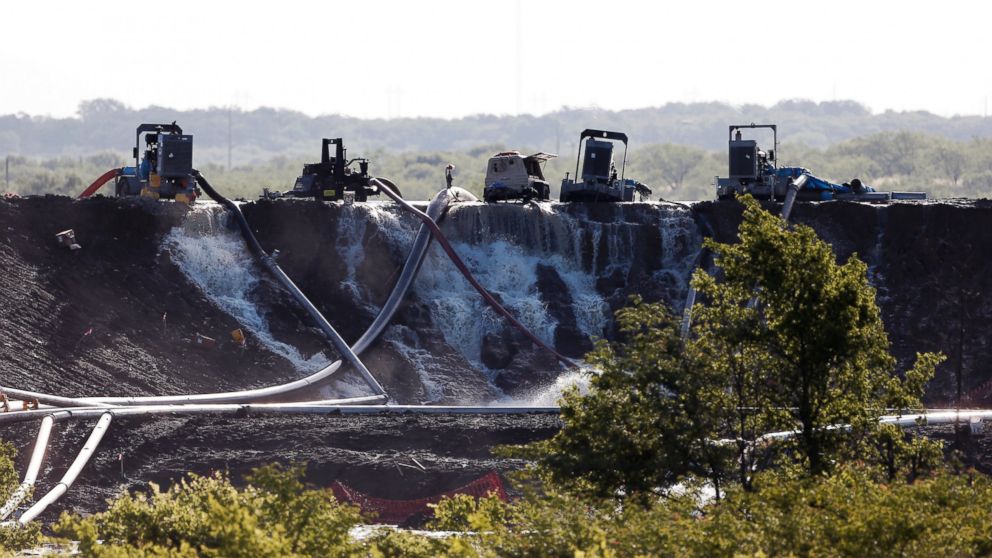
PHOTO: Workers attempt to relieve the pressure from the earthen dam at Padera Lake, May 27, 2015, in Midlothian, Texas.


A flash flood warning was issued for parts of six counties in Texas that include Houston, and parts of the city remain underwater after a weekend of torrential rain. 

The warning was issued by the National Weather Service at 6:14 a.m. local time and was expected to last for three hours. 

City officials have confirmed today that another body was discovered this morning near his vehicle after water pumps were brought in to drain a portion of a highway. This death marks the sixth storm-related death in Houston since last week. The statewide death toll blamed on the weather has now reached 16 people. 

More rain is the last thing the region needs. In addition to the flash flood threat from rain, a dam southwest of Dallas appears on the brink of breaking. If the water runs over the top of the dam at Padera Lake, one of the state's major highways could be flooded, the Associated Press reported. 

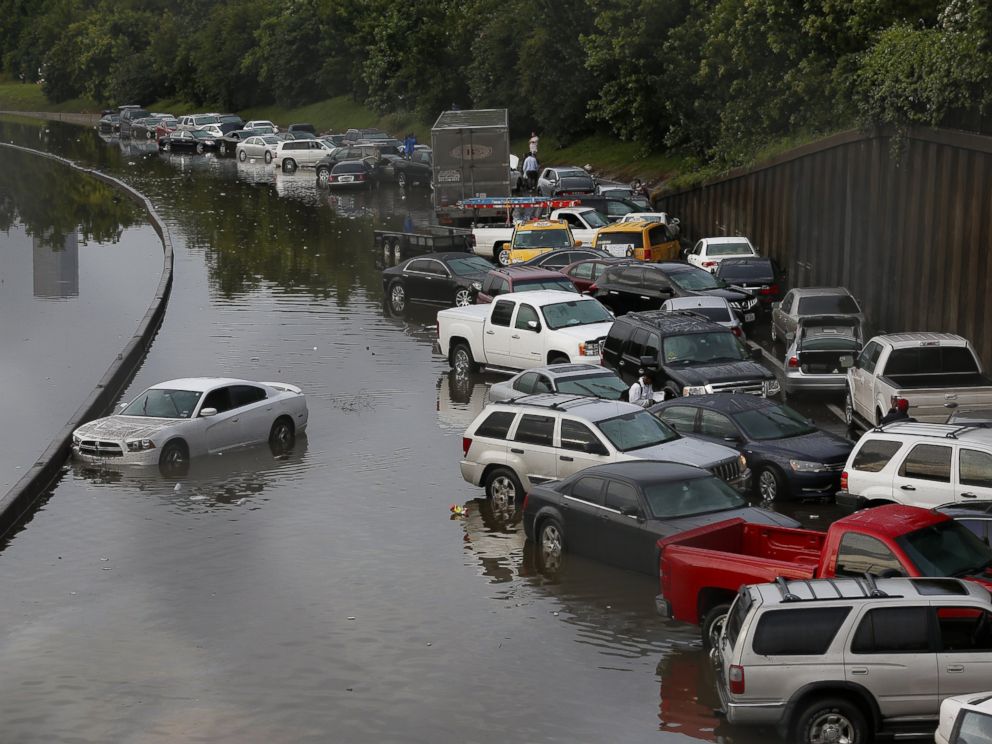
Photos from the most-affected areas show muddy, brown water filling the streets, with the tops of cars visible in some of the most-flooded roadways. 


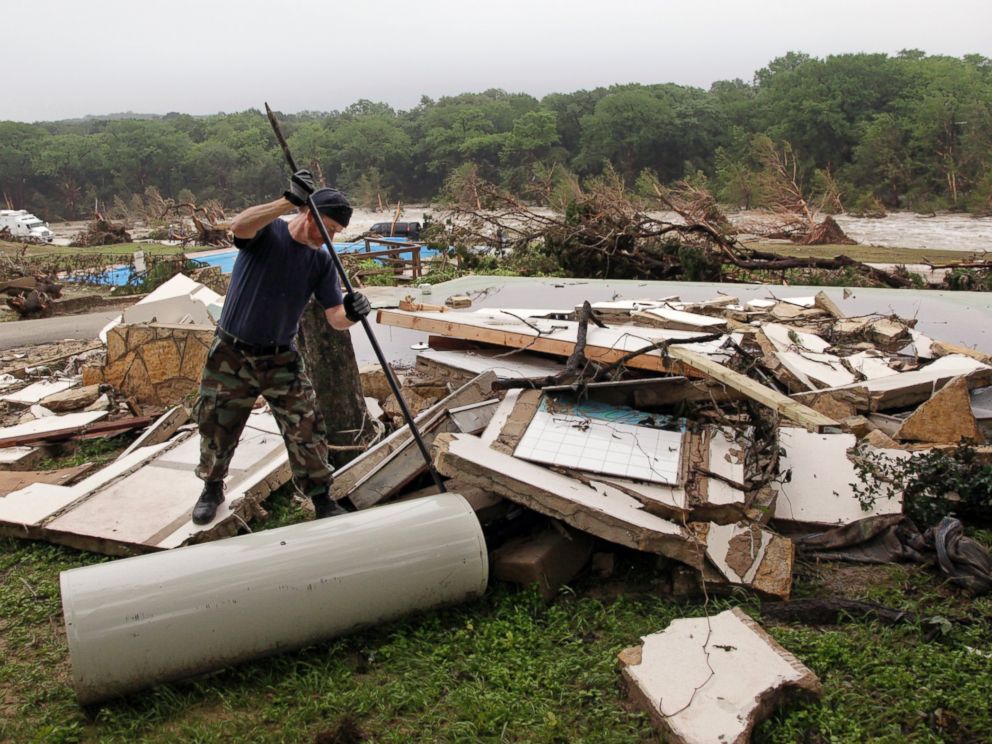
PHOTO: Kevin Calaway pries apart debris from a cabin shattered from a flood at a resort along the Blanco River, May 26, 2015, in Wimberley, Texas.
Elaine Thompson/AP Photo
PHOTO: Kevin Calaway pries apart debris from a cabin shattered from a flood at a resort along the Blanco River, May 26, 2015, in Wimberley, Texas.
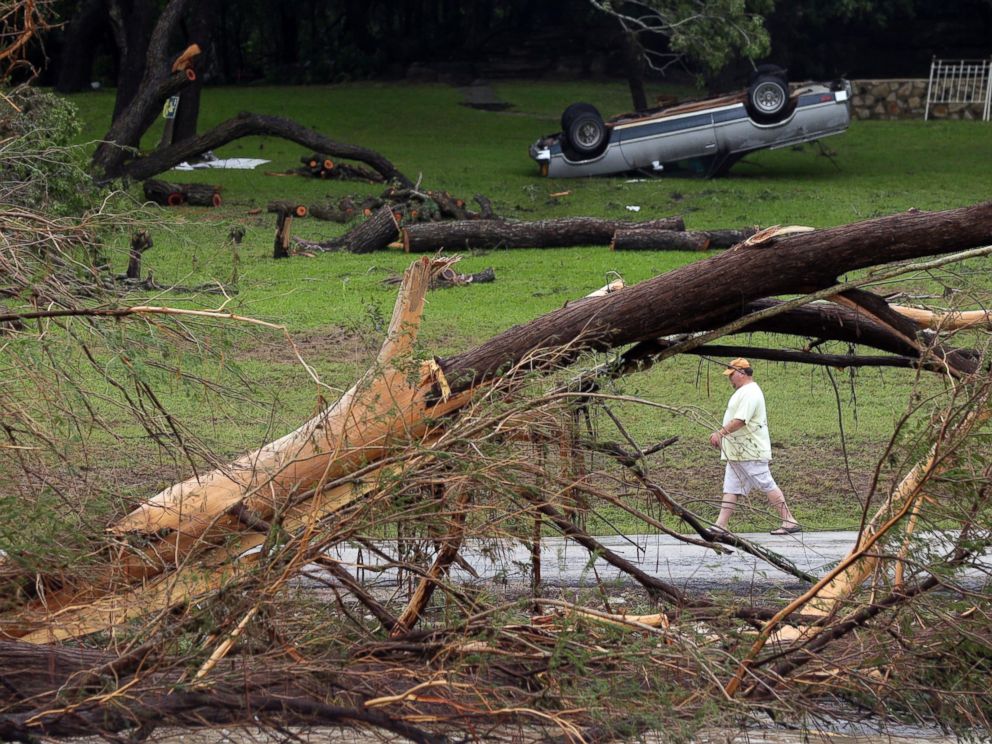
PHOTO: A man walks along the Blanco River
Eric Gay/AP Photo
PHOTO: A man walks along the Blanco River
Drivers stuck in rainwater accounted for at least two of the three deaths that Houston Mayor Annise Parker confirmed on Tuesday following a rain storm Monday night into Tuesday morning. She did not identify the victims but said one person was found inside their vehicle and another was outside and appeared to have suffered a heart attack while trying to push a car out of the flooding. 

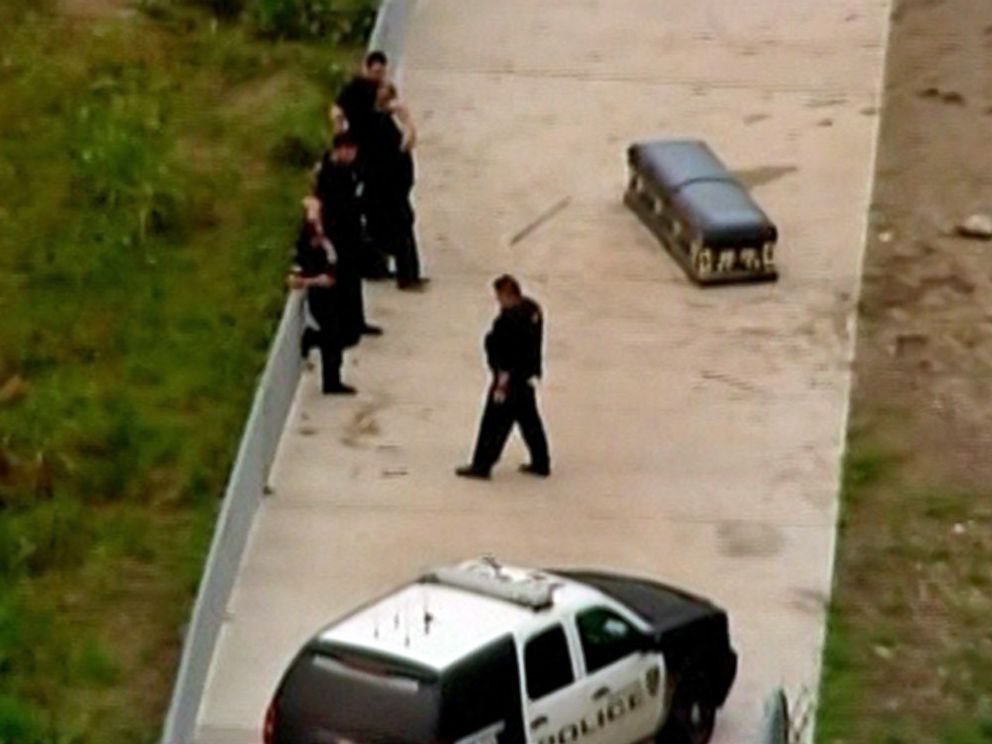
One of the grimmest discoveries came on Tuesday morning when a biker found a casket on a roadway in southwest Houston. 

Walter Rubio told ABC News affiliate KTRK that he saw the casket just laying in the middle of a street, and police opened it and found a dead body inside.
Investigators believe the casket was unearthed from a nearby cemetery during the flooding and determined that it was used to bury a woman who died in 2007. Police have not yet identified the body inside the casket. 


PHOTO: Police stand near a casket that authorities believe was unearthed from the Riceville Cemetery by recent flooding in Houston, Texas on May 26, 2015.
KRIV
PHOTO: Police stand near a casket that authorities believe was unearthed from the Riceville Cemetery by recent flooding in Houston, Texas on May 26, 2015.
Officials have urged residents to avoid touching any objects in the water and to report debris that they find. 


Today's rain has already led to partial closures of I-45 because of flooding.
On Tuesday, Texas Gov. Greg Abbott added eight counties to the list of 13 that he had already declared disaster areas. 


PHOTO: Vehicles sit stranded on a flooded Interstate 45 in Houston, Texas on May 26, 2015.
Aaron M. Sprecher/AFP/Getty Images
PHOTO: Vehicles sit stranded on a flooded Interstate 45 in Houston, Texas on May 26, 2015.
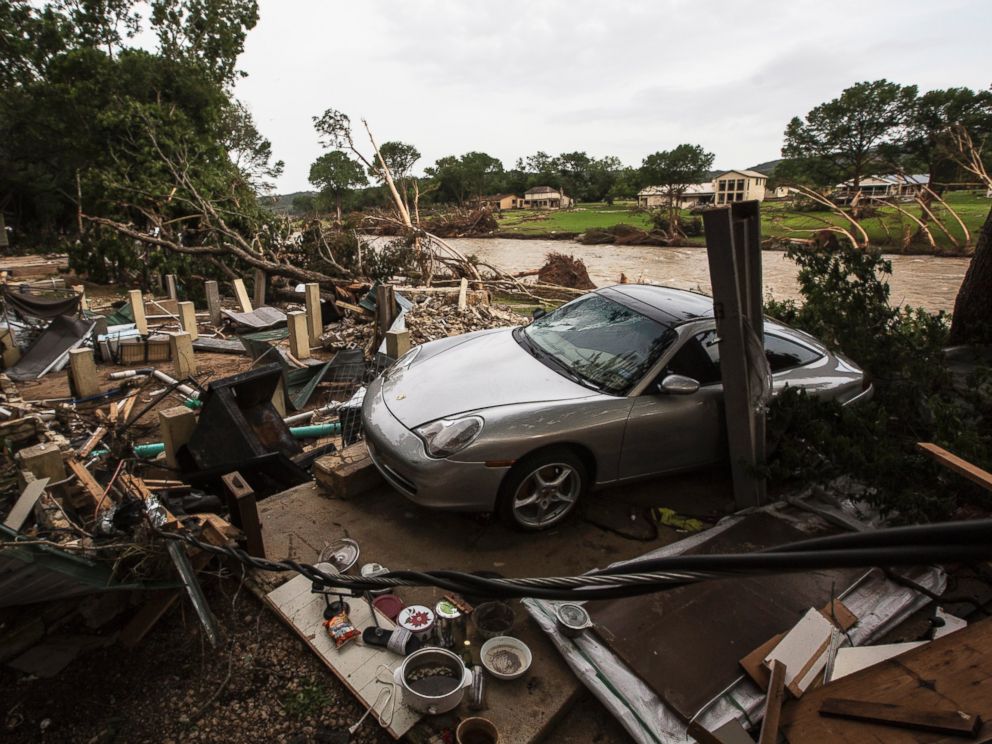
PHOTO: A Porsche rests against the foundation of a home destroyed by the Memorial Day weekend floods in Wimberley, Texas, May 26, 2015.
Tamir Kalifa/Reuters
PHOTO: A Porsche rests against the foundation of a home destroyed by the Memorial Day weekend floods in Wimberley, Texas, May 26, 2015.

Reasons We Need the Clean Water Rule


By EPA Administrator Gina McCarthy and Assistant Secretary of the Army for Civil Works Jo-Ellen Darcy

Today, EPA and the Army are finalizing a Clean Water Rule to protect the streams and wetlands we rely on for our health, our economy, and our way of life.

As summer kicks off, many of us plan to be outside with our friends and families fishing, paddling, surfing, and swimming. And for the lakes and rivers we love to be clean, the streams and wetlands that feed them have to be clean, too. That’s just one of many reasons why this rule is so important. Here are several more:

Clean water is vital to our health. One in three Americans get drinking water from streams that lacked clear protection from pollution without the Clean Water Rule. Finalizing the rule helps protect 117 million Americans’ health.

Our economy depends on clean water. Major economic sectors—from manufacturing and energy production to agriculture, food service, tourism, and recreation—depend on clean water to function and flourish. Without clean water, business grinds to a halt—a reality too many local small business owners faced in Toledo last year when drinking water became contaminated for several days.

Clean water helps farms thrive, and the rule preserves commonsense agriculture exemptions. Farms across America depend on clean and reliable water for livestock, crops, and irrigation. Activities like planting, harvesting, and moving livestock across streams have long been exempt from Clean Water Act regulation; the Clean Water Rule doesn’t change that. 

The final rule doesn’t create any new permitting requirements for agriculture, maintains all previous exemptions and exclusions, and even adds exclusions for features like artificial lakes and ponds, water-filled depressions from construction, and grass swales—all to make clear our goal is to stay out of agriculture’s way. Just like before, a Clean Water Act permit is only needed if a water is going to be polluted or destroyed—and all exemptions for agriculture stay in place. 

Climate change makes protection of water resources even more essential. Impacts from climate change like more intense droughts, storms, fires, and floods—not to mention warmer temperatures and sea level rise—threaten our water supplies.

But healthy streams and wetlands can protect communities by trapping floodwaters, retaining moisture during droughts, recharging groundwater supplies, filtering pollution, and providing habitat for fish and wildlife.  With states like California in the midst of historic drought, it’s more important than ever that we protect the clean water we’ve got. 


Clear protections mean cleaner water. The Clean Water Act has protected our health for more than 40 years—and helped our nation clean up hundreds of thousands of miles of polluted waterways. But Supreme Court decisions in 2001 and 2006 threw protections into question for 60 percent of our nation’s streams and millions of acres of wetlands. Using the latest science, this rule clears up the confusion, providing greater certainty for the first time in more than a decade about which waters are important to protect.

Science shows us the most important waters to protect. In developing the Clean Water Rule, the Agencies used the latest science, including a report summarizing more than 1,200 peer-reviewed, published scientific studies—which showed small streams and wetlands play an important role in the health of larger downstream waterways like rivers and lakes.

You asked for greater clarity. Members of Congress, state and local officials, industry, agriculture, environmental groups, scientists, and the public called on EPA and the Army to clarify which waters are protected under the Clean Water Act. 

With this rule, the agencies are responding to those requests and addressing the Supreme Court decisions. EPA and the Army held hundreds of meetings with stakeholders across the country, reviewed over a million public comments, and listened carefully to perspectives from all sides. All of this input shaped and improved the final rule we’re announcing today.

Just as importantly, there are lots of things the rule doesn’t do. The rule only protects waters historically covered under the Clean Water Act. It doesn’t interfere with private property rights, and it only covers water—not land use. It also doesn’t regulate most ditches, doesn’t regulate groundwater or shallow subsurface flows, and doesn’t change policy on irrigation or water transfers.

These are just a few of the many reasons why clean water and this rule are important—learn more here http://www2.epa.gov/cleanwaterrule and share yours with #CleanWaterRules.

Clean Water Rule Protects Streams and Wetlands Critical to Public Health, Communities, and Economy


CONTACT:
Robert Daguillard
daguillard.robert@epa.gov
(202) 564-6618

Moira Kelley
Moira.l.kelley.civ@mail.mil
703-614-3992


FOR IMMEDIATE RELEASE
 
May 27, 2015


Clean Water Rule Protects Streams and Wetlands Critical to Public Health, Communities, and Economy

Does not create any new permitting requirements and maintains all previous exemptions and exclusions

Washington, DC

In a historic, albeit belated, step for the protection of clean water, the U.S. Environmental Protection Agency and the U.S. Army finalized the Clean Water Rule today to clearly protect from pollution and degredation the streams and wetlands that form the foundation of the nation’s water resources.

The rule ensures that waters protected under the Clean Water Act are more precisely defined and predictably determined, making permitting less costly, easier, and faster for businesses and industry. The rule is grounded in law and the latest science, and is shaped by public input. The rule does not create any new permitting requirements for agriculture and maintains all previous exemptions and exclusions.

“For the water in the rivers and lakes in our communities that flow to our drinking water to be clean, the streams and wetlands that feed them need to be clean too,” said EPA Administrator Gina McCarthy. “Protecting our water sources is a critical component of adapting to climate change impacts like drought, sea level rise, stronger storms, and warmer temperatures – which is why EPA and the Army have finalized the Clean Water Rule to protect these important waters, so we can strengthen our economy and provide certainty to American businesses.”

“Today's rule marks the beginning of a new era in the history of the Clean Water Act,” said Assistant Secretary for the Army (Civil Works) Jo-Ellen Darcy. “This is a generational rule and completes another chapter in history of the Clean Water Act. This rule responds to the public's demand for greater clarity, consistency, and predictability when making jurisdictional determinations. The result will be better public service nationwide."

People need clean water for their health: About 117 million Americans – one in three people – get drinking water from streams that lacked clear protection before the Clean Water Rule. America’s cherished way of life depends on clean water, as healthy ecosystems provide wildlife habitat and places to fish, paddle, surf, and swim. Clean and reliable water is an economic driver, including for manufacturing, farming, tourism, recreation, and energy production. The health of our rivers, lakes, bays, and coastal waters are impacted by the streams and wetlands where they begin.

Protection for many of the nation’s streams and wetlands has been confusing, complex, and time-consuming as the result of Supreme Court decisions in 2001 and 2006. EPA and the Army are taking this action today to provide clarity on protections under the Clean Water Act after receiving requests for over a decade from members of Congress, state and local officials, industry, agriculture, environmental groups, scientists, and the public for a rulemaking.

In developing the rule, the agencies held more than 400 meetings with stakeholders across the country, reviewed over one million public comments, and listened carefully to perspectives from all sides. EPA and the Army also utilized the latest science, including a report summarizing more than 1,200 peer-reviewed, published scientific studies which showed that small streams and wetlands play an integral role in the health of larger downstream water bodies.

Climate change makes protection of water resources even more essential. Streams and wetlands provide many benefits to communities by trapping floodwaters, recharging groundwater supplies, filtering pollution, and providing habitat for fish and wildlife. Impacts from climate change like drought, sea level rise, stronger storms, and warmer temperatures threaten the quantity and quality of America’s water. Protecting streams and wetlands will improve our nation’s resilience to climate change.

Specifically, the Clean Water Rule:
  • Clearly defines and protects tributaries that impact the health of downstream waters. The Clean Water Act protects navigable waterways and their tributaries. The rule says that a tributary must show physical features of flowing water – a bed, bank, and ordinary high water mark – to warrant protection. The rule provides protection for headwaters that have these features and science shows can have a significant connection to downstream waters.
  • Provides certainty in how far safeguards extend to nearby waters. The rule protects waters that are next to rivers and lakes and their tributaries because science shows that they impact downstream waters. The rule sets boundaries on covering nearby waters for the first time that are physical and measurable.
  • Protects the nation’s regional water treasures. Science shows that specific water features can function like a system and impact the health of downstream waters. The rule protects prairie potholes, Carolina and Delmarva bays, pocosins, western vernal pools in California, and Texas coastal prairie wetlands when they impact downstream waters.
  • Focuses on streams, not ditches. The rule limits protection to ditches that are constructed out of streams or function like streams and can carry pollution downstream. So ditches that are not constructed in streams and that flow only when it rains are not covered.
  • Maintains the status of waters within Municipal Separate Storm Sewer Systems. The rule does not change how those waters are treated and encourages the use of green infrastructure.
  • Reduces the use of case-specific analysis of waters. Previously, almost any water could be put through a lengthy case-specific analysis, even if it would not be subject to the Clean Water Act. The rule significantly limits the use of case-specific analysis by creating clarity and certainty on protected waters and limiting the number of similarly situated water features.
A Clean Water Act permit is only needed if a water is going to be polluted or destroyed. The Clean Water Rule only protects the types of waters that have historically been covered under the Clean Water Act. 

It does not regulate most ditches and does not regulate groundwater, shallow subsurface flows, or tile drains. It does not make changes to current policies on irrigation or water transfers or apply to erosion in a field. The Clean Water Rule addresses the pollution and destruction of waterways – not land use or private property rights.

The rule protects clean water necessary for farming, ranching, and forestry and provides greater clarity and certainty to farmers about coverage of the Clean Water Act. Farms across America depend on clean and reliable water for livestock, crops, and irrigation. 

The final rule specifically recognizes the vital role that U.S. agriculture serves in providing food, fuel, and fiber at home and around the world. The rule does not create any new permitting requirements for America’s farmers. Activities like planting, harvesting, and moving livestock have long been exempt from Clean Water Act regulation, and the Clean Water Rule preserves those exemptions.
The Clean Water Rule will be effective 60 days after publication in the Federal Register.

More information: www.epa.gov/cleanwaterrule and http://www.army.mil/asacw